Free Printable Pack
Barberton Daisy printable lesson pack
Free to print or save as PDF — no account needed. Go ad-free for $9.9 (one-time).
SizeRef Pro Pack
Barberton Daisy
Explore a vibrant flower with engaging, age-appropriate English and science activities.
Learning Goals
- Identify and name a Barberton Daisy.
- Learn descriptive words related to flowers and colors.
- Understand basic measurements and make comparisons.
- Practice English vocabulary, sentence building, and discussion skills.
Teacher / Parent Setup
Print all activity pages. Gather crayons, markers, and a ruler or measuring tape. Prepare a picture or a real Barberton Daisy for visual reference.
Curiosity Focus
Why does the Barberton Daisy grow this way?
This pack includes a reviewed diagram poster and a Kids Ask Why page that turns curiosity into a short explanation and mini activity.

Page 2
Vocabulary Builder
My First Daisy
Barberton Daisy
Trace the word 'DAISY' with your finger, then with a crayon.
Look at the Barberton Daisy picture. What bright colors do you see? Point to the petals. Point to the long stem.
Stand up tall like a Barberton Daisy reaching for the sun! Now, gently sway your body like a flower in the wind.
Daisy Words and Sentences
A Barberton Daisy is a beautiful flower.
It can be orange, pink, or yellow.
This flower grows very tall.
Write two sentences about a Barberton Daisy using at least three words from the word bank.
Word bank: daisy · flower · tall · bright · happy · stem
Daisy Science and Wonder
Barberton Daisies are also known as Gerbera Daisies. They are popular for their vibrant colors and long-lasting blooms. These flowers are part of a large plant family called Asteraceae, which includes sunflowers and dandelions. Their bright petals attract insects like bees, which helps the flower make seeds. This process is called pollination, and it's how new daisy plants can grow. Their strong stems help them stand...
Why do you think Barberton Daisies have such bright colors? How does this help the flower and its environment?
Page 3
Size Science Lab
Read the size clue
Imagine a Barberton Daisy! It can grow to be about 500 millimeters (50 centimeters) tall. That's like stacking five standard rulers end-to-end! Its flower head is about 100 millimeters (10 centimeters) wide, which is as wide as a small juice box. The stem is about 30 millimeters (3 centimeters) thick, which is thicker than your thumb. This tall, bright flower can make a big impact in a garden or a vase!
Quick Check
How tall is a Barberton Daisy in centimeters?
Estimate
Find something in your room that you think is about 50 centimeters tall. Use a ruler to check your estimate!
Is a Barberton Daisy taller or shorter than your arm from elbow to fingertips? How about a standard school chair?
Page 4
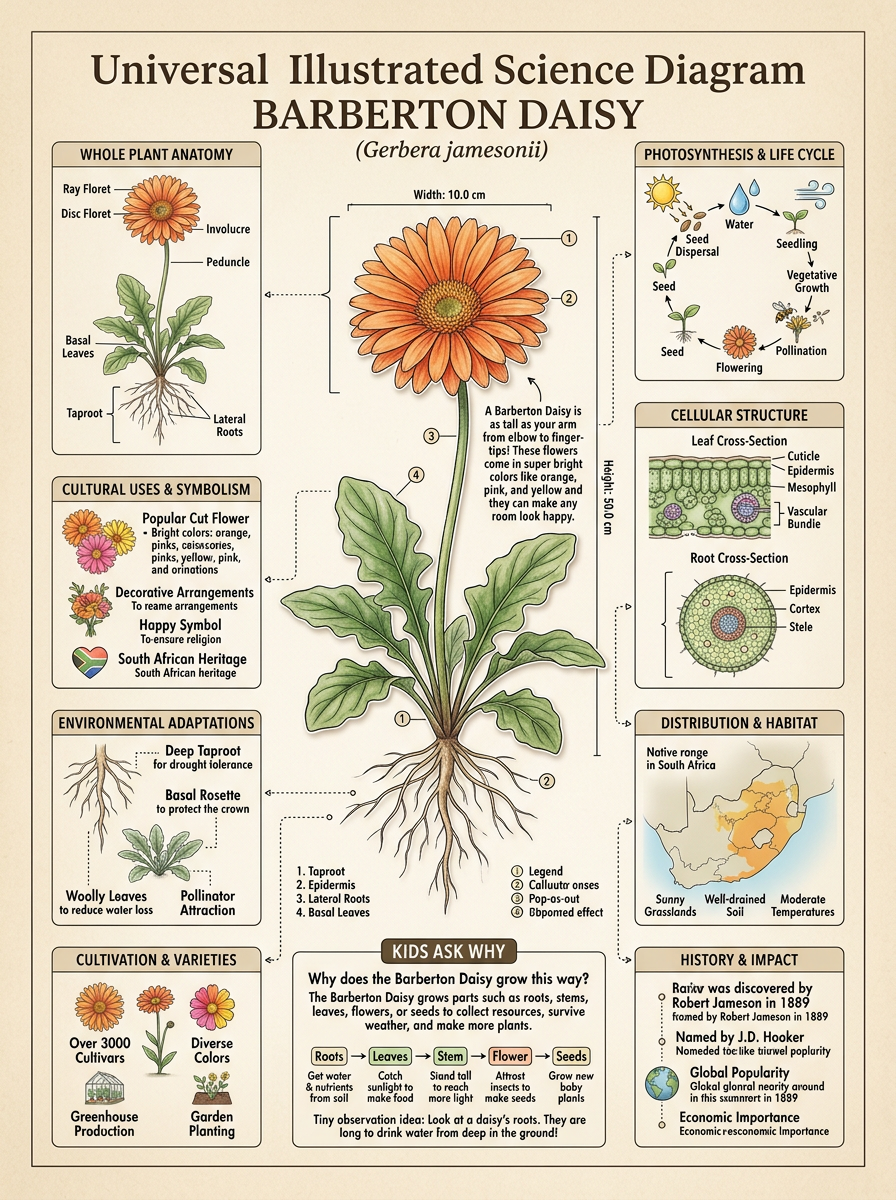
Scientific Diagram Poster
Reviewed diagram
Barberton Daisy Scientific Diagram with Kids Ask Why
Batch reviewed generated diagram for Pro Pack use. Check labels, Kids Ask Why panel, anatomy/context modules, and print readability.
2026-06-12
Page 5
Kids Ask Why Lab
Big Question
Why does the Barberton Daisy grow this way?
The Barberton Daisy grows parts such as roots, stems, leaves, flowers, or seeds to collect resources, survive weather, and make more plants.
How to diagram it
Show roots, leaves, sunlight, water, and growth arrows in one simple cause-and-effect panel.
Cause-and-effect arrows
1-minute activity
Look at a leaf or plant photo and point to the part that catches light.
I noticed:
My answer in one sentence:
Draw your own explanation
Page 6
Comprehension + Drawing
1. What is the name of the flower in this pack?
2. What are some colors a Barberton Daisy can be?
3. How does this flower make a room feel?
4. What is one way a Barberton Daisy helps bees?
Draw and compare
Draw a Barberton Daisy. Try to make it as tall as your arm from elbow to fingertips on your paper. Use your favorite bright colors!
Page 7
Answer Key + Teaching Notes
Answer Key
- Barberton Daisy.
- Orange, pink, and yellow.
- Happy.
- Its bright petals attract bees for pollination.
- 50 centimeters.
Teaching Notes
- Encourage children to use their senses (sight, touch) when describing the flower.
- For younger learners, focus on identifying colors and simple actions.
- For older learners, discuss the importance of flowers in nature and the pollination process.
- Use real flowers or high-quality images to enhance the visual learning experience.
- Adapt activities based on the child's English proficiency and attention span.
Extension Activity
Create a 'Flower Garden' collage using construction paper, drawing, or magazine cutouts. Label each flower you add.
Unlock the full Pro library
This pack provides ready-to-use, age-appropriate activities saving parents and teachers valuable lesson planning time.