Free Printable Pack
Biscuit printable lesson pack
Free to print or save as PDF — no account needed. Go ad-free for $9.9 (one-time).
SizeRef Pro Pack
Biscuit
This Pro Pack provides comprehensive, age-differentiated activities to teach children about a biscuit, saving hours of preparation time.
Learning Goals
- Identify and name a biscuit in English.
- Describe a biscuit using sensory words like crunchy and sweet.
- Understand basic dimensions and comparisons related to a biscuit.
- Develop early literacy skills through tracing, reading, and writing simple sentences.
Teacher / Parent Setup
Print the activity pages. Gather pencils, crayons, and optionally, a real biscuit and a ruler. Prepare for interactive discussion and movement activities.
Curiosity Focus
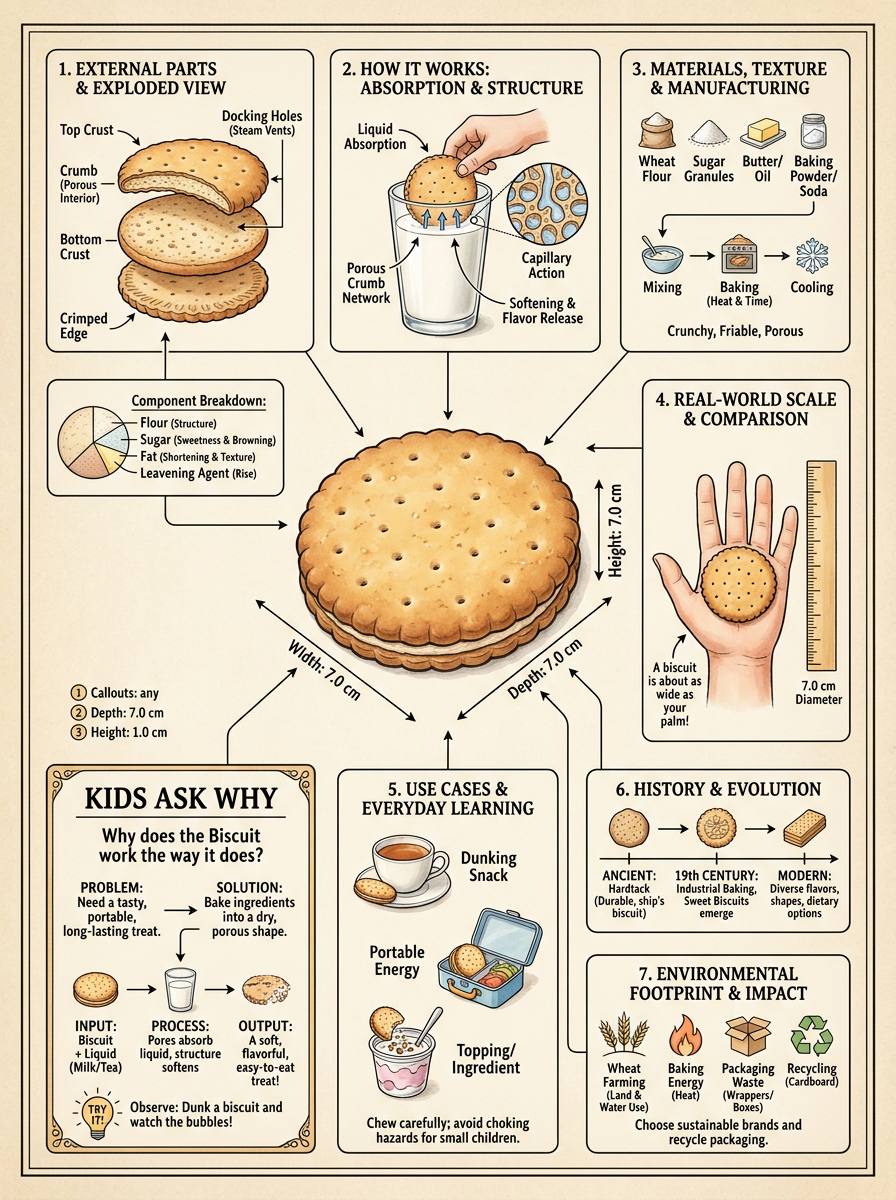
Why does the Biscuit work the way it does?
This pack includes a reviewed diagram poster and a Kids Ask Why page that turns curiosity into a short explanation and mini activity.
Page 2
Vocabulary Builder
Little Learners: Biscuit Fun!
Biscuit
Trace the word 'biscuit' with your finger, then with a crayon. What letter does it start with?
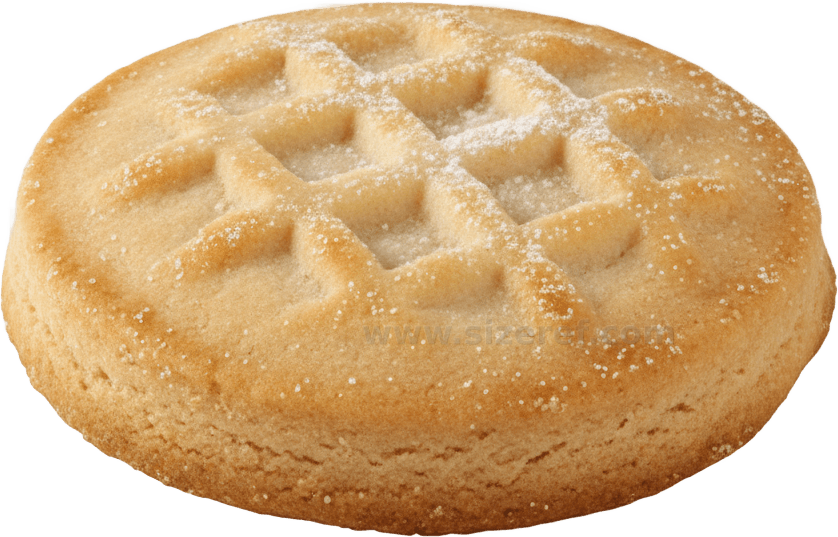
Look at the picture of the biscuit. What shape is it? What color is it? Does it look crunchy?
Point to your palm. A biscuit is about as wide as your palm! Now, pretend to take a bite out of a crunchy biscuit!
Biscuit Builders: Words and Sentences!
A biscuit is a sweet treat.
It is crunchy and yummy.
We can dunk a biscuit in milk.
Write two sentences about what you like to do with a biscuit.
Word bank: sweet · crunchy · dunk · milk · round · eat
Biscuit Explorers: Science and Senses!
When you eat a biscuit, many senses work together! Your eyes see its shape and color. Your nose smells its sweet aroma. Your ears hear the 'crunch' as you bite it. Your tongue tastes its sweetness and feels its texture. This combination of sensory input helps your brain understand and enjoy the biscuit. The crunchy texture comes from baking, which removes water and makes the ingredients firm. Our brains quickly learn...
Why do you think some biscuits are made to be dunked in milk, and what happens to the biscuit when you dunk it?
Page 3
Size Science Lab
Read the size clue
A biscuit is typically about 70 millimeters (7.0 centimeters) wide and 70 millimeters (7.0 centimeters) deep, which is roughly the size of your palm. It's quite flat, usually only 10 millimeters (1.0 centimeter) tall. Imagine a stack of ten biscuits; that stack would be about as tall as an adult's finger! If you put two biscuits side-by-side, they would be 14 cm wide, about the length of a small pencil. This flat, wide shape makes it easy to hold and dunk.
Quick Check
How many centimeters wide is a biscuit?
Estimate
Estimate how many biscuits you would need to cover the length of your hand from wrist to fingertips.
Is a biscuit taller or wider than a standard crayon?
Page 4
Scientific Diagram Poster
Reviewed diagram
Biscuit Scientific Diagram with Kids Ask Why
Batch reviewed generated diagram for Pro Pack use. Check labels, Kids Ask Why panel, anatomy/context modules, and print readability.
2026-06-11
Page 5
Kids Ask Why Lab
Big Question
Why does the Biscuit work the way it does?
The Biscuit works because its shape, materials, parts, and forces fit together to solve a real-world problem.
How to diagram it
Use arrows to connect the main parts to their jobs, then show the input and output.
Cause-and-effect arrows
1-minute activity
Find one part of the object and explain what would happen if that part was missing.
I noticed:
My answer in one sentence:
Draw your own explanation
Page 6
Comprehension + Drawing
1. What is a biscuit often described as?
2. What can you do with a biscuit that makes it softer?
3. What shape is a common biscuit?
4. Name two senses you use when eating a biscuit.
Draw and compare
Draw your favorite biscuit. Now, draw something that is about the same width as your biscuit.
Page 7
Answer Key + Teaching Notes
Answer Key
- A biscuit is a crunchy, sweet treat.
- You can dunk a biscuit in milk to make it softer.
- A common biscuit is round.
- Sight, smell, taste, touch, hearing.
- A biscuit is 7 cm wide. (Answer to Quick Check)
Teaching Notes
- Encourage children to use all their senses when describing the biscuit.
- For younger learners, focus on the 'crunchy' and 'sweet' aspects.
- Use a real biscuit if possible to enhance the learning experience.
- When discussing size, use common objects for comparison, like a ruler or a small toy.
- Remind learners that 'biscuit' can mean different things in different countries (e.g., cookie in the US).
Extension Activity
Bake simple biscuits together, focusing on measuring ingredients and observing changes during baking.
Unlock the full Pro library
This pack provides ready-to-use, differentiated activities across multiple age groups, eliminating the need for separate lesson planning.