Free Printable Pack
Blackcurrant printable lesson pack
Free to print or save as PDF — no account needed. Go ad-free for $9.9 (one-time).
SizeRef Pro Pack
Blackcurrant
This Pro Pack offers ready-to-teach English, science, and cognition activities centered on the blackcurrant, saving you valuable preparation time.
Learning Goals
- Identify and name a blackcurrant in English.
- Understand the size of a blackcurrant using standard and familiar comparisons.
- Learn about the nutritional benefits of blackcurrants, like Vitamin C.
- Develop vocabulary and sentence structure related to fruits and healthy eating.
Teacher / Parent Setup
Print all pages before the lesson. Gather drawing supplies like crayons or markers. Have a real blackcurrant or a picture of one ready if possible.
Curiosity Focus
Why does the Blackcurrant grow this way?
This pack includes a reviewed diagram poster and a Kids Ask Why page that turns curiosity into a short explanation and mini activity.

Page 2
Vocabulary Builder
Meet the Blackcurrant!
Blackcurrant
Trace the word 'blackcurrant' with your finger or a crayon.
Look at the blackcurrant picture. What color is it? Is it big or small?
Pretend to pick a tiny blackcurrant. Now, show me how small it is with your fingers!
Blackcurrant Facts
A blackcurrant is a small, round fruit.
It is dark purple, almost black.
Blackcurrants are full of Vitamin C.
Write two sentences about what you like about blackcurrants or other fruits.
Word bank: fruit · small · purple · juice · sweet · healthy
The Power of Blackcurrants
Blackcurrants are tiny powerhouses of nutrition, especially known for their high Vitamin C content. Vitamin C is an antioxidant that helps protect our bodies from damage and supports our immune system, keeping us healthy. It also plays a role in making collagen, which is important for healthy skin, bones, and blood vessels. Eating blackcurrants, whether fresh, in juice, or jam, is a delicious way to get important nut...
Why do you think it's important to eat fruits like blackcurrants that are full of vitamins?
Page 3
Size Science Lab
Read the size clue
Imagine a blackcurrant. It's truly tiny! Its width, height, and depth are all about 12 millimeters, which is 1.2 centimeters. To help you visualize this, think of a small pea or a regular blueberry – a blackcurrant is very similar in size. It's smaller than your thumbnail and about the same size as a small marble. If you line up ten blackcurrants, they would stretch just 12 centimeters across. This small size makes them perfect for popping into your mouth or blending into a smooth juice.
Quick Check
How many millimeters wide is a blackcurrant?
Estimate
Without measuring, draw a line on your paper that you think is 1.2 centimeters long.
Name another fruit that is about the same size as a blackcurrant.
Page 4
Scientific Diagram Poster
Reviewed diagram
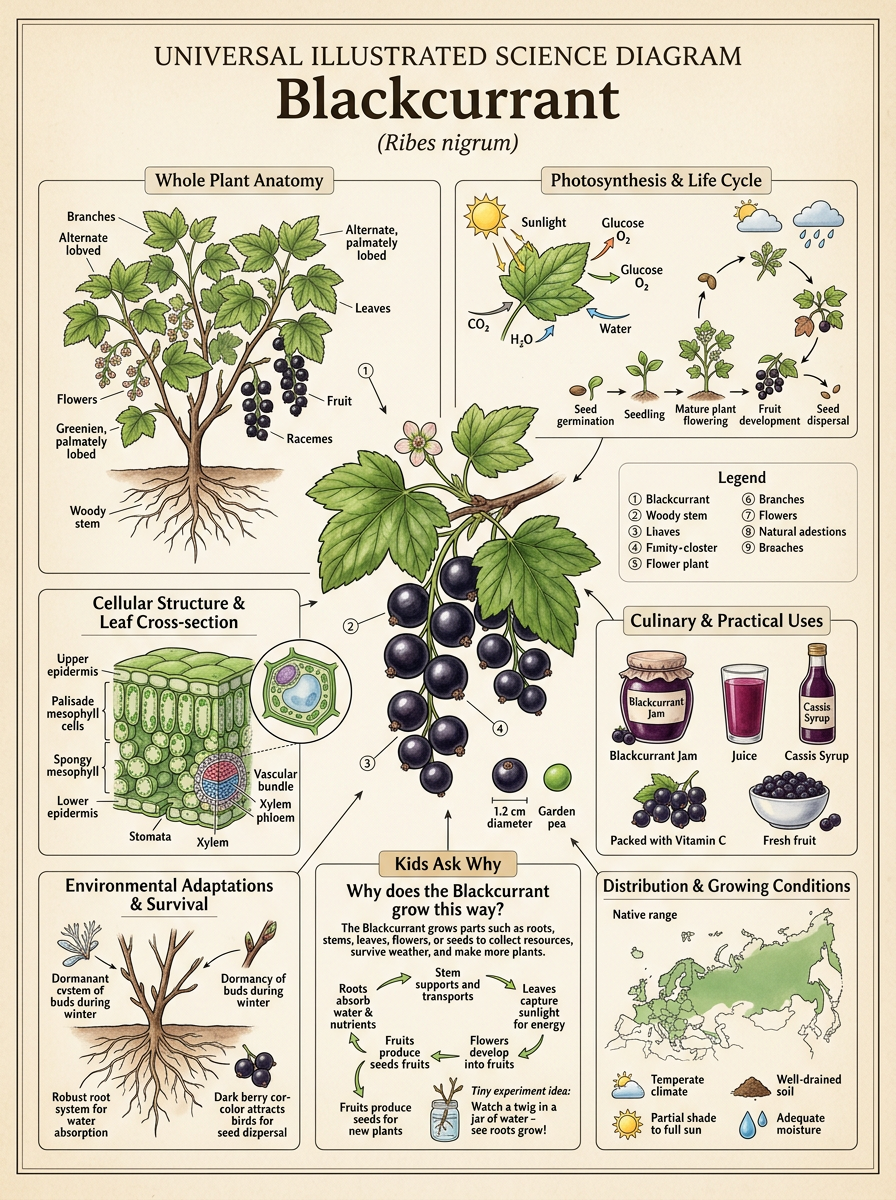
Blackcurrant Scientific Diagram with Kids Ask Why
Batch reviewed generated diagram for Pro Pack use. Check labels, Kids Ask Why panel, anatomy/context modules, and print readability.
2026-06-11
Page 5
Kids Ask Why Lab
Big Question
Why does the Blackcurrant grow this way?
The Blackcurrant grows parts such as roots, stems, leaves, flowers, or seeds to collect resources, survive weather, and make more plants.
How to diagram it
Show roots, leaves, sunlight, water, and growth arrows in one simple cause-and-effect panel.
Cause-and-effect arrows
1-minute activity
Look at a leaf or plant photo and point to the part that catches light.
I noticed:
My answer in one sentence:
Draw your own explanation
Page 6
Comprehension + Drawing
1. What color is a blackcurrant?
2. What vitamin are blackcurrants packed with?
3. Name two things you can make from blackcurrants.
4. Is a blackcurrant big or small?
Draw and compare
Draw a blackcurrant next to something you eat that is much bigger, like an apple or a banana. Label both drawings.
Page 7
Answer Key + Teaching Notes
Answer Key
- Dark purple or almost black.
- Vitamin C.
- Juice and jam.
- Small.
- 12 millimeters (or 1.2 centimeters).
Teaching Notes
- Encourage learners to use descriptive words when talking about the blackcurrant's color and taste.
- For younger learners, use real blackcurrants or pictures to enhance visual learning.
- Emphasize the 'a' article before 'blackcurrant' for correct English usage.
- Connect the size comparisons to objects familiar in the learner's local environment.
- Discuss the importance of Vitamin C for health, linking it to everyday experiences like getting sick.
Extension Activity
Have students try blackcurrant juice or jam and describe the taste using new English words (e.g., 'tart', 'sweet', 'fruity').
Unlock the full Pro library
This pack delivers a complete, multi-age lesson plan with integrated English and science, eliminating the need for extensive lesson planning.