Free Printable Pack
Boat printable lesson pack
Free to print or save as PDF — no account needed. Go ad-free for $9.9 (one-time).
SizeRef Pro Pack
Boat
This Pro Pack helps young learners explore the word 'boat' through engaging, age-appropriate activities and real-world size comparisons.
Learning Goals
- Identify the word 'boat' and its meaning.
- Describe a boat using simple English words.
- Understand basic size concepts related to boats.
- Develop fine motor skills through tracing and drawing.
Teacher / Parent Setup
Print all pages for the relevant age groups. Gather crayons, pencils, and a ruler or tape measure. Prepare a clear space for movement activities.
Curiosity Focus
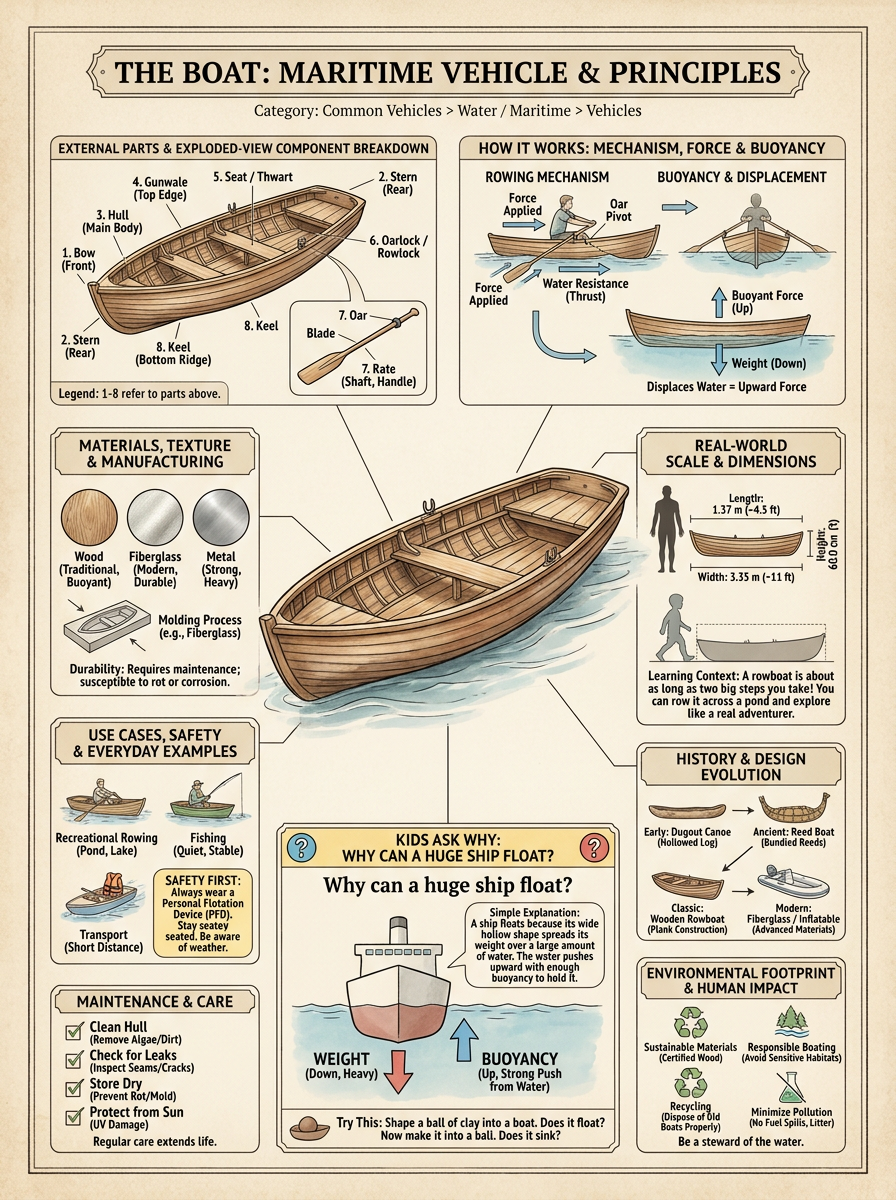
Why can a huge ship float?
This pack includes a reviewed diagram poster and a Kids Ask Why page that turns curiosity into a short explanation and mini activity.

Page 2
Vocabulary Builder
Little Explorers: My Boat!
Boat
Trace the word 'boat' with your finger, then with a crayon.
Look at the boat picture. What colors do you see? Can you point to the water?
Pretend to row a boat! Move your arms like you are paddling. Can you point to something blue in the room, like the water?
Boat Builders: Sentences & Words
A boat floats on water.
We can row a small boat.
I see a red boat.
Write one sentence about what you can do with a boat.
Word bank: boat · water · row · float · travel · paddle
Boat Engineers: How Boats Work
Boats float because of a science principle called buoyancy. When a boat is placed in water, it pushes some water away. If the boat is lighter than the water it pushes away, it floats! The shape of a boat, often wide and hollow, helps it displace more water without being too heavy itself. This design allows boats to carry people and cargo across lakes, rivers, and oceans. Without buoyancy, boats would simply sink, mak...
Why is the shape of a boat important for it to float?
Page 3
Size Science Lab
Read the size clue
Imagine a small rowboat. It's about 3.35 meters long, which is like lying down three grown-ups head-to-toe! This boat stands about 60 centimeters tall, which is as high as a big dog. Its depth, or how wide it is from one side to the other, is about 1.37 meters. That's like two standard school desks put together. So, while it's not huge, it's big enough for a few people to sit in and row across a pond, just like a real adventurer!
Quick Check
How tall is this boat in centimeters?
Estimate
Look at your classroom door. Do you think this boat is longer or shorter than the door?
Compare the length of this boat (3.35 meters) to your own height. How many 'yous' long is the boat?
Page 4
Scientific Diagram Poster
Reviewed diagram
Boat Scientific Diagram with Kids Ask Why
Batch reviewed generated diagram for Pro Pack use. Check labels, Kids Ask Why panel, anatomy/context modules, and print readability.
2026-06-11
Page 5
Kids Ask Why Lab
Big Question
Why can a huge ship float?
A ship floats because its wide hollow shape spreads its weight over a large amount of water. The water pushes upward with enough buoyancy to hold it.
How to diagram it
Show a ship cross-section with water pushing up and weight pushing down.
Cause-and-effect arrows
1-minute activity
Float a small bowl on water, then add coins slowly to feel how shape and weight matter.
I noticed:
My answer in one sentence:
Draw your own explanation
Page 6
Comprehension + Drawing
1. What is the object we are learning about?
2. What category does a boat belong to?
3. Where do boats travel?
4. What do you use to move a rowboat?
Draw and compare
Draw a picture of a boat on the water. Now, draw yourself next to it. Is your boat bigger or smaller than you?
Page 7
Answer Key + Teaching Notes
Answer Key
- 1. A boat.
- 2. Vehicles.
- 3. On water (lakes, rivers, oceans).
- 4. Oars/paddles.
- 5. 60 centimeters.
Teaching Notes
- Encourage students to share personal experiences with boats.
- Use visual aids like pictures or videos of different types of boats.
- Emphasize the difference between 'a boat' and 'the boat' for ESL learners.
- Model the actions for the micro-activity for younger learners.
- For older students, discuss different types of boats (e.g., sailboat, motorboat, canoe).
Extension Activity
Create a simple paper boat and test if it floats in a basin of water. Discuss why it floats.
Unlock the full Pro library
This Pro Pack offers ready-to-use, differentiated activities and clear instructions, eliminating the need for extensive lesson planning.