Free Printable Pack
Bun printable lesson pack
Free to print or save as PDF — no account needed. Go ad-free for $9.9 (one-time).
SizeRef Pro Pack
Bun
This Pro Pack provides differentiated lessons and activities about a bun, saving you hours of preparation time.
Learning Goals
- Identify and name a bun in English.
- Describe a bun using simple adjectives and size comparisons.
- Understand basic measurements related to a bun.
- Practice writing and discussing concepts related to buns.
Teacher / Parent Setup
Print the lesson pack pages. Gather pencils, crayons, and a ruler. Have a real bun or a picture of one ready for demonstration.
Curiosity Focus
Why does the Bun work the way it does?
This pack includes a reviewed diagram poster and a Kids Ask Why page that turns curiosity into a short explanation and mini activity.

Page 2
Vocabulary Builder
My First Bun
Bun
Trace the word 'bun' with your finger, then with a crayon. Say 'bun' each time you trace it.
Look at the picture of the bun. What color is it? Is it round or square? What do you think it feels like?
Hold your hand flat like a bun. Now, pretend to squish a soft bun between your fingers. Say 'soft bun!'
Bun Builders
A bun is soft bread.
You can eat a bun with a burger.
This bun is round and brown.
Draw your favorite food that uses a bun. Write one sentence about it.
Word bank: bun · soft · bread · burger · round · eat
Bun Science & History
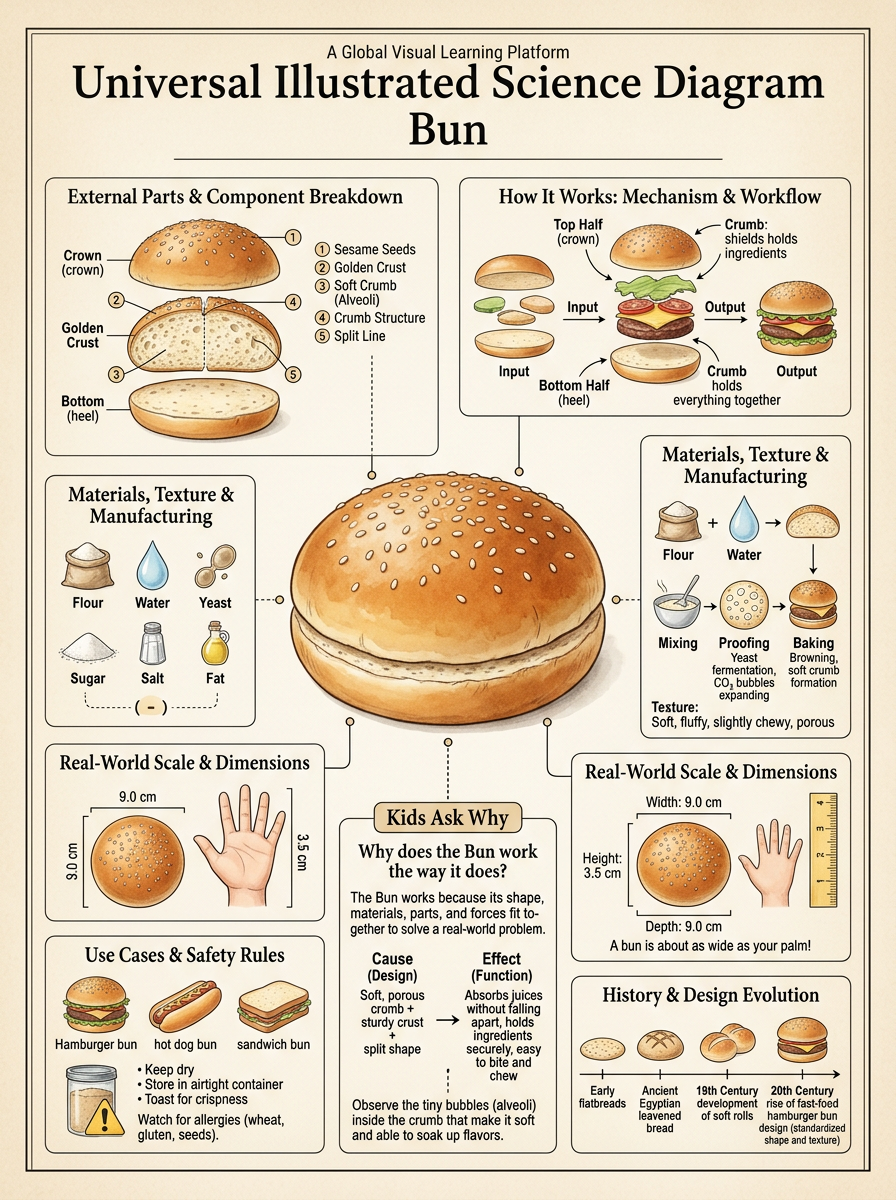
Buns are a type of bread, often made from flour, water, yeast, and a little sugar. The yeast makes the dough rise, creating a light and airy texture. This process, called fermentation, produces carbon dioxide gas, which gets trapped in the dough, forming small bubbles. When baked, these bubbles expand, making the bun fluffy. Historically, buns have been a staple food for centuries, evolving from simple flatbreads to...
Why do you think buns are so popular for holding burgers and sandwiches, compared to other types of bread?
Page 3
Size Science Lab
Read the size clue
A bun is typically 90 millimeters (9.0 cm) wide and 35 millimeters (3.5 cm) tall. To help you imagine this, think about your palm. A bun is about as wide as an average adult's palm. Its height, 3.5 cm, is roughly the height of two stacked dominoes or a small eraser. So, a bun is a small, round, and relatively flat piece of bread, perfect for fitting in your hand and holding delicious fillings.
Quick Check
How many centimeters wide is a bun?
Estimate
Without measuring, find an object in your classroom or home that you think is about 3.5 cm tall. Then measure it to check.
How is the shape of a bun similar to a donut? How is it different?
Page 4
Scientific Diagram Poster
Reviewed diagram
Bun Scientific Diagram with Kids Ask Why
Batch reviewed generated diagram for Pro Pack use. Check labels, Kids Ask Why panel, anatomy/context modules, and print readability.
2026-06-11
Page 5
Kids Ask Why Lab
Big Question
Why does the Bun work the way it does?
The Bun works because its shape, materials, parts, and forces fit together to solve a real-world problem.
How to diagram it
Use arrows to connect the main parts to their jobs, then show the input and output.
Cause-and-effect arrows
1-minute activity
Find one part of the object and explain what would happen if that part was missing.
I noticed:
My answer in one sentence:
Draw your own explanation
Page 6
Comprehension + Drawing
1. What is a bun?
2. What food is often eaten with a bun?
3. Is a bun usually hard or soft?
4. How wide is a bun in centimeters?
Draw and compare
Draw a bun. Next to it, draw something that is much bigger than a bun and something that is much smaller than a bun.
Page 7
Answer Key + Teaching Notes
Answer Key
- A bun is a type of soft bread.
- A burger or sandwich is often eaten with a bun.
- A bun is usually soft.
- A bun is 9.0 cm wide.
- 9.0 cm.
Teaching Notes
- Encourage students to touch and smell a real bun if available.
- Emphasize the article 'a' with 'bun' (a bun).
- For younger learners, use hand gestures to show 'wide' and 'tall.'
- When discussing size, use both millimeters and centimeters to build familiarity.
- Connect bun examples to local cuisine if appropriate for global learners.
Extension Activity
Have students bring in pictures or descriptions of different types of buns from their culture (e.g., hot dog bun, sweet bun, bao bun) and discuss their shapes, sizes, and uses.
Unlock the full Pro library
This pack offers age-differentiated activities and detailed size comparisons, saving parents and teachers significant lesson planning time.