Free Printable Pack
Camellia printable lesson pack
Free to print or save as PDF — no account needed. Go ad-free for $9.9 (one-time).
SizeRef Pro Pack
Camellia
Engage young learners with a beautiful camellia flower, building vocabulary and early science skills.
Learning Goals
- Identify and name 'a camellia'.
- Describe the camellia's features, such as color and texture.
- Understand basic size comparisons using familiar objects.
- Practice English vocabulary related to flowers and nature.
Teacher / Parent Setup
Print the lesson pack pages. Gather art supplies like crayons, colored pencils, or paint. If possible, have a real camellia flower or a high-quality picture ready for visual reference.
Curiosity Focus
Why does the Camellia grow this way?
This pack includes a reviewed diagram poster and a Kids Ask Why page that turns curiosity into a short explanation and mini activity.

Page 2
Vocabulary Builder
Little Learners: Meet the Camellia
Camellia
Trace the word 'Camellia' with your finger or a red crayon.
Look at the camellia picture. What colors do you see? Can you point to the smooth petals?
Pretend your hand is a camellia flower. Slowly open and close your fingers like petals blooming.
Growing with Camellias
A camellia is a beautiful flower.
It has many smooth petals.
Camellias can be pink, red, or white.
Write one sentence about your favorite color camellia flower.
Word bank: flower · petals · smooth · pink · red · white
Discovering Camellia Science
Camellias are known for their elegant, often waxy petals. This waxy coating, called a cuticle, helps the flower stay fresh by preventing water loss. It also gives the petals their smooth, almost silky feel. These beautiful flowers belong to the Camellia genus, which includes over 200 species. Many camellias bloom in late winter or early spring, bringing color when other plants are still dormant. Their strong structur...
Why do you think camellias have such smooth, strong petals? How does this help them survive in different weather conditions?
Page 3
Size Science Lab
Read the size clue
Imagine holding a camellia flower in your hand. It's about 80 millimeters (8.0 centimeters) wide, which is roughly the width of an adult's hand or a small teacup. Its height is around 60 millimeters (6.0 centimeters), similar to a standard sticky note. The flower is not very thick, with a depth of about 30 millimeters (3.0 centimeters), like two stacked erasers. So, a camellia is wider than it is tall, and not very deep, making it a beautiful, compact bloom that fits nicely in your palm.
Quick Check
How wide is a camellia flower in centimeters?
Estimate
Find an object in your classroom or home that is about 6 cm tall. What is it?
Compare the width of a camellia (8 cm) to the length of your shortest finger. Is the camellia shorter or longer?
Page 4
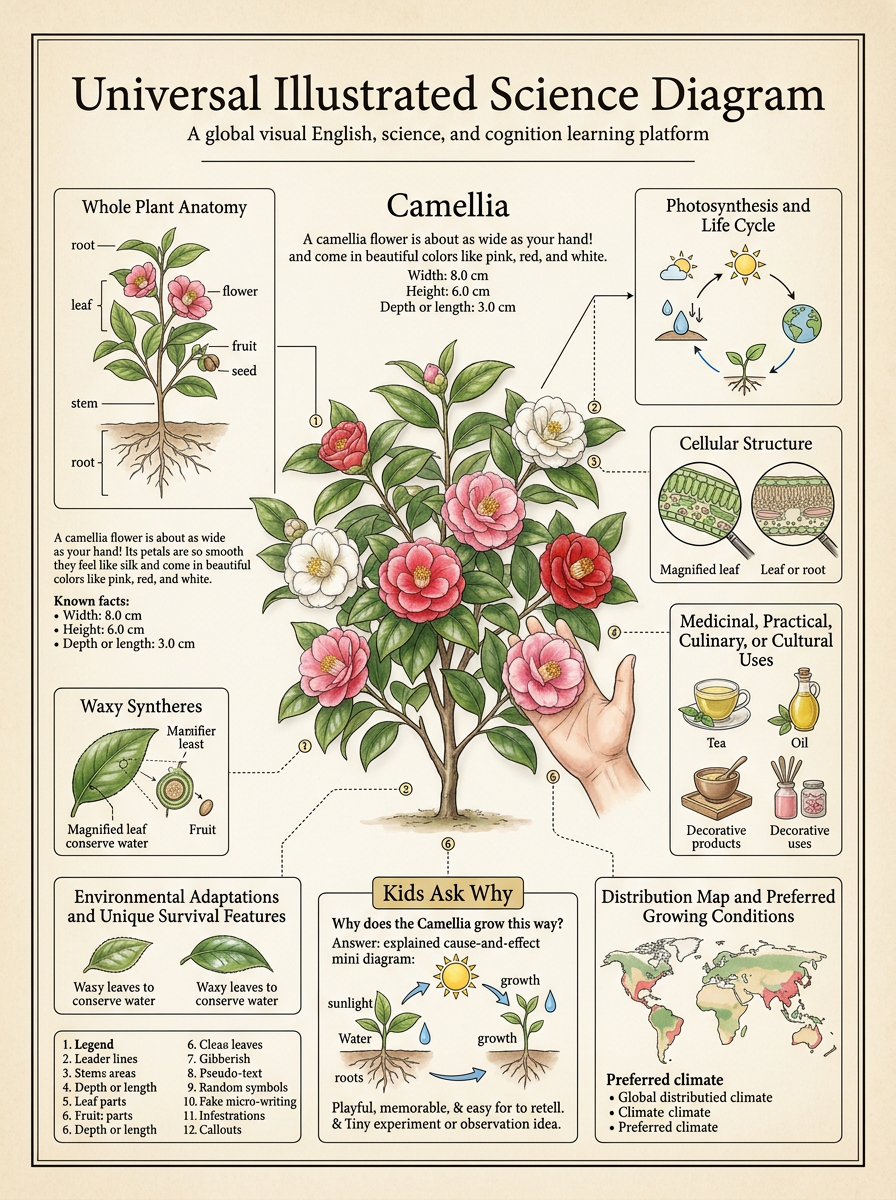
Scientific Diagram Poster
Reviewed diagram
Camellia Scientific Diagram with Kids Ask Why
Batch reviewed generated diagram for Pro Pack use. Check labels, Kids Ask Why panel, anatomy/context modules, and print readability.
2026-06-11
Page 5
Kids Ask Why Lab
Big Question
Why does the Camellia grow this way?
The Camellia grows parts such as roots, stems, leaves, flowers, or seeds to collect resources, survive weather, and make more plants.
How to diagram it
Show roots, leaves, sunlight, water, and growth arrows in one simple cause-and-effect panel.
Cause-and-effect arrows
1-minute activity
Look at a leaf or plant photo and point to the part that catches light.
I noticed:
My answer in one sentence:
Draw your own explanation
Page 6
Comprehension + Drawing
1. What colors can a camellia flower be?
2. How do camellia petals feel?
3. What part of the camellia helps it stay fresh?
4. Is a camellia flower wider or taller?
Draw and compare
Draw a camellia flower. Try to make it about the same size as your hand. What colors will you use for your camellia?
Page 7
Answer Key + Teaching Notes
Answer Key
- Pink, red, and white.
- Smooth or silky.
- Its waxy coating or cuticle (on the petals).
- Wider.
- 8.0 cm.
Teaching Notes
- Encourage learners to use their senses (sight, touch) when describing the camellia.
- Use real camellia flowers or high-quality images for visual reference to enhance learning.
- Adapt activities for different age groups by providing more or less scaffolding as needed.
- Emphasize the use of the article 'a' when referring to a single camellia flower.
- Discuss the importance of flowers in nature, such as for pollinators or for beauty in gardens.
Extension Activity
Create a 'Camellia Garden' collage. Use construction paper, cut-outs, and drawings to make a garden scene with many camellia flowers of different colors.
Unlock the full Pro library
This ready-to-use pack provides structured, multi-level activities, saving educators valuable preparation time.