Free Printable Pack
Camper printable lesson pack
Free to print or save as PDF — no account needed. Go ad-free for $9.9 (one-time).
SizeRef Pro Pack
Camper
This Pro Pack offers engaging, age-appropriate activities to teach English vocabulary and concepts around the word 'Camper'.
Learning Goals
- Identify and name a camper.
- Understand basic features and use of a camper.
- Learn descriptive words related to campers and travel.
- Explore size comparisons and real-world dimensions.
Teacher / Parent Setup
Print all pages. Prepare crayons, pencils, and optional playdough or building blocks. Encourage interactive learning and discussion at each stage.
Curiosity Focus
Why does the Camper work the way it does?
This pack includes a reviewed diagram poster and a Kids Ask Why page that turns curiosity into a short explanation and mini activity.

Page 2
Vocabulary Builder
Little Explorers: My Camper
Camper
Trace the word 'CAMPER' with your finger, then with a crayon.
Look at the picture of the camper. What colors do you see? Point to the wheels. Point to the door.
Pretend to drive a camper! Wiggle your hands like you're steering, then make a 'vroom' sound. Now, pretend to sleep inside your camper.
Camper Fun: Words and Sentences
A camper is a home on wheels.
My family can sleep in a camper.
We can cook food inside the camper.
Write one sentence about where you would like to go in a camper.
Word bank: wheels · door · window · bed · travel · adventure
Camper Science and Design
Campers are amazing examples of compact design and engineering. They are built to fit many things into a small space, like beds, a kitchen, and a bathroom. This is called 'space efficiency'. Think about how engineers decide where to put everything so it's easy to use and safe for travel. The wheels and strong frame allow it to move, while the interior is designed for comfort, making a camper a mobile home. It's like...
If you could design your own camper, what three special features would you add and why?
Page 3
Size Science Lab
Read the size clue
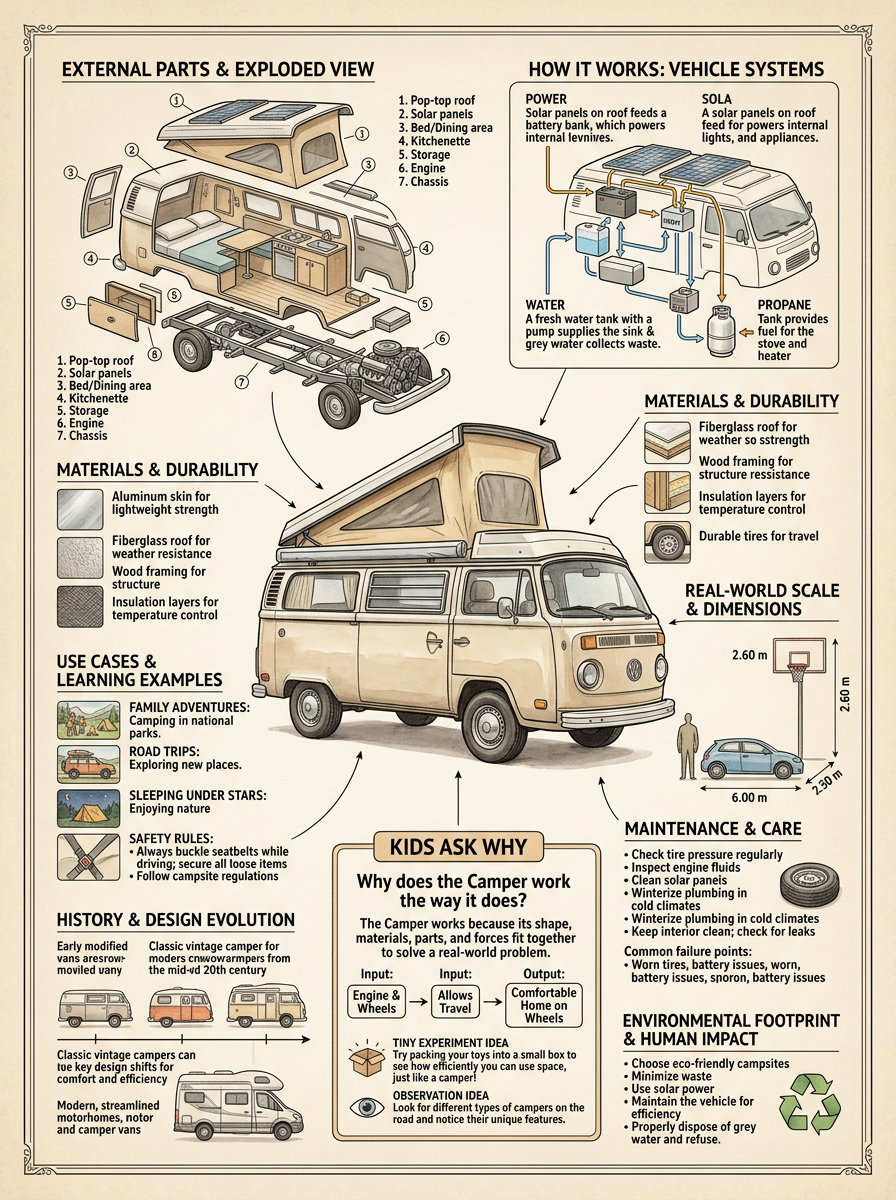
A camper is quite big! Its width is 6000 millimeters, which is 6 meters. That's about the length of two small cars parked one behind the other! Imagine how much space that is. Its height is 2600 millimeters, or 2.6 meters, which is taller than most adults and almost as tall as a basketball hoop. The depth is 2500 millimeters, or 2.5 meters. This means a camper is like a small, cozy house that can travel with you, offering plenty of room inside for sleeping and living on your adventures.
Quick Check
How many meters long is a camper?
Estimate
Look at a school bus. Do you think a camper is longer or shorter than a school bus?
How is a camper similar to a house? How is it different?
Page 4
Scientific Diagram Poster
Reviewed diagram
Camper Scientific Diagram with Kids Ask Why
Batch reviewed generated diagram for Pro Pack use. Check labels, Kids Ask Why panel, anatomy/context modules, and print readability.
2026-06-11
Page 5
Kids Ask Why Lab
Big Question
Why does the Camper work the way it does?
The Camper works because its shape, materials, parts, and forces fit together to solve a real-world problem.
How to diagram it
Use arrows to connect the main parts to their jobs, then show the input and output.
Cause-and-effect arrows
1-minute activity
Find one part of the object and explain what would happen if that part was missing.
I noticed:
My answer in one sentence:
Draw your own explanation
Page 6
Comprehension + Drawing
1. What is a camper?
2. Where can you sleep in a camper?
3. What can you do in a camper besides sleeping?
4. What is one big difference between a camper and a regular car?
Draw and compare
Draw a picture of a camper. Now, draw something next to it to show how big it is, like a person or a tree.
Page 7
Answer Key + Teaching Notes
Answer Key
- A camper is a vehicle that is like a small home on wheels.
- You can sleep inside a camper.
- You can cook, eat, and relax in a camper.
- A camper is much bigger and has beds and a kitchen, unlike a regular car.
- A camper is 6 meters long.
Teaching Notes
- Encourage students to share personal experiences with campers or travel.
- Use visuals like real pictures or videos of campers in action.
- Adapt activities for different learning styles (visual, auditory, kinesthetic).
- Emphasize pronunciation of 'camper' and related vocabulary.
- Extend learning by discussing different types of recreational vehicles.
Extension Activity
Build a 'mini-camper' using blocks, LEGOs, or cardboard boxes. Talk about what rooms or features it has.
Unlock the full Pro library
This pack provides ready-to-use, differentiated activities, saving valuable preparation time for busy educators and parents.