Free Printable Pack
Canoe printable lesson pack
Free to print or save as PDF — no account needed. Go ad-free for $9.9 (one-time).
SizeRef Pro Pack
Canoe
Explore the world of canoes with engaging activities for all ages, designed to build English vocabulary and understanding.
Learning Goals
- Identify a canoe by sight and name.
- Learn key vocabulary related to canoes and water travel.
- Understand the approximate size of a canoe using familiar comparisons.
- Describe how and where a canoe is used.
Teacher / Parent Setup
Print all pages for each student or group. Gather crayons, pencils, and a clear picture of a canoe. Prepare a space for simple movement activities.
Curiosity Focus
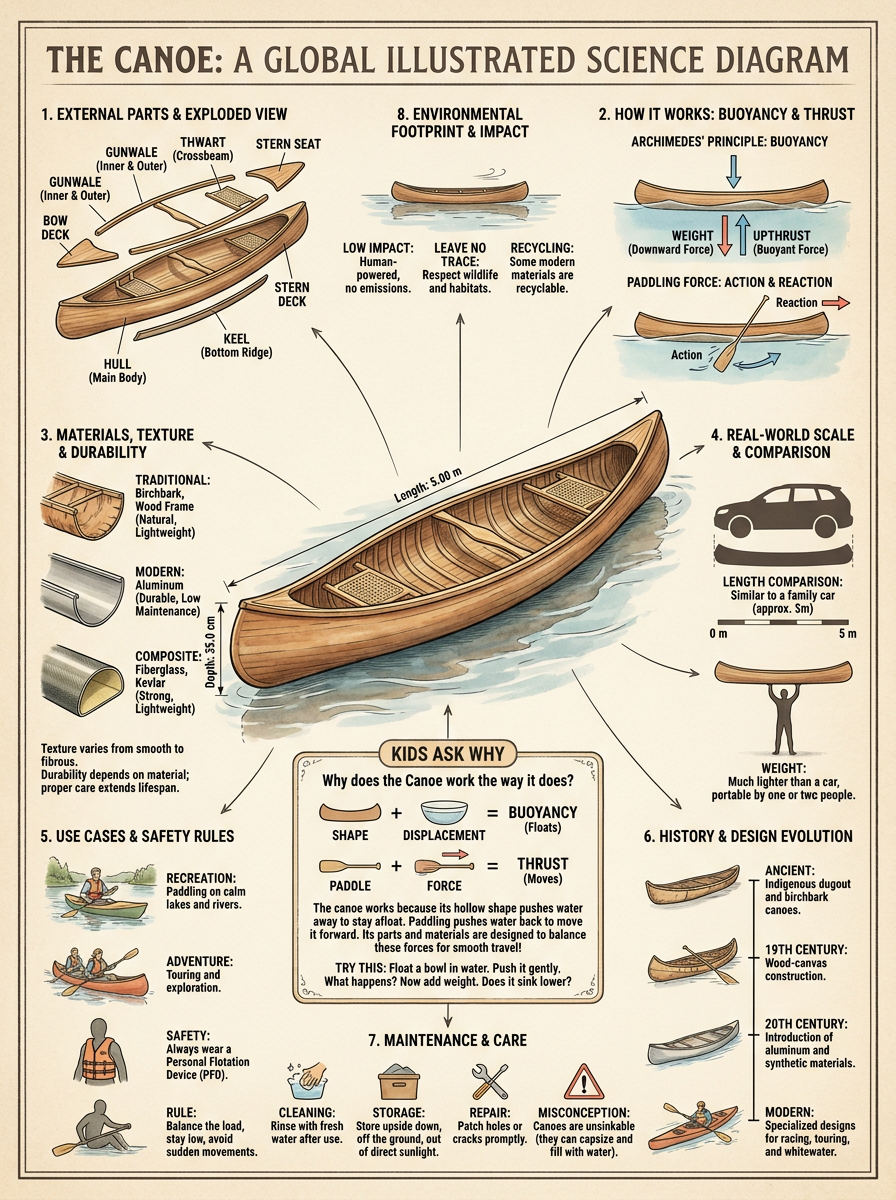
Why does the Canoe work the way it does?
This pack includes a reviewed diagram poster and a Kids Ask Why page that turns curiosity into a short explanation and mini activity.

Page 2
Vocabulary Builder
My First Canoe Words
Canoe
Trace the letters to spell 'canoe' with your finger or a crayon.
Look at the canoe picture. What color is the canoe? Can you point to the paddle? What color is the water?
Pretend to paddle a canoe! Sit down and move your arms like you are paddling on water. Say 'paddle, paddle, paddle!'
Canoe Sentences and Stories
A canoe is a long, narrow boat.
You use a paddle to move a canoe.
Canoes float on the water.
Write two sentences about what you would do if you were in a canoe.
Word bank: canoe · paddle · water · boat · lake · river
Canoe Science and Exploration
A canoe floats because of something called buoyancy. This means the water pushes up on the canoe, holding it up. Canoes are long and narrow, which helps them move smoothly through the water with less effort. Their shape also makes them stable, even when people are paddling inside. Early canoes were often made from hollowed-out logs or animal skins stretched over frames, showing clever design to use natural materials...
Why do you think canoes are often used for exploring nature, like quiet rivers or lakes, instead of big, wavy oceans?
Page 3
Size Science Lab
Read the size clue
Imagine a canoe that is about 5 meters long. That's like lining up two adult bicycles end-to-end! Its height is only 35 centimeters, which is less than the height of a standard school ruler. The canoe is 90 centimeters wide, about the same width as a large dog bed. So, while it's long like a family car, it's very low and narrow. This sleek design helps it glide easily across the water, making it perfect for quiet adventures on lakes and calm rivers.
Quick Check
How many meters long is a canoe?
Estimate
Stand up. How wide do you think a canoe is? Show with your arms.
Compare the length of a canoe (5 meters) to the length of your classroom. Is it shorter or longer?
Page 4
Scientific Diagram Poster
Reviewed diagram
Canoe Scientific Diagram with Kids Ask Why
Batch reviewed generated diagram for Pro Pack use. Check labels, Kids Ask Why panel, anatomy/context modules, and print readability.
2026-06-11
Page 5
Kids Ask Why Lab
Big Question
Why does the Canoe work the way it does?
The Canoe works because its shape, materials, parts, and forces fit together to solve a real-world problem.
How to diagram it
Use arrows to connect the main parts to their jobs, then show the input and output.
Cause-and-effect arrows
1-minute activity
Find one part of the object and explain what would happen if that part was missing.
I noticed:
My answer in one sentence:
Draw your own explanation
Page 6
Comprehension + Drawing
1. What do you use to move a canoe?
2. Where can you paddle a canoe?
3. Is a canoe heavy or light compared to a car?
4. What is one thing that helps a canoe float?
Draw and compare
Draw a picture of yourself in a canoe on a lake or river. Make sure to draw a paddle!
Page 7
Answer Key + Teaching Notes
Answer Key
- A paddle.
- On lakes and rivers.
- Much lighter.
- Buoyancy (or: the water pushes it up / its shape).
- 5 meters.
Teaching Notes
- Encourage active participation in all movement and drawing activities.
- Use real-life photos or short videos of canoes to enhance understanding.
- Emphasize vocabulary repetition, especially for younger learners.
- Adapt activities for mixed-age groups by pairing older children with younger ones.
- Focus on making learning fun and adventurous, connecting to the idea of exploration.
Extension Activity
Research different types of canoes (e.g., dugout, birch bark) and their history. Share what you learned with the class or family.
Unlock the full Pro library
This pack offers a complete, multi-level learning experience, saving hours of research and activity creation for busy educators.