Free Printable Pack
Chocolate printable lesson pack
Free to print or save as PDF — no account needed. Go ad-free for $9.9 (one-time).
SizeRef Pro Pack
Chocolate
A comprehensive, age-differentiated lesson pack for exploring the English language and science of chocolate.
Learning Goals
- Identify and name 'chocolate' in English.
- Describe chocolate using simple adjectives.
- Understand basic dimensions and make size comparisons.
- Learn about the physical properties of chocolate.
Teacher / Parent Setup
Print all activity sheets. Gather a real chocolate bar if possible, or a picture. Review the age-specific sections to tailor the lesson.
Curiosity Focus
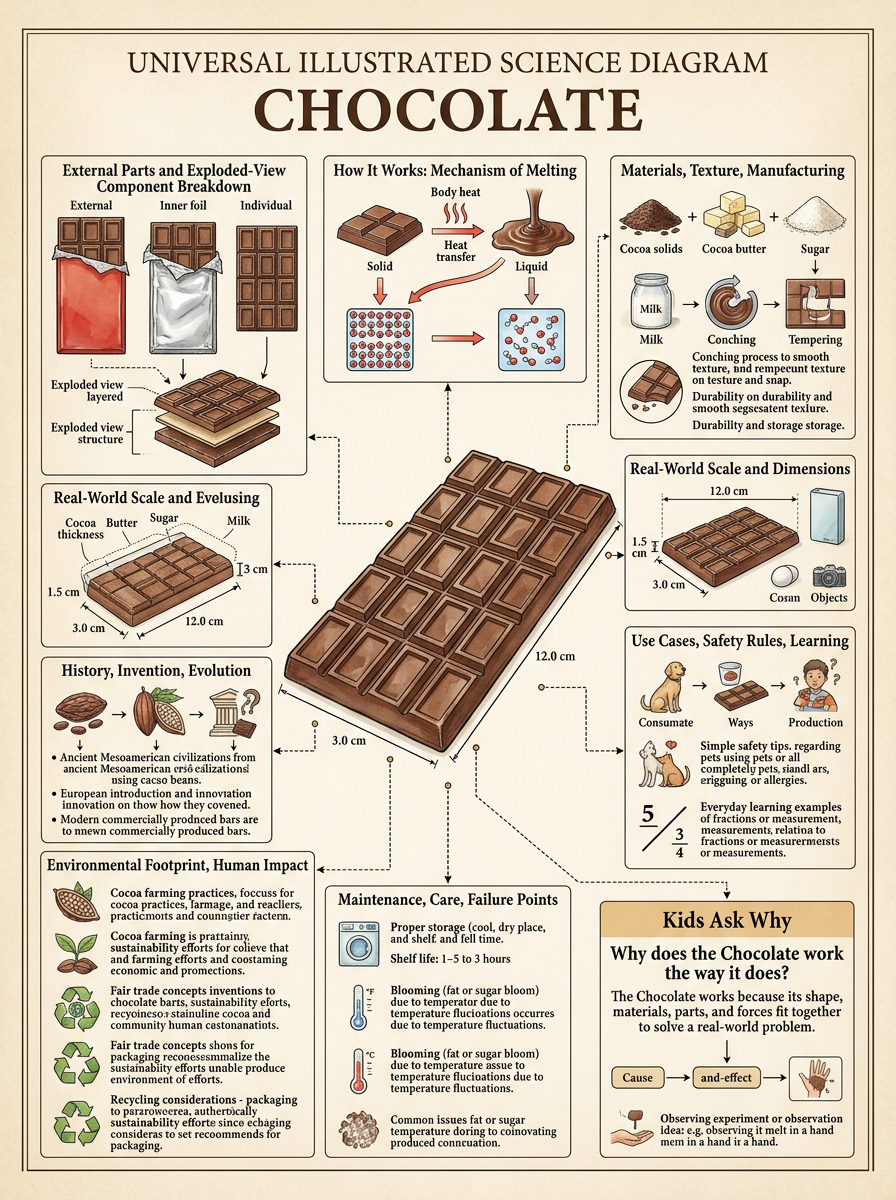
Why does the Chocolate work the way it does?
This pack includes a reviewed diagram poster and a Kids Ask Why page that turns curiosity into a short explanation and mini activity.

Page 2
Vocabulary Builder
My First Chocolate Words
Chocolate
Trace the word: chocolate.
Look at the picture of the chocolate bar. What color is it? Point to the yummy chocolate.
Pretend to eat a piece of chocolate. Say 'Mmm, delicious!'
Chocolate Fun Facts
A chocolate bar is a sweet treat.
It can be dark, milk, or white.
Chocolate melts when it gets warm.
Draw your favorite type of chocolate and write one word to describe how it tastes.
Word bank: sweet · melt · bar · dark · milk · treat
The Science of Chocolate
Chocolate is special because of how it changes from a solid to a liquid. This is called melting. Cocoa butter, a main ingredient, has a low melting point, which means it gets soft and melts easily at body temperature. That's why chocolate melts in your mouth! Different types of chocolate have different amounts of cocoa butter, affecting how quickly they melt and their texture. This unique property makes chocolate enj...
Why is it important for chocolate to melt smoothly in your mouth, and what would happen if it didn't?
Page 3
Size Science Lab
Read the size clue
A chocolate bar is usually about 120 millimeters (12.0 centimeters) wide. That's about as long as your hand from your wrist to your fingertips! It is quite thin, only about 15 millimeters (1.5 centimeters) high, which is like stacking two common coins together. Its depth is around 30 millimeters (3.0 centimeters), which is similar to the width of your thumb. These dimensions make it easy to hold and break into pieces.
Quick Check
How many centimeters wide is a typical chocolate bar?
Estimate
Without a ruler, estimate the length of your pencil in centimeters. Now, imagine how many chocolate bars would fit end-to-end to match that length.
Find an object in your classroom that is approximately 1.5 centimeters high. What is it?
Page 4
Scientific Diagram Poster
Reviewed diagram
Chocolate Scientific Diagram with Kids Ask Why
Batch reviewed generated diagram for Pro Pack use. Check labels, Kids Ask Why panel, anatomy/context modules, and print readability.
2026-06-11
Page 5
Kids Ask Why Lab
Big Question
Why does the Chocolate work the way it does?
The Chocolate works because its shape, materials, parts, and forces fit together to solve a real-world problem.
How to diagram it
Use arrows to connect the main parts to their jobs, then show the input and output.
Cause-and-effect arrows
1-minute activity
Find one part of the object and explain what would happen if that part was missing.
I noticed:
My answer in one sentence:
Draw your own explanation
Page 6
Comprehension + Drawing
1. What kind of food is chocolate?
2. What happens to chocolate when it gets warm?
3. Can chocolate come in different colors?
4. How does the size of a chocolate bar compare to your hand?
Draw and compare
Draw a chocolate bar. Next to it, draw something that is smaller than the chocolate bar, and something that is bigger than the chocolate bar. Label your drawings.
Page 7
Answer Key + Teaching Notes
Answer Key
- Food / A sweet treat.
- It melts.
- Yes, dark, milk, or white.
- It is about as long as your hand.
- 12 centimeters.
Teaching Notes
- Encourage learners to use their senses (sight, smell, touch) if a real chocolate bar is available.
- Emphasize the 'a' article with 'chocolate bar' for countable usage.
- Adapt activities based on learners' English proficiency, not just age.
- Use gestures and realia to support vocabulary acquisition.
- Celebrate all attempts at speaking and writing, focusing on communication.
Extension Activity
Have learners research different types of chocolate (e.g., dark, milk, white, ruby) and discuss their origins or main ingredients.
Unlock the full Pro library
This pack provides ready-to-use, age-appropriate activities and content, saving valuable lesson planning time for busy educators and parents.