Free Printable Pack
Cilantro printable lesson pack
Free to print or save as PDF — no account needed. Go ad-free for $9.9 (one-time).
SizeRef Pro Pack
Cilantro
This Pro Pack provides ready-to-use, multi-age activities to teach English and science concepts using the common herb, cilantro.
Learning Goals
- Identify and name 'cilantro' in English.
- Describe cilantro using simple adjectives.
- Understand basic plant parts and their uses.
- Compare and estimate object sizes using standard units.
Teacher / Parent Setup
Print all pages. Gather a fresh bunch of cilantro, paper, and crayons. Prepare a small snack with cilantro if possible.
Curiosity Focus
Why does the Cilantro grow this way?
This pack includes a reviewed diagram poster and a Kids Ask Why page that turns curiosity into a short explanation and mini activity.

Page 2
Vocabulary Builder
My First Cilantro Words
Cilantro
Trace the word 'Cilantro' with your finger, then with a crayon.
Look at the picture of cilantro. What colors do you see? What shape are the leaves?
Hold a real piece of cilantro. Smell it! Does it smell fresh? Can you point to the leaves and the stem?
Cilantro Sentences and Words
Cilantro is a green herb.
It smells fresh and strong.
We can eat cilantro in food.
Use three words from the word bank to write one sentence about cilantro.
Word bank: cilantro · green · leaves · smell · taste · herb
The Science of Cilantro
Cilantro is an aromatic herb, meaning it has a strong, pleasant smell. This smell comes from special oils in its leaves. When you eat cilantro, these oils activate taste receptors on your tongue and smell receptors in your nose, creating its unique flavor. For some, it tastes fresh and citrusy, but for others, it can taste like soap! This difference is often due to genetics, showing how our bodies react differently t...
Why do you think some people love cilantro and others dislike it, even though it's the same plant?
Page 3
Size Science Lab
Read the size clue
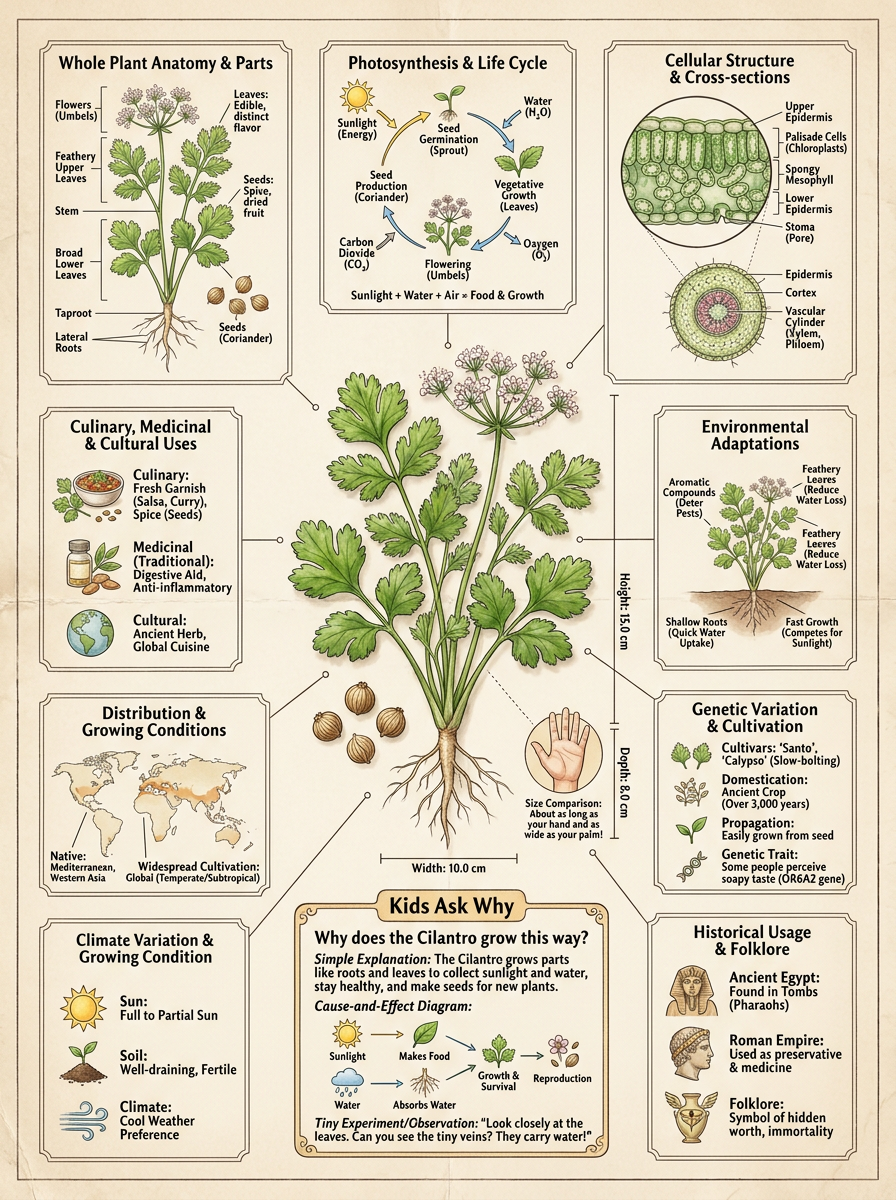
A typical bunch of cilantro is about 15.0 cm tall, which is like holding two standard pencils end-to-end. It's about 10.0 cm wide, similar to the width of your palm, and 8.0 cm deep, which is a bit thicker than a small apple. So, a bunch of cilantro is about as long as your hand and as wide as your palm! It's not very big, but its flavor is huge!
Quick Check
How tall is a bunch of cilantro in centimeters?
Estimate
Estimate how many bunches of cilantro would fit in a shoebox.
Compare the height of a cilantro bunch to a banana. Which is taller?
Page 4
Scientific Diagram Poster
Reviewed diagram
Cilantro Scientific Diagram with Kids Ask Why
Batch reviewed generated diagram for Pro Pack use. Check labels, Kids Ask Why panel, anatomy/context modules, and print readability.
2026-06-11
Page 5
Kids Ask Why Lab
Big Question
Why does the Cilantro grow this way?
The Cilantro grows parts such as roots, stems, leaves, flowers, or seeds to collect resources, survive weather, and make more plants.
How to diagram it
Show roots, leaves, sunlight, water, and growth arrows in one simple cause-and-effect panel.
Cause-and-effect arrows
1-minute activity
Look at a leaf or plant photo and point to the part that catches light.
I noticed:
My answer in one sentence:
Draw your own explanation
Page 6
Comprehension + Drawing
1. What is cilantro?
2. What does cilantro smell like?
3. Can you eat cilantro?
4. What is one way people feel about cilantro's taste?
Draw and compare
Draw a bunch of cilantro. Then, draw something else that is about the same height as cilantro.
Page 7
Answer Key + Teaching Notes
Answer Key
- Cilantro is a green herb.
- It smells fresh and strong.
- Yes, you can eat cilantro.
- Some people love its taste, and others do not.
- 15.0 cm.
Teaching Notes
- Bring a real bunch of cilantro for sensory exploration.
- Encourage students to describe the smell and taste (if trying).
- Use flashcards with key vocabulary words.
- Connect cilantro to foods they might know, like tacos or salsa.
- Emphasize that it's okay for people to have different taste preferences.
Extension Activity
Make a simple salsa or guacamole together using cilantro, discussing the ingredients and steps in English.
Unlock the full Pro library
This Pro Pack provides comprehensive, age-differentiated activities and clear instructions, saving hours of lesson planning and resource creation.