Free Printable Pack
Cranberry printable lesson pack
Free to print or save as PDF — no account needed. Go ad-free for $9.9 (one-time).
SizeRef Pro Pack
Cranberry
This premium pack offers engaging, age-differentiated activities to explore cranberries, boosting English vocabulary and scientific understanding.
Learning Goals
- Learn the English word 'cranberry'.
- Understand the size and unique properties of cranberries.
- Practice English listening, speaking, reading, and writing skills.
- Explore basic science concepts related to cranberries, like density and air pockets.
Teacher / Parent Setup
Print all pages of the pack. Gather a few fresh cranberries if possible, or clear pictures of them. Prepare pencils, crayons, and paper for drawing and writing activities.
Curiosity Focus
Why does the Cranberry grow this way?
This pack includes a reviewed diagram poster and a Kids Ask Why page that turns curiosity into a short explanation and mini activity.

Page 2
Vocabulary Builder
Little Learners: Cranberry Fun
Cranberry
Trace the word 'cranberry' with your finger or a red crayon.
Look closely at the picture of the cranberry. What color is it? Is it big or small?
Pretend to pick a tiny cranberry from a bush. Now, make it bounce with your hand and say 'bounce!'
Cranberry Explorers: Words and Facts
A cranberry is a small, round, red fruit.
It grows in wet places, often called bogs.
Cranberries have tiny air pockets inside them.
Write two sentences about what you learned about cranberries, using words from the word bank.
Word bank: cranberry · red · small · fruit · bounces · floats
Cranberry Scientists: Size and Science
Cranberries are truly unique fruits, especially because of their amazing ability to bounce! This isn't magic; it's science. Inside each cranberry are tiny pockets of air. These air pockets make the cranberry less dense than water, which is why they float. Farmers use this when they harvest cranberries by flooding the fields. The air also acts like a natural spring, allowing the cranberry to bounce when it's ripe and...
How does knowing that cranberries bounce help farmers, and what does this tell us about the fruit's inside?
Page 3
Size Science Lab
Read the size clue
Imagine a tiny, perfect red ball! A cranberry is about 15 millimeters wide, 15 millimeters high, and 15 millimeters deep. That's the same as 1.5 centimeters in each direction. To help you picture this, a cranberry is roughly the size of a common marble you might play with, or a large bead from a necklace. It's much smaller than a grape, but a bit bigger than a pea. So, when you see a cranberry, think of it as a perfect little sphere, just big enough to hold between your thumb and finger.
Quick Check
How wide is a cranberry in centimeters?
Estimate
Look at your smallest finger. Do you think a cranberry is bigger or smaller than the tip of your smallest finger?
Find an object in your classroom or home that is about the same size as a cranberry. What is it?
Page 4
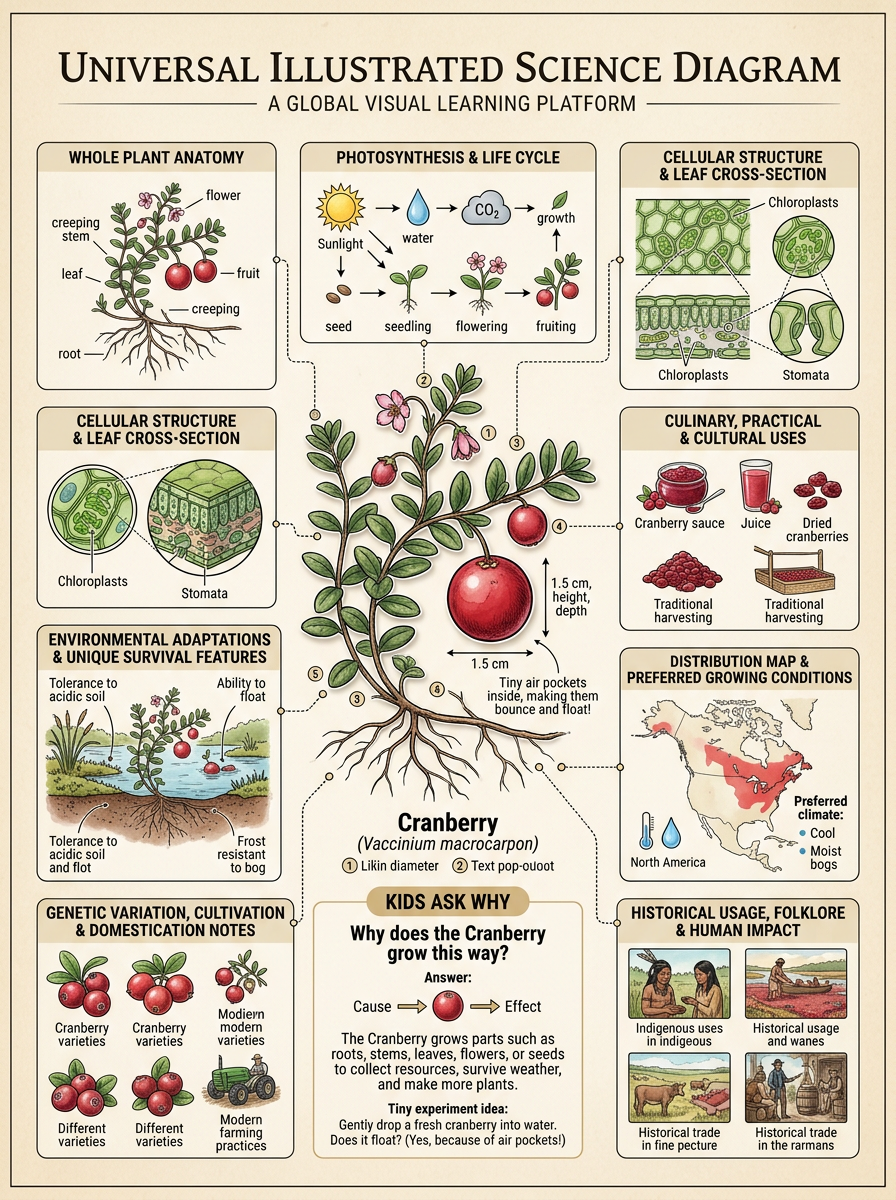
Scientific Diagram Poster
Reviewed diagram
Cranberry Scientific Diagram with Kids Ask Why
Batch reviewed generated diagram for Pro Pack use. Check labels, Kids Ask Why panel, anatomy/context modules, and print readability.
2026-06-11
Page 5
Kids Ask Why Lab
Big Question
Why does the Cranberry grow this way?
The Cranberry grows parts such as roots, stems, leaves, flowers, or seeds to collect resources, survive weather, and make more plants.
How to diagram it
Show roots, leaves, sunlight, water, and growth arrows in one simple cause-and-effect panel.
Cause-and-effect arrows
1-minute activity
Look at a leaf or plant photo and point to the part that catches light.
I noticed:
My answer in one sentence:
Draw your own explanation
Page 6
Comprehension + Drawing
1. What color is a cranberry?
2. Why do cranberries bounce?
3. Can cranberries float in water?
4. What is one way farmers check if cranberries are good?
Draw and compare
Draw a picture of a cranberry. Next to it, draw something else that is about the same size as a cranberry.
Page 7
Answer Key + Teaching Notes
Answer Key
- Red.
- They have tiny air pockets inside.
- Yes, they can float.
- They check if they bounce.
- 1.5 cm.
Teaching Notes
- Encourage hands-on exploration with real cranberries if available, focusing on their size, color, and texture.
- Emphasize the 'bouncing' and 'air pockets' concepts using simple demonstrations or visuals.
- Adapt activities based on the child's English proficiency; for beginners, focus on listening and speaking.
- Use visual aids like pictures or videos of cranberry harvesting to enhance understanding of their unique properties.
- Connect cranberry facts to other small fruits or objects to reinforce size comparisons.
Extension Activity
Research other fruits that grow in unique ways, like blueberries or strawberries, and compare their sizes and growing environments.
Unlock the full Pro library
This pack provides ready-to-use, differentiated content, saving valuable lesson planning time for busy educators and parents.