Free Printable Pack
Crane printable lesson pack
Free to print or save as PDF — no account needed. Go ad-free for $9.9 (one-time).
SizeRef Pro Pack
Crane
Unlock English, science, and critical thinking skills with this comprehensive, age-differentiated lesson on the powerful crane.
Learning Goals
- Identify and name a crane and its main parts.
- Understand and use size comparison vocabulary related to a crane.
- Practice writing simple sentences about a crane's function.
- Discuss the role and importance of cranes in construction.
Teacher / Parent Setup
Print all pages for the relevant age groups. Prepare drawing materials and, if possible, a ruler. Review the answer key and teaching notes before starting the lesson.
Curiosity Focus
Why does the Crane work the way it does?
This pack includes a reviewed diagram poster and a Kids Ask Why page that turns curiosity into a short explanation and mini activity.

Page 2
Vocabulary Builder
Little Builders Learn About Cranes
Crane
Trace the word 'crane' with your finger or a crayon. Say the word aloud.
Point to the long arm of the crane. Where is the hook that lifts things?
Stand tall and stretch your arm up high like a crane's boom. Now, pretend to lift a very heavy toy with your hand.
Cranes: Big Machines, Big Jobs
A crane is a very big machine.
It has a long arm called a boom.
Cranes lift heavy things like steel beams.
Write two sentences about what a crane does or what it looks like.
Word bank: crane · lift · heavy · boom · hook · building
Engineering Marvels: How Cranes Work
Cranes are incredible machines that use simple physics to lift extremely heavy objects. They often use a long arm, called a boom, which acts like a lever. The further the weight is from the pivot point, the harder it is to lift, but cranes are designed to balance these forces. Many cranes also use a system of pulleys and cables. Pulleys help reduce the force needed to lift a heavy load by distributing the weight over...
Why do we need cranes to build tall buildings and bridges instead of just people and smaller tools?
Page 3
Size Science Lab
Read the size clue
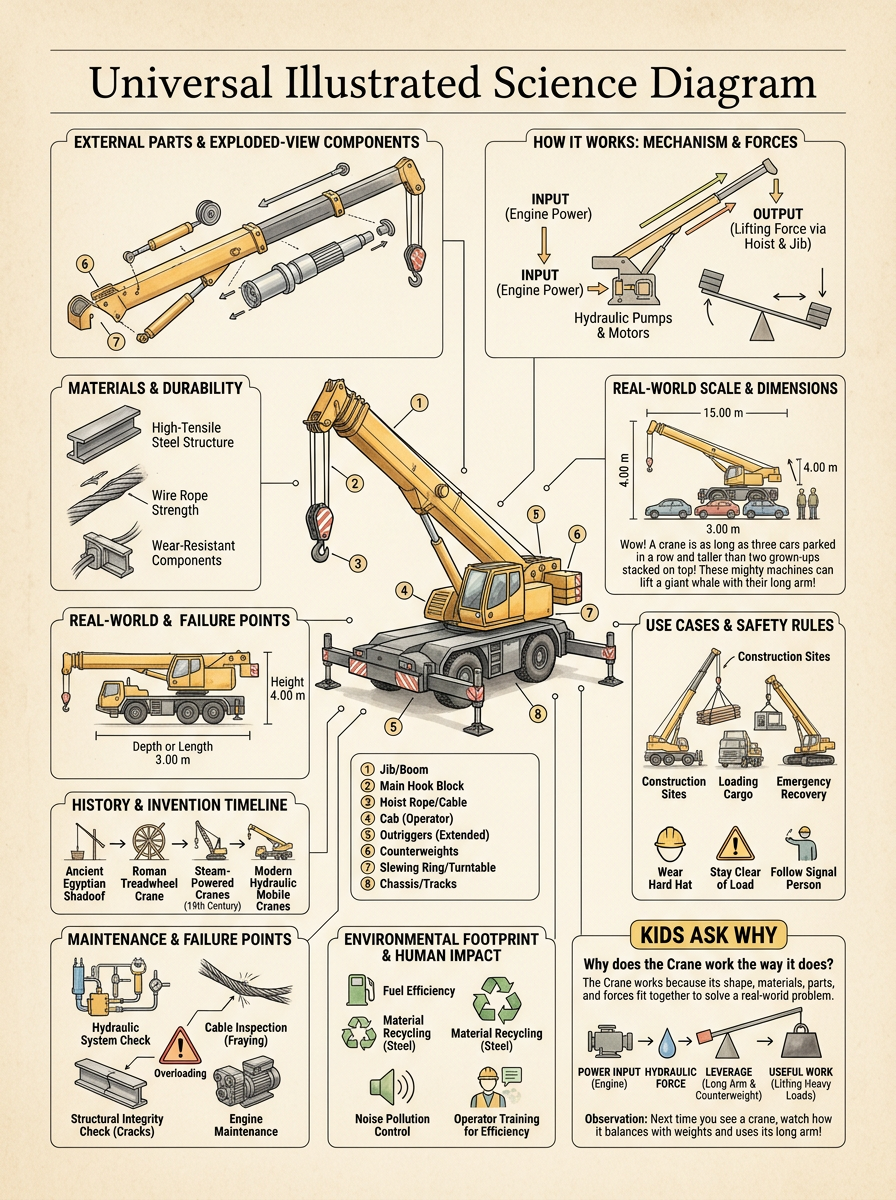
Imagine a crane! It can be really big. This crane is about 15,000 millimeters (15 meters) long. That's like three family cars parked one after another! It stands 4,000 millimeters (4 meters) tall, which is taller than two grown-ups standing on each other's shoulders. And it's 3,000 millimeters (3 meters) deep, which is wider than a big refrigerator. These huge dimensions help it stay stable while lifting very heavy objects high into the air, making it a true giant of the construction world.
Quick Check
How many meters long is this crane?
Estimate
If a crane lifts a large box, would the box be heavier or lighter than a small car?
Compare the height of a crane to the height of your house or school. Which one is taller?
Page 4
Scientific Diagram Poster
Reviewed diagram
Crane Scientific Diagram with Kids Ask Why
Batch reviewed generated diagram for Pro Pack use. Check labels, Kids Ask Why panel, anatomy/context modules, and print readability.
2026-06-11
Page 5
Kids Ask Why Lab
Big Question
Why does the Crane work the way it does?
The Crane works because its shape, materials, parts, and forces fit together to solve a real-world problem.
How to diagram it
Use arrows to connect the main parts to their jobs, then show the input and output.
Cause-and-effect arrows
1-minute activity
Find one part of the object and explain what would happen if that part was missing.
I noticed:
My answer in one sentence:
Draw your own explanation
Page 6
Comprehension + Drawing
1. What is the name of the big machine in the picture?
2. What does a crane's long arm do?
3. Where might you see a crane working?
4. Why are cranes important for building things?
Draw and compare
Draw a crane lifting something very heavy, like a part of a building. Next to your crane, draw something small that a person could lift easily. Label both your drawings.
Page 7
Answer Key + Teaching Notes
Answer Key
- Crane.
- It lifts heavy objects.
- At a construction site or where new buildings are being made.
- Cranes help build tall buildings and move very heavy materials that people cannot lift.
- 15 meters.
Teaching Notes
- Encourage learners to use their own words when answering questions.
- For younger learners, focus on identifying the crane and its main parts (boom, hook).
- For older learners, discuss the principles of leverage and stability in crane operation.
- Use visual aids like pictures or short videos of cranes in action to enhance understanding.
- Emphasize safety around construction sites where cranes operate.
Extension Activity
Build a simple model crane using blocks, LEGOs, or craft sticks. Experiment with lifting small, light objects with your model.
Unlock the full Pro library
This pack provides ready-to-use, differentiated content across multiple age groups and subjects, saving hours of lesson planning and resource creation.