Free Printable Pack
Croissant printable lesson pack
Free to print or save as PDF — no account needed. Go ad-free for $9.9 (one-time).
SizeRef Pro Pack
Croissant
This Pro Pack offers ready-to-use, age-differentiated activities to teach English vocabulary, science concepts, and critical thinking using a delicious croissan...
Learning Goals
- Identify and name "a croissant" in English.
- Describe a croissant using adjectives like "flaky" and "buttery".
- Understand basic measurements and comparisons of size.
- Develop fine motor skills and creative expression.
Teacher / Parent Setup
Print the activity pages. Gather crayons, pencils, and optionally, a real croissant. Prepare a space for tracing and drawing.
Curiosity Focus
Why does the Croissant work the way it does?
This pack includes a reviewed diagram poster and a Kids Ask Why page that turns curiosity into a short explanation and mini activity.

Page 2
Vocabulary Builder
My First Croissant
Croissant
Trace the word 'croissant' with your finger, then with a crayon. Say 'croissant' aloud!
Look at the picture of the croissant. What shape do you see? Is it big or small? What color is it?
Point to the flaky layers on the croissant. Pretend to take a bite and say 'Mmm, yummy!'
Croissant Words and Sentences
A croissant is a yummy breakfast food.
It has many flaky, buttery layers.
Croissants are often shaped like a crescent moon.
Write two sentences about your favorite part of a croissant, using words from the word bank.
Word bank: croissant · flaky · buttery · delicious · breakfast · crescent
The Science of a Croissant
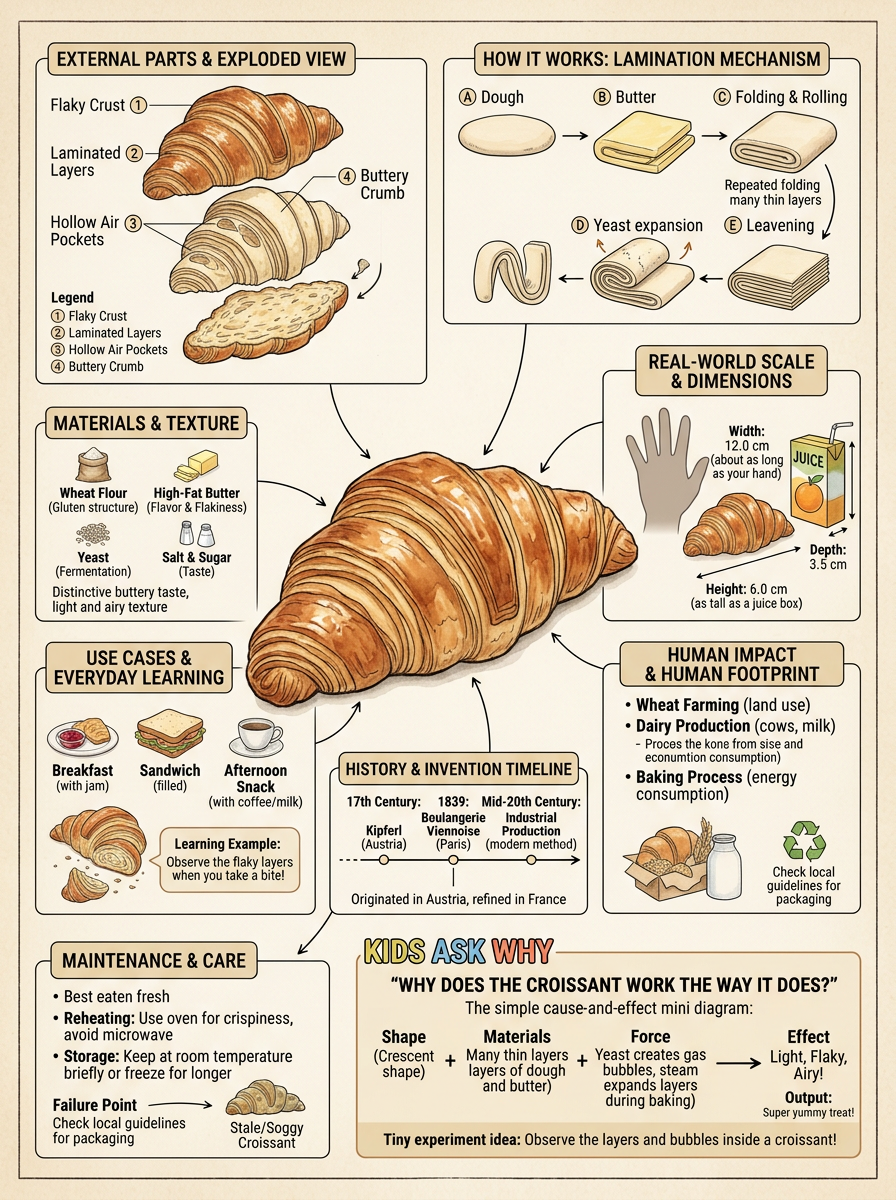
A croissant's unique texture comes from lamination, a special baking technique. Bakers fold butter into dough many times, creating thin layers. When baked, the water in the butter turns to steam, pushing the layers apart and making the croissant light and flaky. This process is similar to how some rocks form layers over time. Understanding lamination helps us appreciate the science behind everyday foods and how diffe...
How does the lamination process make a croissant different from a regular bread roll, both in texture and taste?
Page 3
Size Science Lab
Read the size clue
Imagine a croissant. It's about 120 millimeters (12.0 cm) wide, which is roughly the length of a typical smartphone. Its height is around 60 millimeters (6.0 cm), similar to a small juice box standing on its side. The depth, or how thick it is, is about 35 millimeters (3.5 cm), like stacking two thick markers together. So, a croissant is longer than it is tall, and not too thick. It fits nicely in your hand, making it a perfect snack!
Quick Check
Is a croissant wider or taller?
Estimate
Find something in your room that is about 12 cm long, like a croissant.
How is the shape of a croissant similar to or different from a banana?
Page 4
Scientific Diagram Poster
Reviewed diagram
Croissant Scientific Diagram with Kids Ask Why
Batch reviewed generated diagram for Pro Pack use. Check labels, Kids Ask Why panel, anatomy/context modules, and print readability.
2026-06-11
Page 5
Kids Ask Why Lab
Big Question
Why does the Croissant work the way it does?
The Croissant works because its shape, materials, parts, and forces fit together to solve a real-world problem.
How to diagram it
Use arrows to connect the main parts to their jobs, then show the input and output.
Cause-and-effect arrows
1-minute activity
Find one part of the object and explain what would happen if that part was missing.
I noticed:
My answer in one sentence:
Draw your own explanation
Page 6
Comprehension + Drawing
1. What is a croissant made of?
2. What shape is a croissant often?
3. How do the layers become flaky?
4. What is one way to eat a croissant?
Draw and compare
Draw a croissant and something else you like to eat for breakfast. Compare their sizes.
Page 7
Answer Key + Teaching Notes
Answer Key
- A croissant is made with dough and butter.
- A croissant is often shaped like a crescent moon.
- The layers become flaky because steam pushes them apart during baking.
- You can eat a croissant plain or with jam.
- A croissant is wider than it is tall.
Teaching Notes
- Encourage students to use all their senses when describing the croissant (sight, smell, touch, taste if applicable).
- For younger learners, use real objects for size comparisons whenever possible.
- Emphasize the 'a' article before 'croissant' as it's a countable noun.
- Discuss the origin of the word 'croissant' (French for 'crescent').
- Adapt activities for group work or individual learning based on classroom needs.
Extension Activity
Research other flaky pastries from different countries and compare their ingredients or baking methods to a croissant.
Unlock the full Pro library
This Pro Pack provides a complete, multi-age lesson plan with differentiated content, eliminating the need for extensive research and activity creation.