Free Printable Pack
Duck printable lesson pack
Free to print or save as PDF — no account needed. Go ad-free for $9.9 (one-time).
SizeRef Pro Pack
Duck
This Pro Pack offers age-differentiated activities to teach English vocabulary and science concepts about ducks, saving you valuable preparation time.
Learning Goals
- Identify the word 'duck' and its common features.
- Understand basic facts about ducks, like where they live and what they eat.
- Practice English vocabulary related to birds and water.
- Develop size comparison skills using real-world measurements.
Teacher / Parent Setup
Print all pages. Gather crayons, pencils, and optional playdough. Have a ruler or measuring tape ready for science activities.
Curiosity Focus
Why is the Duck built this way?
This pack includes a reviewed diagram poster and a Kids Ask Why page that turns curiosity into a short explanation and mini activity.

Page 2
Vocabulary Builder
Meet the Duck
Duck
Trace the word 'duck' with your finger, then with a crayon.
Look at the picture of the duck. What colors do you see? What is the duck doing?
Waddle like a duck! Point to the duck's beak, feathers, and feet in the picture.
Duck Facts and Fun
A duck has soft feathers.
Ducks like to swim in water.
They eat plants and small bugs.
Write one sentence about what a duck can do.
Word bank: duck · feathers · swim · water · beak · duckling
Amazing Duck Adaptations
Ducks are incredible birds built for life on water. Their feathers have a special oil that makes them waterproof, so water slides right off. This keeps them warm and dry, even in cold ponds or rivers. Their webbed feet act like paddles, helping them swim fast. Ducks also have a flat beak, perfect for sifting through mud to find food. These features are called adaptations, helping ducks survive and thrive in their env...
Imagine you are a duck. What is the most important thing your body helps you do? Why?
Page 3
Size Science Lab
Read the size clue
A duck is usually about 55.0 cm (21.7 inches) wide, which is like the length of your arm from your elbow to your fingertips! It stands about 35.0 cm (13.8 inches) tall, similar to a standard ruler stood on its end. The duck's body is about 12.0 cm (4.7 inches) deep, roughly the size of a large juice box. These dimensions help us understand how big a real duck is compared to everyday objects.
Quick Check
How tall is a duck in centimeters?
Estimate
Look at a ruler. How many rulers tall do you think a duck is?
Find an object in your room that is about 12 cm deep, like a duck's body.
Page 4
Scientific Diagram Poster
Reviewed diagram
Duck Scientific Diagram with Kids Ask Why
Batch reviewed generated diagram for Pro Pack use. Check labels, Kids Ask Why panel, anatomy/context modules, and print readability.
2026-06-11
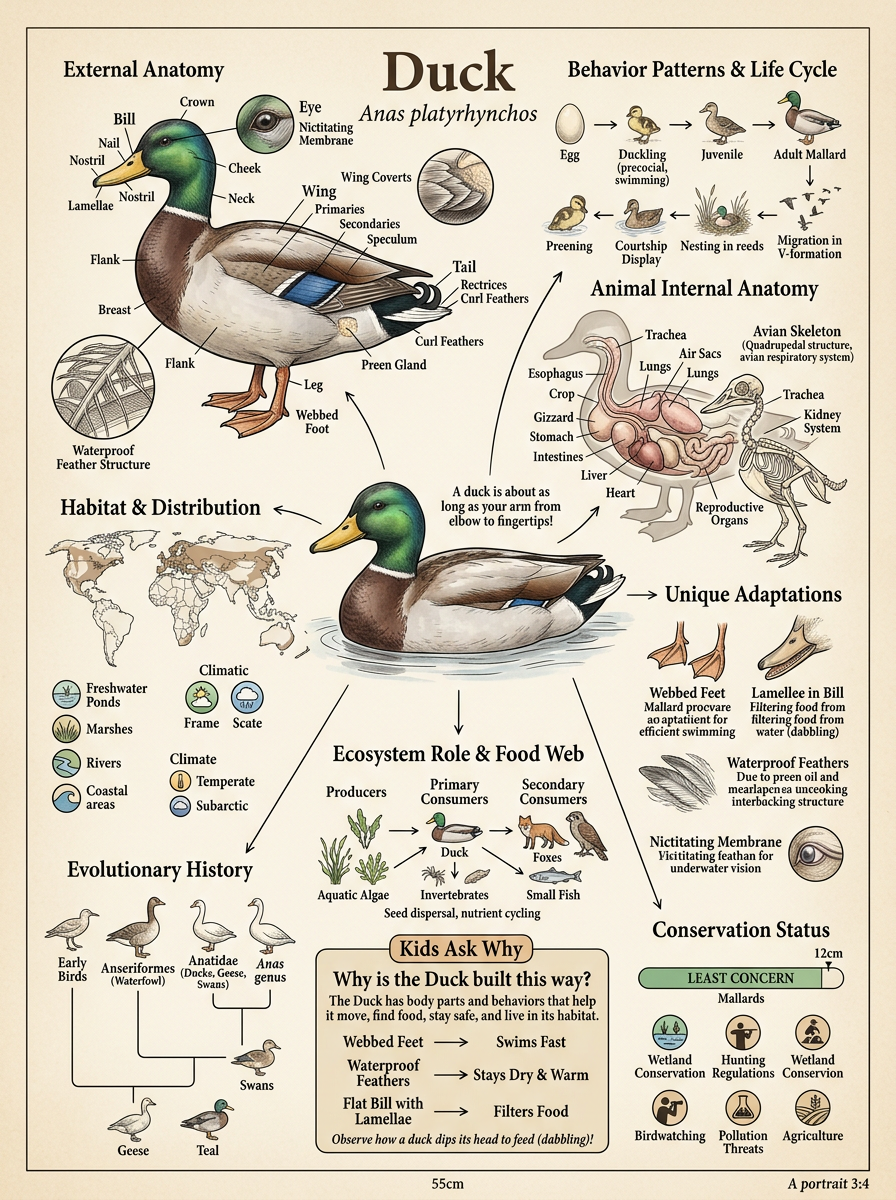
Page 5
Kids Ask Why Lab
Big Question
Why is the Duck built this way?
The Duck has body parts and behaviors that help it move, find food, stay safe, and live in its habitat.
How to diagram it
Connect one body part to one survival job with arrows and short labels.
Cause-and-effect arrows
1-minute activity
Choose one visible body part and ask what job it might help the animal do.
I noticed:
My answer in one sentence:
Draw your own explanation
Page 6
Comprehension + Drawing
1. What keeps a duck's feathers dry?
2. What is a baby duck called?
3. What do ducks use their webbed feet for?
4. Can ducks swim in cold water?
Draw and compare
Draw a duck swimming in a pond. Next to it, draw something that is about the same length as a duck (55 cm).
Page 7
Answer Key + Teaching Notes
Answer Key
- Special oil on their feathers.
- A duckling.
- To swim fast.
- Yes, because of their special feathers and oil.
- 35.0 cm.
Teaching Notes
- Encourage learners to make duck sounds (quack!) to engage them.
- For younger learners, focus on identifying colors and simple actions in the picture.
- Use gestures and actions when introducing new vocabulary words.
- Connect the size comparisons to real objects learners can touch and measure.
- Emphasize the 'why' behind duck adaptations for older children.
Extension Activity
Watch a short, child-friendly video about ducks swimming or eating to see their adaptations in action. Discuss what they observe.
Unlock the full Pro library
This comprehensive pack provides ready-to-use, age-appropriate materials and activities, eliminating the need for extensive lesson planning.