Free Printable Pack
Fish printable lesson pack
Free to print or save as PDF — no account needed. Go ad-free for $9.9 (one-time).
SizeRef Pro Pack
Fish
This comprehensive pack provides ready-to-use, age-differentiated activities for teaching English vocabulary and concepts related to 'Fish'.
Learning Goals
- Identify and name the object 'fish' in English.
- Describe basic physical characteristics and actions of a fish.
- Understand and use simple measurement comparisons related to fish.
- Develop vocabulary and sentence structure related to marine life.
Teacher / Parent Setup
Print all activity pages. Prepare a large picture of a fish and a standard ruler. Have crayons, pencils, and paper ready for learners.
Curiosity Focus
Why is the Fish built this way?
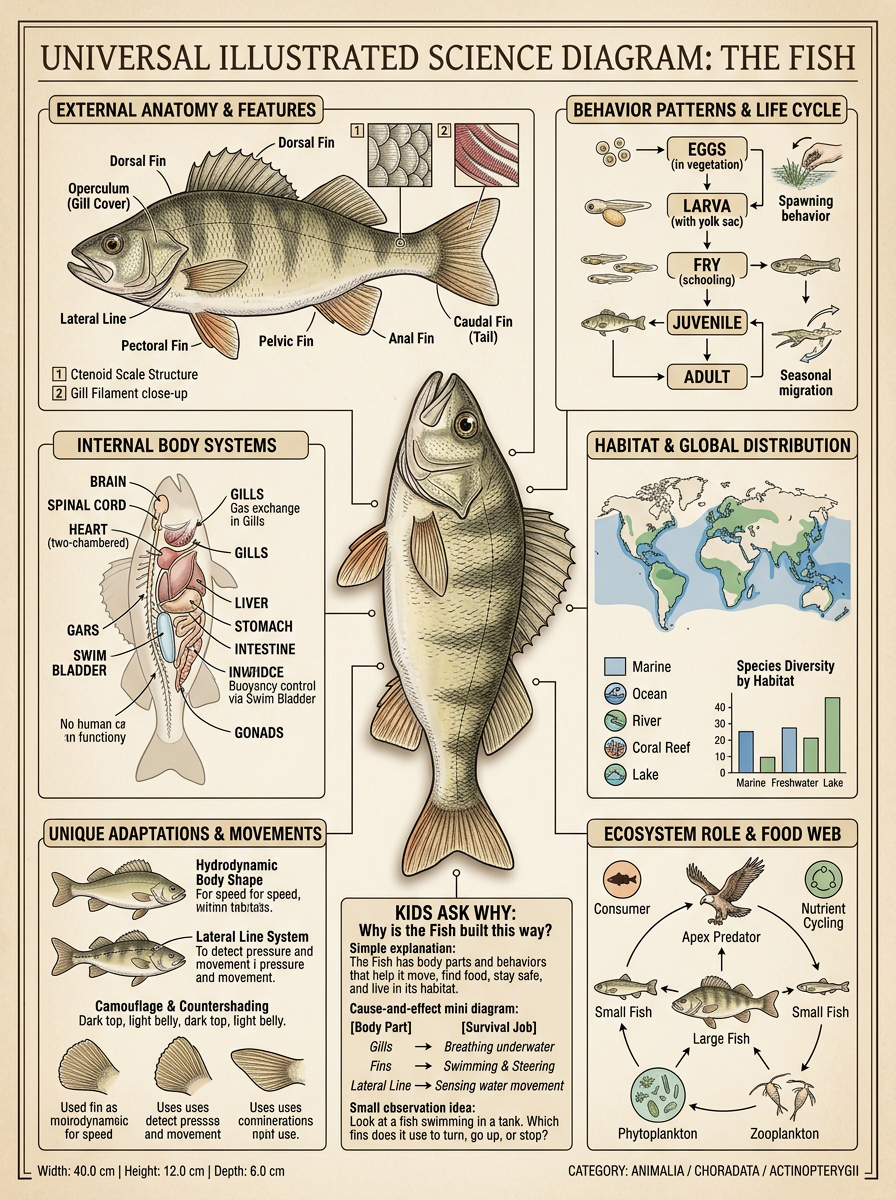
This pack includes a reviewed diagram poster and a Kids Ask Why page that turns curiosity into a short explanation and mini activity.

Page 2
Vocabulary Builder
My First Fish Fun
Fish
Trace the word 'fish' with your finger, then with a crayon. Say 'fish' each time you trace.
Look at the picture of the fish. What colors do you see? Point to its tail, its fins, and its eye.
Wiggle your body like a fish swimming in the water. Can you make a 'fish face'?
Fish Words & Sentences
A fish swims in the ocean.
This fish has shiny scales.
Fish use fins to move.
Write two sentences about what a fish can do or where it lives, using words from the word bank.
Word bank: swim · ocean · fins · scales · water · tail
Fish: Underwater Wonders
Fish are fascinating creatures that live in water all over the world. They have special body parts that help them survive in their aquatic homes. For example, fish use gills to breathe underwater, taking oxygen directly from the water, unlike humans who breathe air with lungs. Their streamlined bodies and strong fins help them swim fast and change direction quickly. Many fish are covered in scales, which protect thei...
How do a fish's body parts help it live and move in the water?
Page 3
Size Science Lab
Read the size clue
Imagine a fish that is 40 centimeters long – that's like two standard rulers laid end-to-end! This fish is also 12 centimeters tall, which is about the same height as your hand from your wrist to your fingertips. And it's 6 centimeters deep, which is like stacking two small toy blocks on top of each other. Wow! A fish is as long as your arm from elbow to fingertip! It swims in the ocean and is super yummy when cooked.
Quick Check
How many millimeters long is this fish?
Estimate
Without measuring, estimate how many of these fish would fit end-to-end on your classroom desk.
Compare the length of this fish (400mm) to the length of a common household object like a spoon or a shoe.
Page 4
Scientific Diagram Poster
Reviewed diagram
Fish Scientific Diagram with Kids Ask Why
Batch reviewed generated diagram for Pro Pack use. Check labels, Kids Ask Why panel, anatomy/context modules, and print readability.
2026-06-11
Page 5
Kids Ask Why Lab
Big Question
Why is the Fish built this way?
The Fish has body parts and behaviors that help it move, find food, stay safe, and live in its habitat.
How to diagram it
Connect one body part to one survival job with arrows and short labels.
Cause-and-effect arrows
1-minute activity
Choose one visible body part and ask what job it might help the animal do.
I noticed:
My answer in one sentence:
Draw your own explanation
Page 6
Comprehension + Drawing
1. What do fish use to breathe underwater?
2. Where do fish typically live?
3. What body parts help a fish swim fast?
4. How long is this fish in centimeters?
Draw and compare
Draw a fish. Then, draw something next to it that is about the same length as the fish (40 cm).
Page 7
Answer Key + Teaching Notes
Answer Key
- Fish use gills to breathe underwater.
- Fish typically live in the ocean, rivers, or lakes (water).
- Streamlined bodies and strong fins help a fish swim fast.
- This fish is 40 centimeters long.
- 400 millimeters.
Teaching Notes
- Encourage learners to act out the movements of a fish to reinforce vocabulary.
- Use visual aids like a real ruler or common objects to demonstrate the fish's dimensions.
- For older learners, discuss different types of fish and their unique adaptations.
- Emphasize the 'a' article for 'fish' as a single, countable noun.
- Connect the discussion of fish as 'food' to healthy eating habits.
Extension Activity
Watch a short, child-friendly video about fish in their natural habitat and identify new vocabulary words.
Unlock the full Pro library
This pack eliminates lesson planning time by providing structured, age-appropriate activities for a key vocabulary item.