Free Printable Pack
Flashlight printable lesson pack
Free to print or save as PDF — no account needed. Go ad-free for $9.9 (one-time).
SizeRef Pro Pack
Flashlight
This pack helps children learn English words and concepts about a flashlight, from basic identification to scientific principles.
Learning Goals
- Identify and name 'a flashlight' in English.
- Use 'flashlight' and related vocabulary in simple sentences.
- Understand the basic function and importance of a flashlight.
- Compare the size of a flashlight using standard measurements.
Teacher / Parent Setup
Prepare the printable activities. Gather a real flashlight to demonstrate its parts and function. Discuss flashlight safety before use, such as not shining it directly into eyes.
Curiosity Focus
Why does the Flashlight work the way it does?
This pack includes a reviewed diagram poster and a Kids Ask Why page that turns curiosity into a short explanation and mini activity.
Page 2
Vocabulary Builder
My First Flashlight Words
Flashlight
Trace the word 'flashlight' with your finger or a crayon. Say the word aloud as you trace.
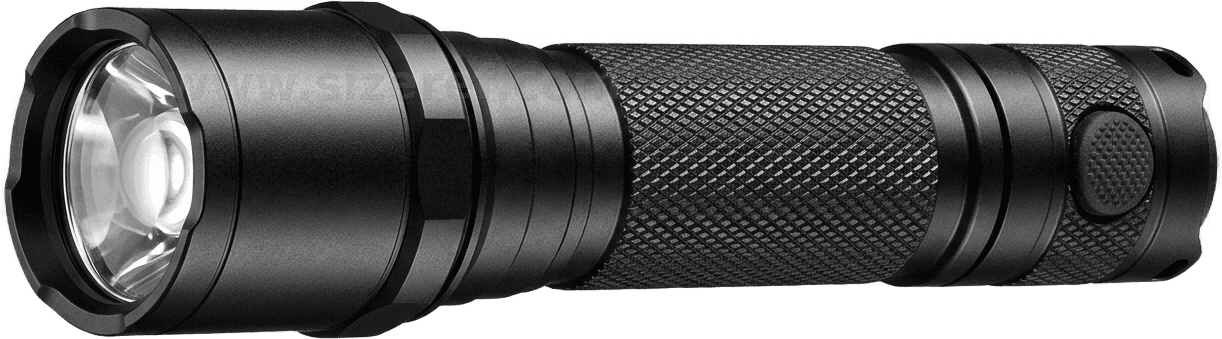
Look at the picture of the flashlight. Point to the part that makes light! Point to the button!
Hold your hands together like a flashlight. Make a 'click' sound and then pretend to shine your 'light' around the room.
Flashlight Sentences & Stories
I have a flashlight.
The flashlight makes light.
We use a flashlight in the dark.
Write one sentence about when you would use a flashlight.
Word bank: light · dark · button · batteries · shine · click
How Flashlights Work & Why We Need Them
A flashlight works by turning stored energy into light. Inside, batteries hold chemical energy. When you press the button, this energy flows to a small bulb or LED. The bulb gets hot and glows, making light. Our eyes need light to see. Without light, our eyes cannot collect enough information, so everything looks dark. Flashlights help us see in places where there is no natural light or electricity.
Why is it important to have a flashlight ready for emergencies like a power outage?
Page 3
Size Science Lab
Read the size clue
A typical flashlight is about 16.0 cm long. That's a little shorter than a standard pencil, which is usually around 19 cm. Its width and height are both 5.0 cm. Imagine holding a small soda can, but a bit shorter and narrower. You could fit about three flashlights side-by-side across a standard piece of paper. This size makes it easy to hold in one hand and carry in a backpack, but too big for a small pocket.
Quick Check
How long is this flashlight in centimeters?
Estimate
Estimate how many flashlights would fit end-to-end on your desk.
How is a flashlight's light different from a candle's light?
Page 4
Scientific Diagram Poster
Diagram worksheet page
Plan a clear diagram for Flashlight
Use this page to organize labels, parts, Kids Ask Why, context, and an answer legend before printing or teaching.
Review checklist
- Clear English labels
- No gibberish or fake logos
- Accurate Kids Ask Why panel
- Safe classroom-friendly image
- Good print readability
Page 5
Kids Ask Why Lab
Big Question
Why does the Flashlight work the way it does?
The Flashlight works because its shape, materials, parts, and forces fit together to solve a real-world problem.
How to diagram it
Use arrows to connect the main parts to their jobs, then show the input and output.
Cause-and-effect arrows
1-minute activity
Find one part of the object and explain what would happen if that part was missing.
I noticed:
My answer in one sentence:
Draw your own explanation
Page 6
Comprehension + Drawing
1. What do you use a flashlight for?
2. What sound does a flashlight make when you turn it on?
3. What does a flashlight need to work?
4. Can you see in the dark without a flashlight?
Draw and compare
Draw a picture of a flashlight lighting up a dark room. Show what you can see because of the light.
Page 7
Answer Key + Teaching Notes
Answer Key
- 16.0 cm
- To see in the dark, to find things, for emergencies.
- A click.
- Batteries.
- No, our eyes need light to see.
Teaching Notes
- Use a real flashlight to demonstrate its parts (head, body, switch, light) and how it works.
- Emphasize safety: never shine a flashlight directly into someone's eyes.
- Encourage hands-on exploration. Let children turn the flashlight on and off.
- Adapt activities to the child's English level. Focus on key vocabulary first.
- Connect to real-world uses: camping, finding things under the bed, power outages.
Extension Activity
Go on a 'dark room' scavenger hunt. Turn off the lights in a safe room and use a flashlight to find hidden objects.
Unlock the full Pro library
This pack offers ready-to-use, age-appropriate activities, saving valuable lesson planning time for busy parents and teachers.