Free Printable Pack
Frog printable lesson pack
Free to print or save as PDF — no account needed. Go ad-free for $9.9 (one-time).
SizeRef Pro Pack
Frog
Engaging, multi-age lessons designed to teach English vocabulary, science, and size comparison using the amazing frog.
Learning Goals
- Identify and name the animal 'frog' in English.
- Learn new vocabulary related to frogs and their environment.
- Understand basic facts about frogs and their incredible jumping ability.
- Practice comparing sizes using real-world objects and measurements.
Teacher / Parent Setup
Print all activity sheets. Gather a ruler, a picture of a frog, and a small smartphone or similar object for size comparison. Prepare to guide students through various activities.
Curiosity Focus
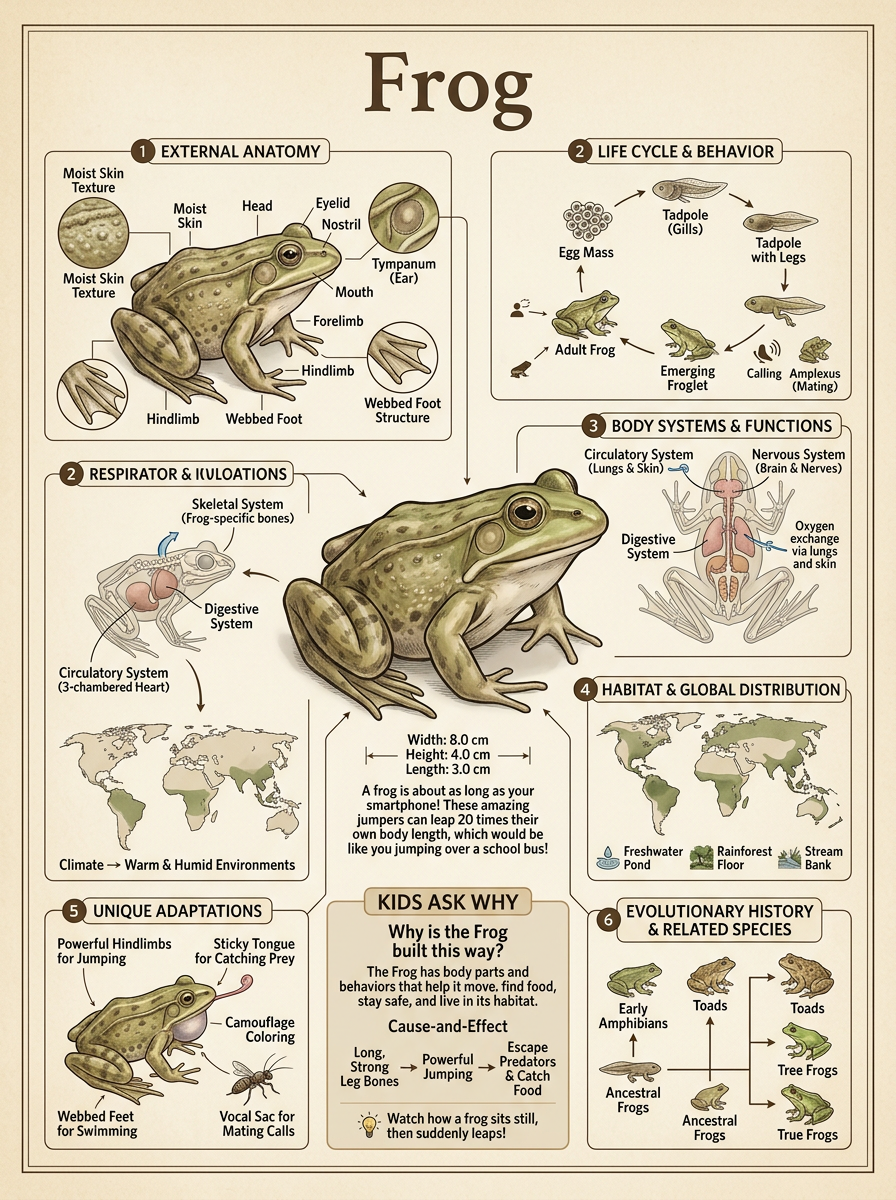
Why is the Frog built this way?
This pack includes a reviewed diagram poster and a Kids Ask Why page that turns curiosity into a short explanation and mini activity.

Page 2
Vocabulary Builder
Little Frog Learners
Frog
Trace the letters 'F-R-O-G' to spell the word 'frog'.
Look at the frog picture. What color is the frog? Can you point to its big eyes?
Let's jump like a frog! Say 'Ribbit!' each time you jump.
Frog Facts & Fun
A frog is an amphibian.
Frogs have strong back legs for jumping.
They often live near ponds and lakes.
Write one sentence about what a frog can do or where it lives.
Word bank: frog · jump · green · water · insect · pond
Amazing Frog Science
Frogs are incredible athletes, especially when it comes to jumping! Their powerful back legs are like coiled springs, allowing them to push off the ground with immense force. This amazing ability helps them catch fast-moving insects for food and escape quickly from predators. A frog can leap up to 20 times its own body length, which is an astonishing feat. Imagine if you could jump over a school bus! This unique skil...
How does a frog's ability to jump so far help it survive in its natural habitat?
Page 3
Size Science Lab
Read the size clue
A typical frog is about 80 millimeters (or 8.0 centimeters) long, which is roughly the same length as a small smartphone. Imagine holding a frog in your hand – it's quite compact! Its height is around 40 millimeters (4.0 centimeters), similar to stacking two small coins. The depth, or how thick it is, is about 30 millimeters (3.0 centimeters), which is close to the thickness of a small paperback book. These measurements show that frogs are small but very agile creatures, perfectly designed for their environment and...
Quick Check
What is the approximate length of a frog in millimeters?
Estimate
Hold up your index finger. Try to show with your thumb and finger how long you think 80mm is.
Find an object in the classroom or home that is about 40mm tall. What did you find?
Page 4
Scientific Diagram Poster
Reviewed diagram
Frog Scientific Diagram with Kids Ask Why
Batch reviewed generated diagram for Pro Pack use. Check labels, Kids Ask Why panel, anatomy/context modules, and print readability.
2026-06-11
Page 5
Kids Ask Why Lab
Big Question
Why is the Frog built this way?
The Frog has body parts and behaviors that help it move, find food, stay safe, and live in its habitat.
How to diagram it
Connect one body part to one survival job with arrows and short labels.
Cause-and-effect arrows
1-minute activity
Choose one visible body part and ask what job it might help the animal do.
I noticed:
My answer in one sentence:
Draw your own explanation
Page 6
Comprehension + Drawing
1. What animal are we learning about?
2. Can frogs jump far?
3. Where do frogs often live?
4. What do frogs eat?
Draw and compare
Draw a frog. Next to your frog, draw something that is about 80mm long, like a small smartphone.
Page 7
Answer Key + Teaching Notes
Answer Key
- Frog
- Yes, they can jump very far.
- Near water, like ponds and lakes.
- Small insects.
- 80mm.
Teaching Notes
- Encourage students to make frog sounds and mimic frog jumps to engage kinesthetic learners.
- Use a real ruler and physical objects (like a smartphone) to demonstrate the frog's dimensions.
- Adapt the complexity of discussions and writing tasks based on the student's English proficiency.
- Show a short, age-appropriate video of a frog jumping or catching an insect.
- Review new vocabulary words frequently through flashcards or games.
Extension Activity
Research different types of frogs from around the world and draw one, noting its unique features.
Unlock the full Pro library
This pack provides ready-to-use, age-appropriate activities and detailed instructions, saving hours of lesson planning and research time.