Free Printable Pack
Glider printable lesson pack
Free to print or save as PDF — no account needed. Go ad-free for $9.9 (one-time).
SizeRef Pro Pack
Glider
This Pro Pack offers engaging, age-appropriate activities to teach English vocabulary and concepts related to gliders, saving you valuable preparation time.
Learning Goals
- Identify and name a glider.
- Understand how a glider flies without an engine.
- Compare the size of a glider to familiar objects.
- Use new vocabulary related to gliders in sentences.
Teacher / Parent Setup
Print all pages for the relevant age groups. Prepare drawing materials and a clear space for movement activities. Review the answer key before starting the lesson.
Curiosity Focus
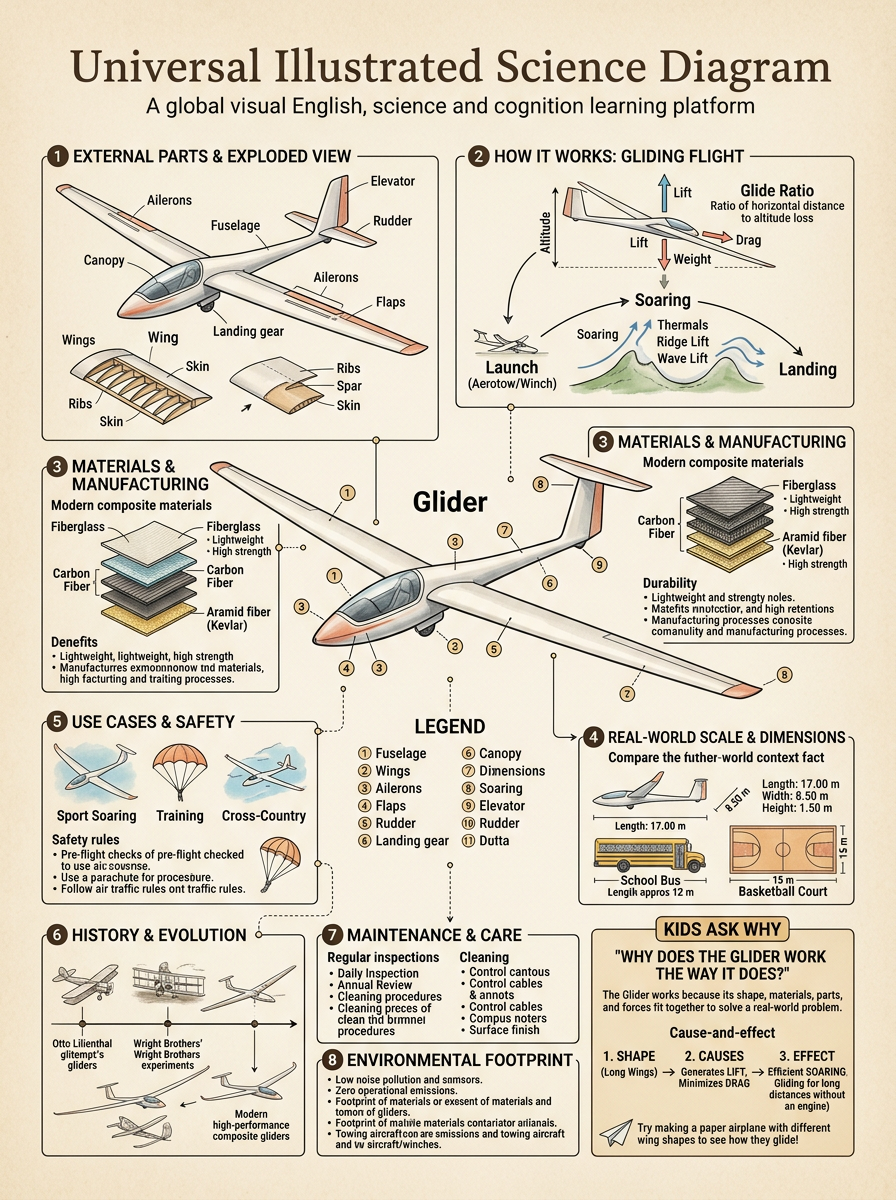
Why does the Glider work the way it does?
This pack includes a reviewed diagram poster and a Kids Ask Why page that turns curiosity into a short explanation and mini activity.

Page 2
Vocabulary Builder
Little Explorers: Glider Fun
Glider
Trace the word 'glider' with your finger or a crayon.
Look at the glider picture. What do you see? Point to the long wings. Point to the tail.
Flap your arms slowly like glider wings. Pretend to soar quietly through the air like a glider.
Young Learners: Glider Adventures
A glider is an aircraft that flies without an engine.
Gliders use wind and rising air to stay high in the sky.
It has long, thin wings that help it soar gracefully.
Write two sentences about what you would see if you were flying in a glider.
Word bank: glider · fly · wings · sky · wind · soar
Junior Scientists: Glider Flight
Gliders are amazing aircraft that fly without an engine! They use clever science principles to stay in the air. When air moves over the special shape of the glider's wings, it creates 'lift,' pushing the glider up. Pilots find rising air currents, like invisible elevators, to gain height. This allows gliders to 'soar' for hours, using only the power of nature. It's like riding a bicycle downhill, but in the sky!
How is a glider like a bird? How is it different?
Page 3
Size Science Lab
Read the size clue
Wow! A glider is as long as a school bus, measuring 17 meters (17000mm) from nose to tail. That's a really long vehicle! Its wings are incredibly wide, spanning 8.5 meters (8500mm). This is wider than a basketball court! Imagine how much sky it covers. The glider's height is 1.5 meters (1500mm), which is about the same height as a tall refrigerator. These big dimensions help it catch the wind and soar high.
Quick Check
How long is a glider in meters?
Estimate
Estimate how many children, lying head-to-toe, would fit along the length of a glider.
Compare the width of a glider's wings to the width of your classroom door.
Page 4
Scientific Diagram Poster
Reviewed diagram
Glider Scientific Diagram with Kids Ask Why
Batch reviewed generated diagram for Pro Pack use. Check labels, Kids Ask Why panel, anatomy/context modules, and print readability.
2026-06-11
Page 5
Kids Ask Why Lab
Big Question
Why does the Glider work the way it does?
The Glider works because its shape, materials, parts, and forces fit together to solve a real-world problem.
How to diagram it
Use arrows to connect the main parts to their jobs, then show the input and output.
Cause-and-effect arrows
1-minute activity
Find one part of the object and explain what would happen if that part was missing.
I noticed:
My answer in one sentence:
Draw your own explanation
Page 6
Comprehension + Drawing
1. What is special about a glider compared to an airplane?
2. How does a glider stay in the air?
3. Can a glider fly without wind?
4. What is one thing you learned about gliders?
Draw and compare
Draw a glider flying high in the sky. Add something small next to it to show how big the glider is.
Page 7
Answer Key + Teaching Notes
Answer Key
- A glider does not have an engine.
- It uses wind and rising air currents to create lift and soar.
- No, gliders need wind and rising air to fly.
- (Accept any reasonable answer, e.g., Gliders are very long, they have wide wings, they don't have an engine.)
- (Accept any reasonable estimate for children, e.g., 10-12 children, based on average child height.)
Teaching Notes
- Encourage children to use the word 'glider' often in their speech.
- Use visuals like pictures or short videos of gliders flying to enhance understanding.
- For younger learners, focus on the core concept of 'no engine' and 'flying like a bird.'
- Emphasize the verb 'soar' to describe the glider's graceful flight.
- Adapt activities to suit individual learner needs and attention spans.
Extension Activity
Research different types of gliders or famous glider pilots. Create a poster or a short presentation about what you find.
Unlock the full Pro library
This pack provides ready-to-use, differentiated content, eliminating the need for extensive lesson planning.