Free Printable Pack
Ham printable lesson pack
Free to print or save as PDF — no account needed. Go ad-free for $9.9 (one-time).
SizeRef Pro Pack
Ham
This Pro Pack offers comprehensive, multi-age activities to teach English vocabulary and science concepts using the object 'Ham'.
Learning Goals
- Identify and name the object 'Ham' in English.
- Understand basic characteristics and uses of ham.
- Develop early literacy skills through tracing and sentence building.
- Explore size, measurement, and food science concepts related to ham.
Teacher / Parent Setup
Print all activity pages. Gather a ruler, a large book, and drawing supplies. Prepare to show a picture of a whole ham and sliced ham.
Curiosity Focus
Why does the Ham work the way it does?
This pack includes a reviewed diagram poster and a Kids Ask Why page that turns curiosity into a short explanation and mini activity.

Page 2
Vocabulary Builder
My First Ham Words
Ham
Trace the letters to write the word: Ham. Say 'Ham' out loud!
Look at the picture of the ham. What colors do you see? Can you point to the skin and the meat?
Point to your leg. Say 'Ham comes from a pig's leg!' Now, pretend to slice a ham with your hand.
Ham Sentences & Stories
A ham is a big piece of meat.
It often comes from a pig.
Many families eat ham for special meals.
Write two sentences about your favorite way to eat ham or a special meal where you might see ham.
Word bank: ham · meat · pig · slice · eat · dinner
The Science of Ham
Ham is a type of meat that comes from the leg of a pig. To become ham, the meat is often 'cured.' Curing means treating the meat with salt, sugar, and sometimes other ingredients to preserve it and add flavor. This process helps the ham last longer and gives it a distinct taste and texture. Sometimes, ham is also smoked over wood, which adds another layer of flavor and helps with preservation. This ancient method of...
Why do you think people developed ways to preserve food like curing ham, especially before refrigerators were common?
Page 3
Size Science Lab
Read the size clue
A whole ham is about 350mm (35.0 cm) long. That's a bit longer than a standard school ruler! It's also 200mm (20.0 cm) high, which is like stacking two tall juice boxes. The depth is 150mm (15.0 cm), as thick as a big chapter book or a stack of five apples. So, a ham is a pretty big piece of food, much larger than a sandwich slice. Imagine carrying something this big!
Quick Check
How many centimeters long is a whole ham?
Estimate
Without measuring, find an object in your room that you think is about 20 cm tall, like a ham. Then measure it to see how close you were!
Is a ham longer or shorter than your forearm? How is its thickness different from a small snack bag?
Page 4
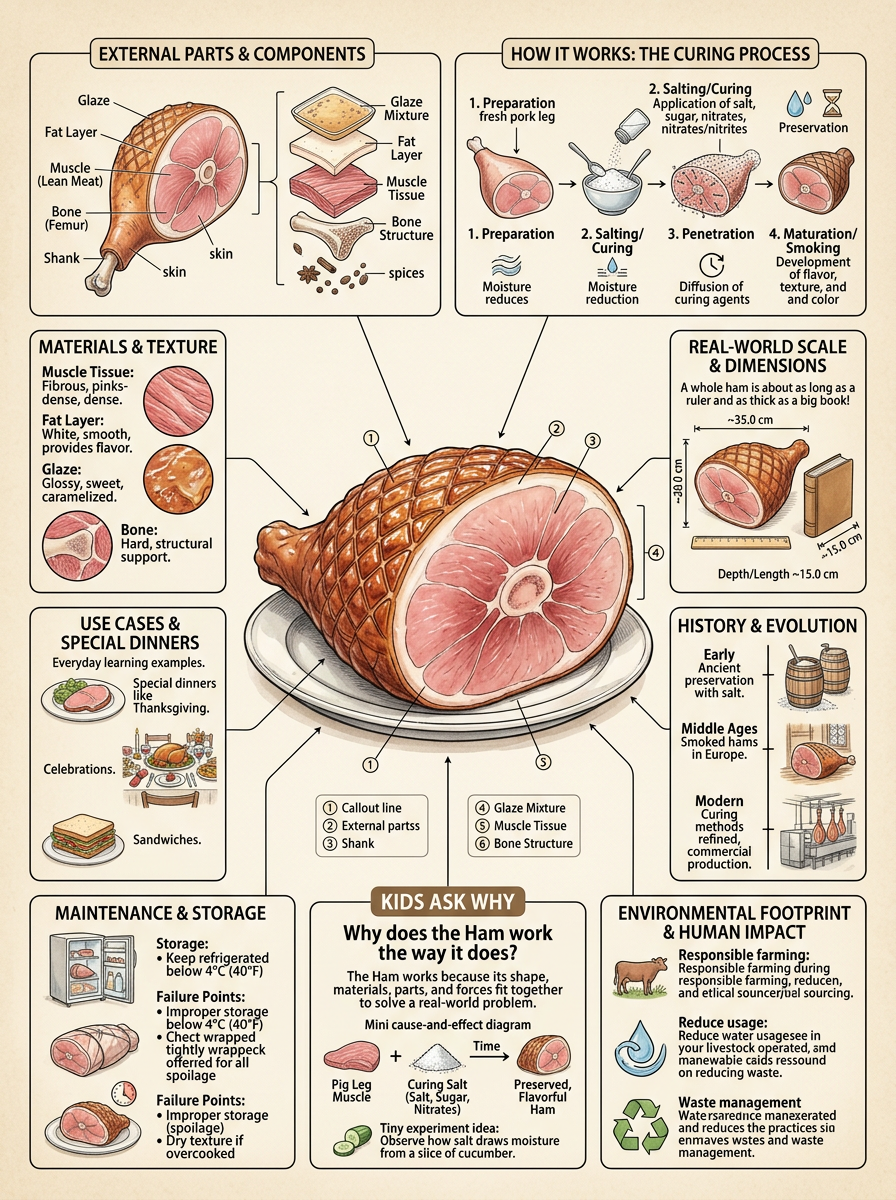
Scientific Diagram Poster
Reviewed diagram
Ham Scientific Diagram with Kids Ask Why
Batch reviewed generated diagram for Pro Pack use. Check labels, Kids Ask Why panel, anatomy/context modules, and print readability.
2026-06-11
Page 5
Kids Ask Why Lab
Big Question
Why does the Ham work the way it does?
The Ham works because its shape, materials, parts, and forces fit together to solve a real-world problem.
How to diagram it
Use arrows to connect the main parts to their jobs, then show the input and output.
Cause-and-effect arrows
1-minute activity
Find one part of the object and explain what would happen if that part was missing.
I noticed:
My answer in one sentence:
Draw your own explanation
Page 6
Comprehension + Drawing
1. What kind of animal does ham come from?
2. What is one special occasion when people often eat ham?
3. What does 'curing' do to the ham?
4. Can you eat ham hot or cold?
Draw and compare
Draw a picture of a ham on a dinner table. Next to it, draw something else that is about the same length as the ham (35 cm).
Page 7
Answer Key + Teaching Notes
Answer Key
- A whole ham is 35.0 cm long.
- Ham comes from a pig.
- People often eat ham at special dinners like Thanksgiving.
- Curing preserves the ham and adds flavor.
- Yes, you can eat ham hot or cold.
Teaching Notes
- Use a visual aid (picture or real object) for 'ham' throughout the lesson.
- Encourage learners to use their senses (imagine smell, taste, touch) when discussing ham.
- For younger learners, focus on the 'big' and 'yummy' aspects of ham.
- When discussing measurements, use real-world objects for comparison to make it tangible.
- Connect the discussion of ham to personal experiences, like family meals or holidays.
Extension Activity
Research different types of ham (e.g., prosciutto, serrano, smoked ham) and discuss how they are similar or different.
Unlock the full Pro library
This pack provides ready-to-use, age-differentiated activities, saving parents and teachers significant lesson planning time.