Free Printable Pack
Hen printable lesson pack
Free to print or save as PDF — no account needed. Go ad-free for $9.9 (one-time).
SizeRef Pro Pack
Hen
This pack offers comprehensive English, science, and cognitive activities centered around a hen.
Learning Goals
- Identify and name a hen.
- Describe a hen's characteristics and actions.
- Understand basic hen-related vocabulary.
- Compare the size of a hen to familiar objects.
Teacher / Parent Setup
Print all pages. Prepare crayons, pencils, and paper. Gather a ruler or measuring tape for science activities.
Curiosity Focus
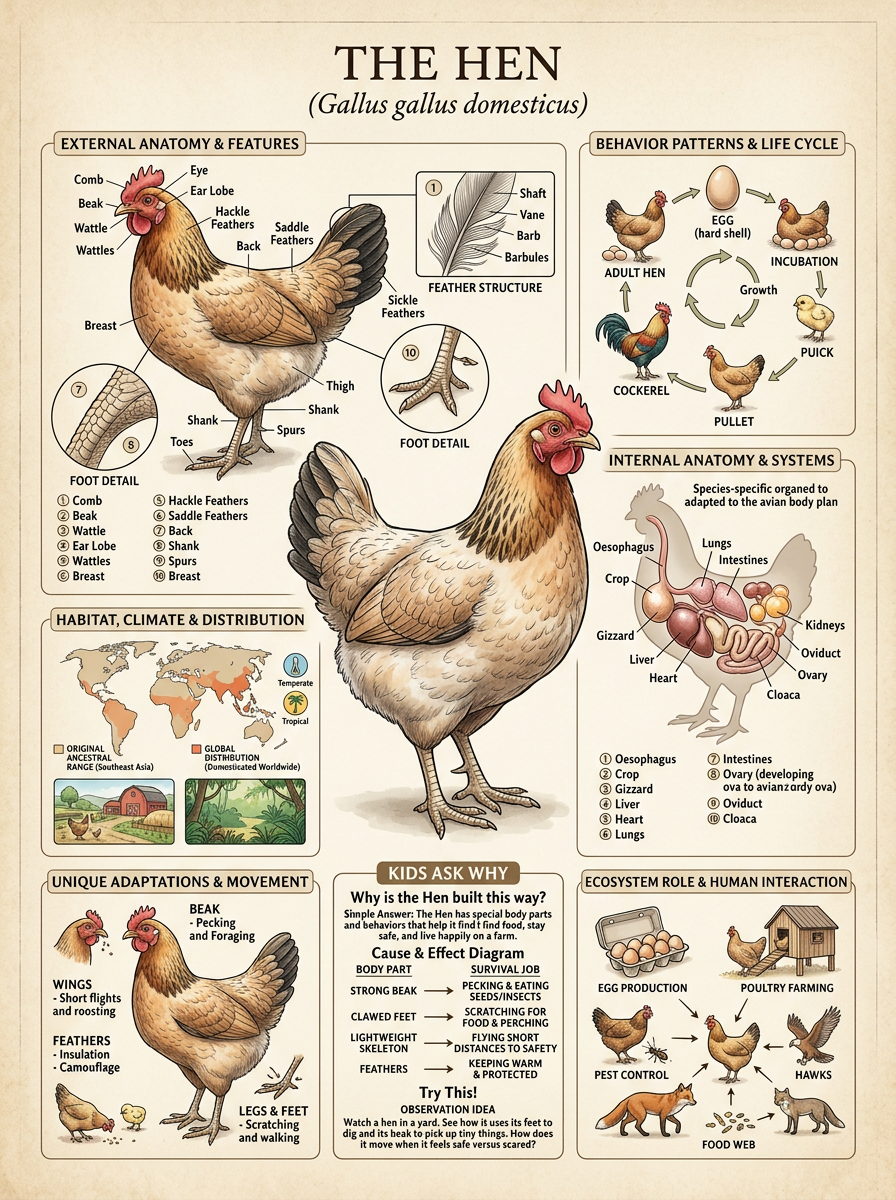
Why is the Hen built this way?
This pack includes a reviewed diagram poster and a Kids Ask Why page that turns curiosity into a short explanation and mini activity.

Page 2
Vocabulary Builder
Little Hen Explorers
Hen
Trace the word 'hen' with your finger, then with a crayon.
Look at the hen picture. What colors do you see? What is the hen doing?
Flap your arms like a hen's wings! Make a 'cluck cluck' sound.
Hen Word Fun
A hen lives on a farm.
A hen has feathers and wings.
A hen lays eggs.
Write two sentences about what a hen does.
Word bank: hen · farm · eggs · feathers · cluck · nest
Hen Facts and Thinking
Hens are fascinating birds known for laying eggs. They are omnivores, meaning they eat both plants and small insects. A hen uses her strong legs to scratch the ground, looking for food. Hens also have excellent hearing and vision, which helps them find food and stay safe from predators. They communicate with each other using many different clucks and calls, showing how intelligent these farm animals truly are. Their...
Why do you think hens are important to humans?
Page 3
Size Science Lab
Read the size clue
A hen is about 38.0 cm wide, which is like the length of two standard rulers placed end-to-end. Its height is about 43.0 cm, similar to a small pillow standing upright. The hen's depth is around 15.0 cm, which is close to the width of your hand. Think about how a hen is about as long as your arm from elbow to fingertips! This friendly farm bird is not too big, making it easy for them to move around and scratch for food. Knowing their size helps us understand their natural habitat and how they interact with their en...
Quick Check
How tall is a hen in centimeters?
Estimate
Estimate how many hens could fit side-by-side on a meter-long fence.
Compare the hen's height to the height of a common household object like a milk carton or a book.
Page 4
Scientific Diagram Poster
Reviewed diagram
Hen Scientific Diagram with Kids Ask Why
Batch reviewed generated diagram for Pro Pack use. Check labels, Kids Ask Why panel, anatomy/context modules, and print readability.
2026-06-11
Page 5
Kids Ask Why Lab
Big Question
Why is the Hen built this way?
The Hen has body parts and behaviors that help it move, find food, stay safe, and live in its habitat.
How to diagram it
Connect one body part to one survival job with arrows and short labels.
Cause-and-effect arrows
1-minute activity
Choose one visible body part and ask what job it might help the animal do.
I noticed:
My answer in one sentence:
Draw your own explanation
Page 6
Comprehension + Drawing
1. What animal is this lesson about?
2. Where does a hen usually live?
3. What sound does a hen make?
4. What does a hen lay for us to eat?
Draw and compare
Draw a hen and something it likes to eat. How big is your drawing compared to a real hen?
Page 7
Answer Key + Teaching Notes
Answer Key
- The hen is 43.0 cm tall.
- A hen usually lives on a farm.
- A hen makes a 'cluck, cluck' sound.
- A hen lays eggs.
- About 2-3 hens (100cm / 38cm width ≈ 2.6 hens).
Teaching Notes
- Encourage students to share personal experiences with hens or farms.
- Use real-life objects for size comparisons whenever possible.
- Emphasize the 'cluck, cluck' sound for younger learners.
- Discuss the importance of hens in providing food.
- Adapt activities for individual learner needs and English proficiency.
Extension Activity
Watch a short video about hens on a farm and discuss what they saw.
Unlock the full Pro library
This pack provides ready-to-use, age-differentiated activities, saving hours of lesson planning.