Free Printable Pack
Ibis printable lesson pack
Free to print or save as PDF — no account needed. Go ad-free for $9.9 (one-time).
SizeRef Pro Pack
Ibis
This pack makes learning about the fascinating ibis fun and easy for all ages and learning styles.
Learning Goals
- Identify an ibis and its key features.
- Understand how an ibis uses its beak to find food.
- Practice English vocabulary related to animals and nature.
- Develop early science observation and measurement skills.
Teacher / Parent Setup
Print the lesson pack materials. Prepare a visual aid of an ibis, either a picture or a toy. Have pencils, crayons, and paper ready for activities.
Curiosity Focus
Why is the Ibis built this way?
This pack includes a reviewed diagram poster and a Kids Ask Why page that turns curiosity into a short explanation and mini activity.

Page 2
Vocabulary Builder
Little Learners: Meet the Ibis
Ibis
Trace the word 'Ibis' with your finger or a crayon.
Look at the ibis picture. What color is its body? What does its beak look like?
Point to the ibis's long, curved beak. Now, pretend your arm is an ibis beak and 'probe' the floor for snacks!
Young Explorers: Ibis Facts
An ibis is a bird with long legs and a long, curved beak.
They live near water, like marshes and rivers.
Ibises use their special beaks to find food in the mud.
Write one sentence about what an ibis eats, using words from the word bank.
Word bank: ibis · beak · mud · crabs · long · bird
Deep Dive Discoveries: Ibis Adaptations
The ibis's unique, curved beak is a perfect example of adaptation in nature. This specialized tool allows them to probe deep into soft mud and sand, feeling for hidden prey that other birds cannot reach. Their long legs also help them wade in shallow water without getting their bodies wet. This combination of features makes the ibis a highly efficient hunter in its wetland habitat, demonstrating how animals evolve to...
How does the ibis's long, curved beak help it survive better than a bird with a short, straight beak in the same environment?
Page 3
Size Science Lab
Read the size clue
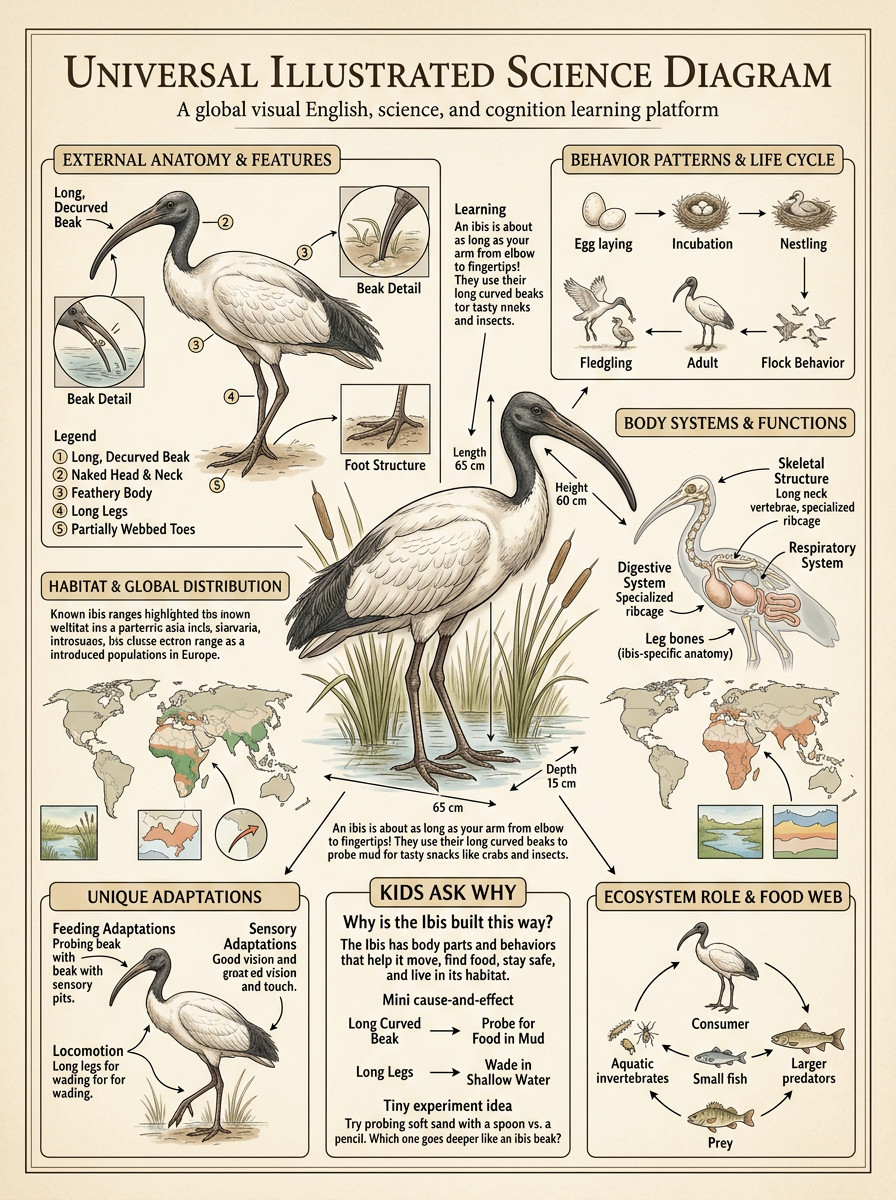
Imagine an ibis standing next to you! It can be about 60 centimeters (600mm) tall, which is like the length of a large school ruler. From its head to its tail, an ibis can be about 65 centimeters (650mm) long – that's almost as long as your arm from your elbow to your fingertips! Its body is not very wide, only about 15 centimeters (150mm), making it sleek for moving through reeds.
Quick Check
How tall can an ibis be in centimeters?
Estimate
If an ibis is 60cm tall, would it be taller or shorter than your knee? Make a guess!
Find an object in your classroom or home that is about 15cm wide. How does this compare to the width of an ibis?
Page 4
Scientific Diagram Poster
Reviewed diagram
Ibis Scientific Diagram with Kids Ask Why
Batch reviewed generated diagram for Pro Pack use. Check labels, Kids Ask Why panel, anatomy/context modules, and print readability.
2026-06-11
Page 5
Kids Ask Why Lab
Big Question
Why is the Ibis built this way?
The Ibis has body parts and behaviors that help it move, find food, stay safe, and live in its habitat.
How to diagram it
Connect one body part to one survival job with arrows and short labels.
Cause-and-effect arrows
1-minute activity
Choose one visible body part and ask what job it might help the animal do.
I noticed:
My answer in one sentence:
Draw your own explanation
Page 6
Comprehension + Drawing
1. What kind of beak does an ibis have?
2. Where do ibises typically look for food?
3. Name two things an ibis might eat.
4. How long is an ibis compared to your arm?
Draw and compare
Draw an ibis using its long beak to find food. What kind of food did it find?
Page 7
Answer Key + Teaching Notes
Answer Key
- An ibis has a long, curved beak.
- Ibises look for food in mud or shallow water.
- An ibis might eat crabs, insects, or small fish.
- An ibis is about as long as your arm from your elbow to your fingertips.
- An ibis can be 60 centimeters tall.
Teaching Notes
- For younger learners, focus on the visual aspects of the ibis and simple actions like 'probing'.
- Encourage older children to use descriptive words when talking about the ibis's beak and its function.
- Use a measuring tape to show the actual dimensions of the ibis to help students visualize its size.
- Discuss the importance of wetlands as habitats for animals like the ibis.
- Remind students that 'an' is used before 'ibis' because the 'i' makes an 'ih' sound, like a vowel.
Extension Activity
Research different types of ibises around the world. How are they similar or different in appearance and habitat?
Unlock the full Pro library
This pack provides ready-to-use, age-appropriate activities and content, saving parents and teachers valuable preparation time.