Free Printable Pack
Kangaroo printable lesson pack
Free to print or save as PDF — no account needed. Go ad-free for $9.9 (one-time).
SizeRef Pro Pack
Kangaroo
Discover the amazing world of kangaroos through engaging activities and visual learning for all ages.
Learning Goals
- Identify and name a kangaroo in English.
- Describe key physical features and actions of a kangaroo.
- Understand the approximate size of a kangaroo using familiar comparisons.
- Learn basic facts about kangaroos and their unique adaptations.
Teacher / Parent Setup
Print the activity sheets and gather drawing supplies like crayons or pencils. Have a large picture or video of a kangaroo ready to show. Prepare a space for movement activities.
Curiosity Focus
Why is the Kangaroo built this way?
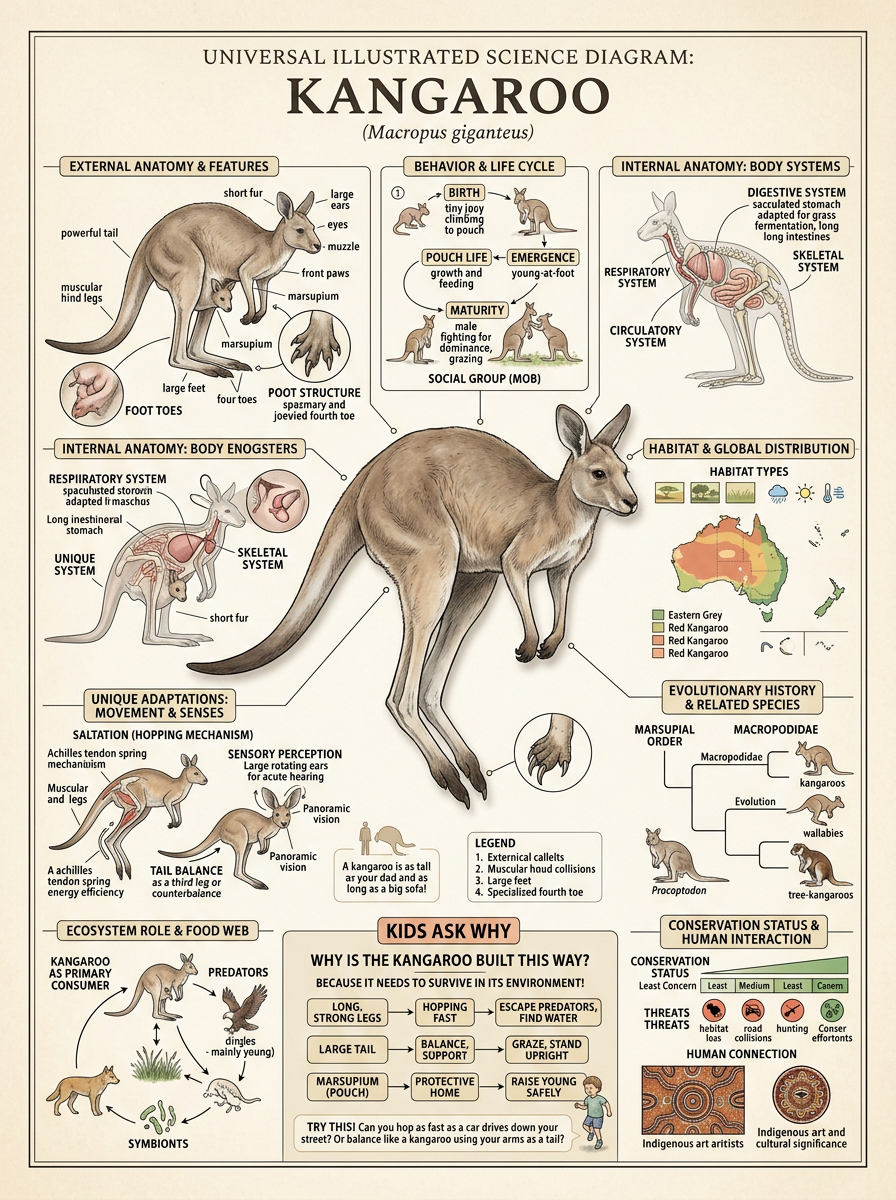
This pack includes a reviewed diagram poster and a Kids Ask Why page that turns curiosity into a short explanation and mini activity.

Page 2
Vocabulary Builder
Little Joey's First Look
Kangaroo
Use your finger or a crayon to trace the word 'KANGAROO' on the page.
Look at the picture of the kangaroo. What color is it? Can you see its big feet and long tail?
Let's hop like a kangaroo! Can you point to the kangaroo's pouch where the baby lives?
Kangaroo Word Explorer
A kangaroo has strong legs for hopping.
Baby kangaroos are called joeys and live in a pouch.
Kangaroos live in Australia.
Choose three words from the word bank and write one sentence about a kangaroo.
Word bank: hop · pouch · joey · Australia · tall · strong
Kangaroo Science & Superpowers
Kangaroos are famous for their powerful hopping. They use their very strong back legs and long tail to balance and push off the ground. This unique way of moving, called saltation, is very energy efficient. When a kangaroo hops faster, it actually uses less energy than if it were moving slowly. Their tendons act like giant springs, storing and releasing energy with each bounce, making them amazing travelers in their...
Why do you think hopping is a good way for kangaroos to travel long distances or escape danger?
Page 3
Size Science Lab
Read the size clue
Imagine a kangaroo! It can be as tall as your dad, about 1.60 meters (1600mm) high. If it stretches out, it's as long as a big sofa, around 2.50 meters (2500mm) from nose to tail. From front to back, it's about 0.50 meters (500mm) deep. These amazing animals can hop as fast as a car drives down your street, reaching speeds of over 50 kilometers per hour! Their size and speed help them survive in the vast Australian outback.
Quick Check
How tall can a kangaroo be in meters?
Estimate
How many of your shoes would you need to line up to match the length of a kangaroo?
Is a kangaroo taller or shorter than a regular bicycle?
Page 4
Scientific Diagram Poster
Reviewed diagram
Kangaroo Scientific Diagram with Kids Ask Why
Batch reviewed generated diagram for Pro Pack use. Check labels, Kids Ask Why panel, anatomy/context modules, and print readability.
2026-06-11
Page 5
Kids Ask Why Lab
Big Question
Why is the Kangaroo built this way?
The Kangaroo has body parts and behaviors that help it move, find food, stay safe, and live in its habitat.
How to diagram it
Connect one body part to one survival job with arrows and short labels.
Cause-and-effect arrows
1-minute activity
Choose one visible body part and ask what job it might help the animal do.
I noticed:
My answer in one sentence:
Draw your own explanation
Page 6
Comprehension + Drawing
1. What is a baby kangaroo called?
2. Where do kangaroos live?
3. What do kangaroos eat?
4. What special body part helps a kangaroo carry its baby?
Draw and compare
Draw a kangaroo next to something you know well, like your house or a car, to show how big it is.
Page 7
Answer Key + Teaching Notes
Answer Key
- A baby kangaroo is called a joey.
- Kangaroos live in Australia.
- Kangaroos eat grass and plants.
- A kangaroo uses its pouch to carry its baby.
- A kangaroo can be about 1.60 meters tall.
Teaching Notes
- Encourage learners to mimic kangaroo hops during the movement activity.
- Use a ruler or tape measure to show 1.60m and 2.50m in the room for a concrete size comparison.
- Point out the unique features of a kangaroo in pictures or videos, like its tail and powerful legs.
- For older learners, discuss the concept of 'marsupial' and how kangaroos are different from other mammals.
- Adapt activities to suit individual learner needs; simplify language or provide extra support as required.
Extension Activity
Watch a short, educational video about kangaroos and discuss three new facts learned.
Unlock the full Pro library
This pack provides ready-to-use, age-differentiated activities and science insights, saving valuable preparation time for busy educators and parents.