Free Printable Pack
Kingfisher printable lesson pack
Free to print or save as PDF — no account needed. Go ad-free for $9.9 (one-time).
SizeRef Pro Pack
Kingfisher
This premium pack offers ready-to-teach English and science lessons about the kingfisher, tailored for diverse age groups.
Learning Goals
- Identify and name a kingfisher in English.
- Describe key physical features and behaviors of a kingfisher.
- Understand the approximate size of a kingfisher using familiar comparisons.
- Expand vocabulary related to birds, nature, and action verbs.
Teacher / Parent Setup
Print the Kingfisher picture and activity sheets. Gather crayons, pencils, and a new pencil for size comparison. Prepare to show a short video of a kingfisher diving if possible.
Curiosity Focus
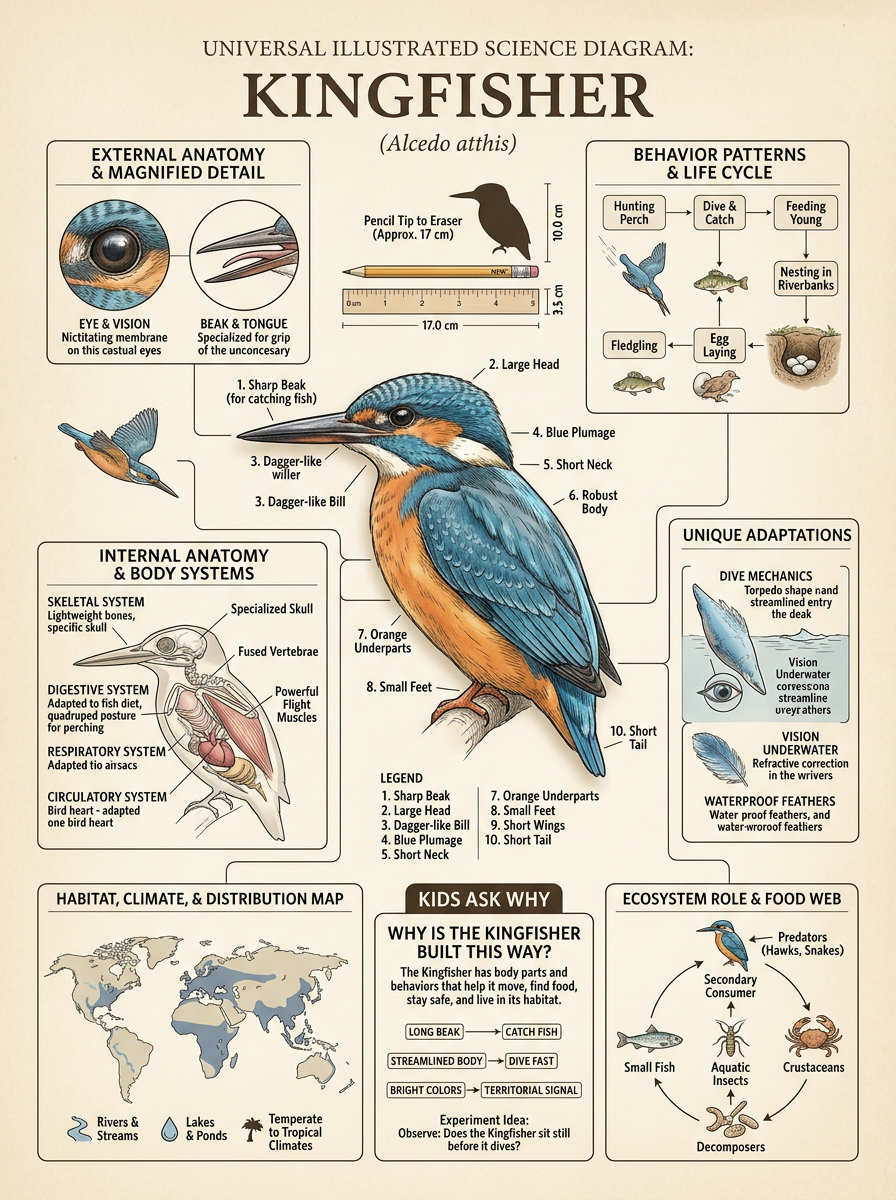
Why is the Kingfisher built this way?
This pack includes a reviewed diagram poster and a Kids Ask Why page that turns curiosity into a short explanation and mini activity.

Page 2
Vocabulary Builder
Little Learners: Kingfisher Colors & Sounds
Kingfisher
Trace the word 'Kingfisher' with your finger, then with a crayon.
Look closely at the kingfisher picture. What bright colors do you see? Can you point to its long beak?
Flap your arms like a kingfisher flying. Make a 'splash!' sound as it dives for a fish!
Young Explorers: Kingfisher Facts & Words
A kingfisher is a small, colorful bird.
It has bright blue and orange feathers.
Kingfishers love to eat fish.
Write one sentence about what a kingfisher does to catch its food.
Word bank: Kingfisher · bird · blue · orange · dive · fish
Nature Detectives: Kingfisher Adaptations
Kingfishers are incredible hunters with special adaptations. Their eyes are designed to see clearly both in the air and underwater, allowing them to spot fish from above. When they dive, their streamlined body shape and tucked-in wings help them cut through the water with minimal splash and great speed. This efficient diving technique is a perfect example of how animals evolve unique features to survive and thrive in...
How do you think a kingfisher's unique body shape and diving technique help it survive in its habitat?
Page 3
Size Science Lab
Read the size clue
A kingfisher is about 17.0 cm long, which is like the length of a brand new pencil from its tip to the eraser! Its body is around 10.0 cm tall, similar to a small juice box standing up. When it's perched, it's quite slender, only about 3.5 cm wide – that's roughly the width of two fingers held together. This compact, torpedo-like size is perfect for its quick, powerful dives into the water to catch fish, making it a small but mighty hunter.
Quick Check
What is the approximate length of a kingfisher, from head to tail?
Estimate
Hold a new pencil. Imagine a kingfisher. About how many kingfishers long do you think your forearm is?
Is a kingfisher shorter or taller than a standard paperback book?
Page 4
Scientific Diagram Poster
Reviewed diagram
Kingfisher Scientific Diagram with Kids Ask Why
Batch reviewed generated diagram for Pro Pack use. Check labels, Kids Ask Why panel, anatomy/context modules, and print readability.
2026-06-11
Page 5
Kids Ask Why Lab
Big Question
Why is the Kingfisher built this way?
The Kingfisher has body parts and behaviors that help it move, find food, stay safe, and live in its habitat.
How to diagram it
Connect one body part to one survival job with arrows and short labels.
Cause-and-effect arrows
1-minute activity
Choose one visible body part and ask what job it might help the animal do.
I noticed:
My answer in one sentence:
Draw your own explanation
Page 6
Comprehension + Drawing
1. What are two main colors of a kingfisher's feathers?
2. What kind of food do kingfishers mostly eat?
3. How do kingfishers catch their food?
4. What does 'dive' mean when talking about a kingfisher?
Draw and compare
Draw a kingfisher sitting on a branch, looking down at the water. How does the size of your drawing compare to a real kingfisher?
Page 7
Answer Key + Teaching Notes
Answer Key
- 17.0 cm
- Blue and orange
- Fish
- They dive into the water
- To jump headfirst into water
Teaching Notes
- Use visual aids like real photos or videos of kingfishers to enhance understanding.
- Encourage children to mimic the kingfisher's diving motion safely.
- For younger learners, focus on one new vocabulary word at a time.
- Connect the kingfisher's diet to the local ecosystem if applicable.
- Emphasize the 'a' article for 'a kingfisher' to reinforce indefinite articles.
Extension Activity
Research other birds that hunt fish and compare their hunting methods to the kingfisher's.
Unlock the full Pro library
This pack provides differentiated, ready-to-use activities and content, saving parents and teachers valuable preparation time.