Free Printable Pack
Kumquat printable lesson pack
Free to print or save as PDF — no account needed. Go ad-free for $9.9 (one-time).
SizeRef Pro Pack
Kumquat
This pack makes learning about kumquats fun and easy for young English learners.
Learning Goals
- Identify and name a kumquat.
- Describe a kumquat's appearance, size, and taste.
- Understand basic measurements and comparisons.
- Practice writing simple sentences about a fruit.
Teacher / Parent Setup
Print all activity pages. Gather crayons, pencils, and optionally, a real kumquat. Prepare to guide learners through each section, adapting to their English level.
Curiosity Focus
Why does the Kumquat grow this way?
This pack includes a reviewed diagram poster and a Kids Ask Why page that turns curiosity into a short explanation and mini activity.

Page 2
Vocabulary Builder
Tiny Tasters
Kumquat
Trace the word 'Kumquat' with your finger or a crayon.
Look at the kumquat picture. What color is it? Does it look soft or firm?
Hold your hand flat. Pretend to put a kumquat in your palm. How small is it? Can you make a tiny 'pop' sound like you're eating it?
Kumquat Adventures
A kumquat is a small fruit.
It is orange, like a tiny orange.
You can eat the skin and the inside.
Write one sentence about what a kumquat looks like or tastes like.
Word bank: kumquat · fruit · small · orange · sweet · sour
Kumquat Discoveries
Kumquats are unique because you can eat the whole fruit, including the peel! The peel is actually the sweetest part, while the inside pulp is more sour. This creates a surprising taste experience. Our brains process these sweet and sour signals together, making the kumquat a fun and interesting fruit to try. It's a great example of how different parts of a fruit can have different flavors, offering a complex sensory...
Why do you think some fruits have edible peels and others don't? What is special about the kumquat's peel and how it affects the taste?
Page 3
Size Science Lab
Read the size clue
A kumquat is a tiny fruit, measuring about 30mm (3.0 cm) wide, 25mm (2.5 cm) high, and 25mm (2.5 cm) deep. To help you imagine this, it's about as wide as two standard paper clips laid end-to-end. Its height is similar to the length of a small Lego brick. It's smaller than a golf ball but a bit bigger than a large marble, fitting perfectly in the palm of your hand.
Quick Check
How many centimeters wide is a kumquat?
Estimate
Find three objects in your classroom or home that you think are about the same size as a kumquat.
How is a kumquat's size different from an apple's size? How are they similar as fruits?
Page 4
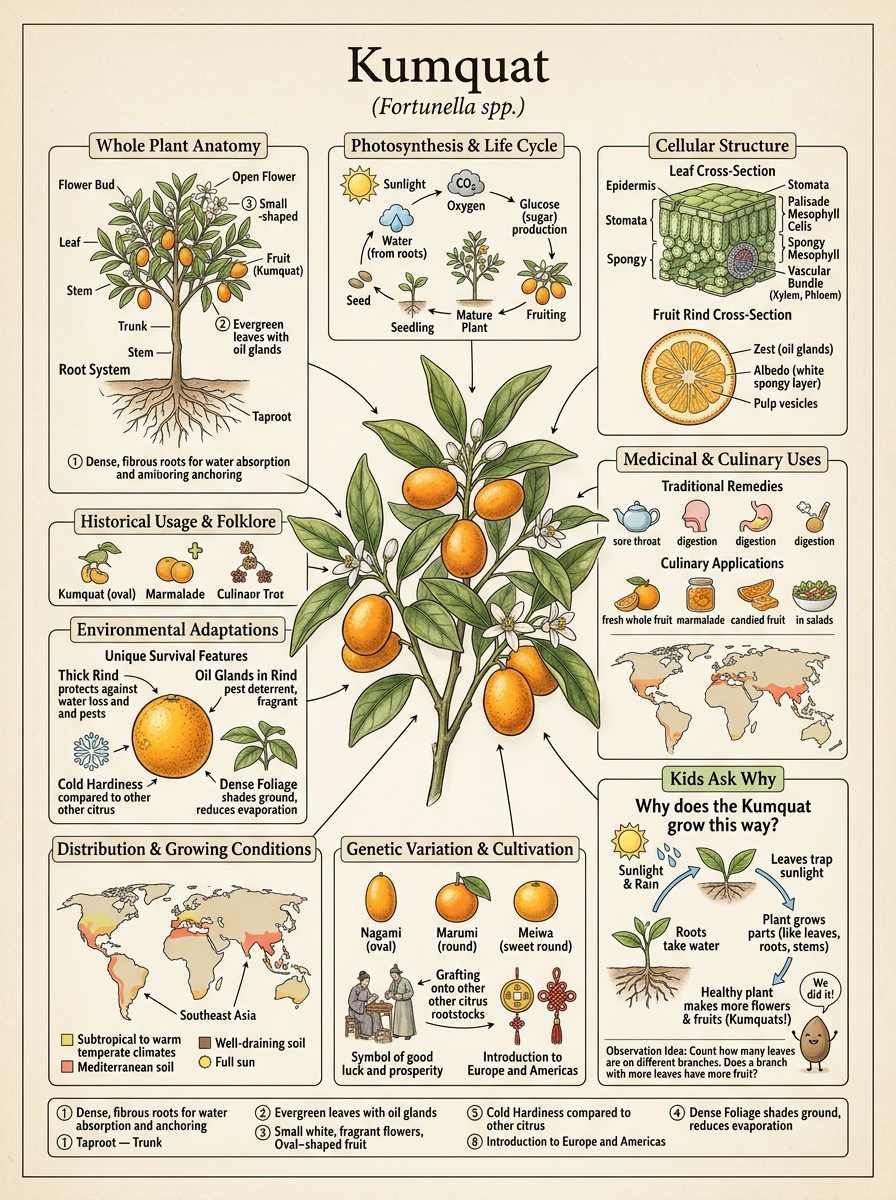
Scientific Diagram Poster
Reviewed diagram
Kumquat Scientific Diagram with Kids Ask Why
Batch reviewed generated diagram for Pro Pack use. Check labels, Kids Ask Why panel, anatomy/context modules, and print readability.
2026-06-11
Page 5
Kids Ask Why Lab
Big Question
Why does the Kumquat grow this way?
The Kumquat grows parts such as roots, stems, leaves, flowers, or seeds to collect resources, survive weather, and make more plants.
How to diagram it
Show roots, leaves, sunlight, water, and growth arrows in one simple cause-and-effect panel.
Cause-and-effect arrows
1-minute activity
Look at a leaf or plant photo and point to the part that catches light.
I noticed:
My answer in one sentence:
Draw your own explanation
Page 6
Comprehension + Drawing
1. What is a kumquat?
2. What color is a kumquat?
3. Can you eat the skin of a kumquat?
4. How does a kumquat taste?
Draw and compare
Draw a kumquat next to a grape. Which one looks bigger in your drawing? Label both fruits.
Page 7
Answer Key + Teaching Notes
Answer Key
- A kumquat is a small fruit.
- It is orange.
- Yes, you can eat the skin.
- It tastes sweet and sour.
- 3.0 cm.
Teaching Notes
- Encourage learners to describe the kumquat using their own words.
- If possible, bring a real kumquat for a multi-sensory experience (look, touch, smell, taste).
- Emphasize the 'sweet and sour' taste description, as it's a key characteristic.
- Guide younger learners to trace the word carefully, focusing on letter formation.
- For older learners, discuss the concept of different fruit parts having different flavors and textures.
Extension Activity
Try making a simple kumquat jam or slicing kumquats into a salad to explore more ways to enjoy them. Research where kumquats grow in the world.
Unlock the full Pro library
This pack provides ready-to-use, age-appropriate activities, saving valuable lesson planning time for busy educators and parents.