Free Printable Pack
Lavender printable lesson pack
Free to print or save as PDF — no account needed. Go ad-free for $9.9 (one-time).
SizeRef Pro Pack
Lavender
Picture vocabulary, size science, drawing, quiz, and teaching notes.
Learning Goals
- Say and read the word "Lavender".
- Describe a real picture using simple English.
- Use width, height, and depth to understand real-world size.
- Compare size with familiar objects at home or school.
Teacher / Parent Setup
Show the picture first. Ask what learners notice, say "Lavender" together, then connect the word to its real size.
Curiosity Focus
Why does the Lavender grow this way?
This pack includes a reviewed diagram poster and a Kids Ask Why page that turns curiosity into a short explanation and mini activity.

Page 2
Vocabulary Builder
Ages 3-5: Trace and Notice
Lavender
Trace the word Lavender. Circle the first letter.
Point to the Lavender. Say one color, shape, or part you can see.
Pretend to make the Lavender with your hands, then say the word again.
Ages 6-8: Read and Write
I can see a Lavender.
The Lavender is a kind of flowers.
Lavender helps me learn a real-world English word.
Write one new sentence about the Lavender.
Word bank: Lavender · Flowers · wide · tall · compare
Ages 9-11: Explain
A lavender plant is about as tall as your waist and as wide as your outstretched arms! It smells lovely and bees love its purple flowers.
Explain why the Lavender is useful or interesting, then support your idea with one size clue.
Page 3
Size Science Lab
Read the size clue
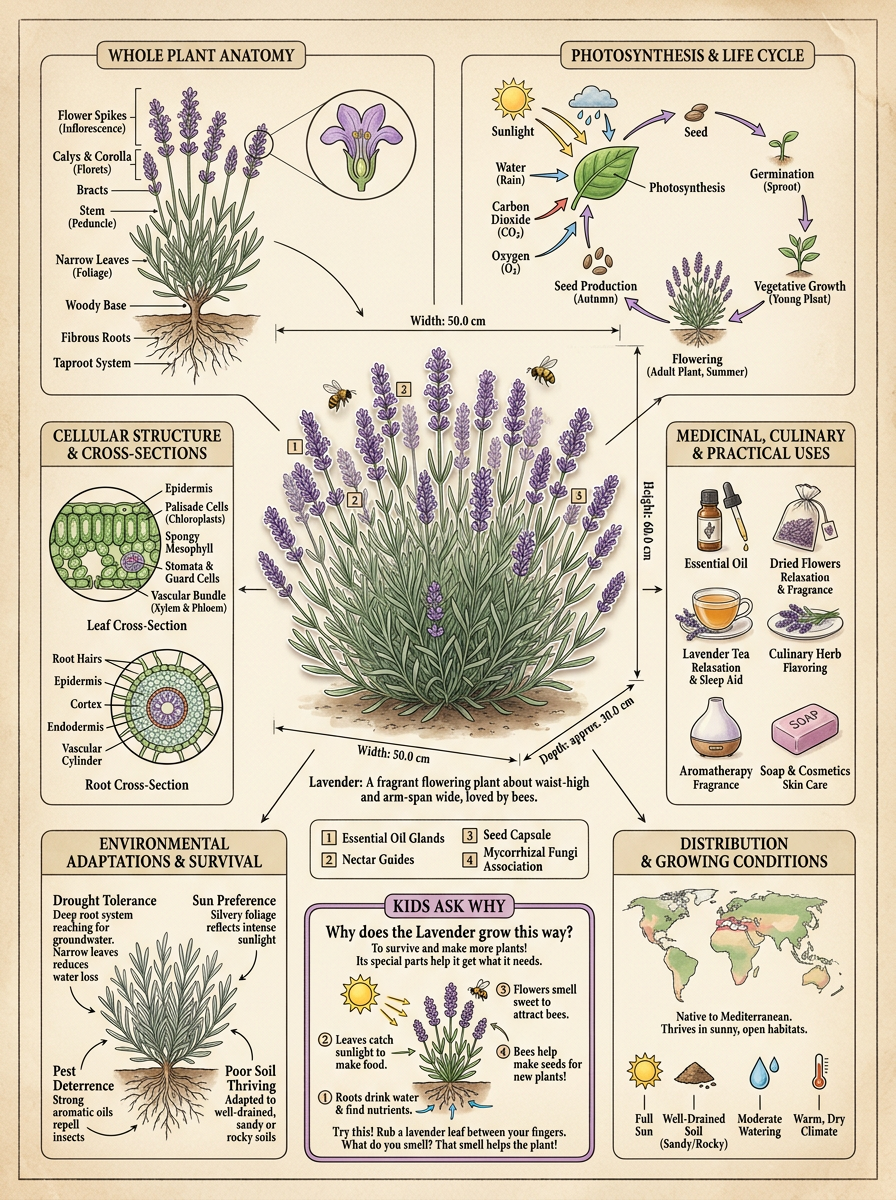
The Lavender measures about 50.0 cm wide, 60.0 cm tall, and 30.0 cm deep. Use the picture and measurements to imagine its real scale.
Quick Check
Which measurement tells how tall it is?
Estimate
Find something near you. Is it taller or shorter than the Lavender?
Compare the Lavender with a person, desk, car, or classroom object.
Page 4
Scientific Diagram Poster
Reviewed diagram
Lavender Scientific Diagram with Kids Ask Why
Batch reviewed generated diagram for Pro Pack use. Check labels, Kids Ask Why panel, anatomy/context modules, and print readability.
2026-06-11
Page 5
Kids Ask Why Lab
Big Question
Why does the Lavender grow this way?
The Lavender grows parts such as roots, stems, leaves, flowers, or seeds to collect resources, survive weather, and make more plants.
How to diagram it
Show roots, leaves, sunlight, water, and growth arrows in one simple cause-and-effect panel.
Cause-and-effect arrows
1-minute activity
Look at a leaf or plant photo and point to the part that catches light.
I noticed:
My answer in one sentence:
Draw your own explanation
Page 6
Comprehension + Drawing
1. What is the English word?
2. What category is it in?
3. Which measurement means height?
4. What makes this object interesting?
Draw and compare
Draw a Lavender next to something familiar so another learner can understand its size.
Page 7
Answer Key + Teaching Notes
Answer Key
- Vocabulary word: Lavender
- Category: Flowers
- Height answer: 60.0 cm
- Useful clues: picture, height, width, depth, and comparison.
- Drawing answers can vary if the learner explains the comparison.
Teaching Notes
- Start with picture talk before reading.
- Ask learners to repeat the word three times.
- Use hand gestures for width, height, and depth.
- Connect the object to something in the learner's home or classroom.
- For older learners, ask them to justify estimates with evidence.
Extension Activity
Make a mini poster with the word Lavender, one drawing, and one size comparison.
Unlock the full Pro library
This pack format saves preparation time by turning one object into leveled vocabulary, science, quiz, answer key, and teaching notes.