Free Printable Pack
Leopard printable lesson pack
Free to print or save as PDF — no account needed. Go ad-free for $9.9 (one-time).
SizeRef Pro Pack
Leopard
This Pro Pack offers ready-to-use, age-differentiated activities to teach English and science through the fascinating world of leopards.
Learning Goals
- Identify and name 'a leopard'.
- Learn descriptive words related to leopards.
- Understand basic leopard behaviors like climbing and hunting.
- Compare a leopard's size to familiar objects using measurements.
Teacher / Parent Setup
Print all pages for each student or group. Gather crayons, pencils, and optional playdough. Ensure a clear space for movement activities.
Curiosity Focus
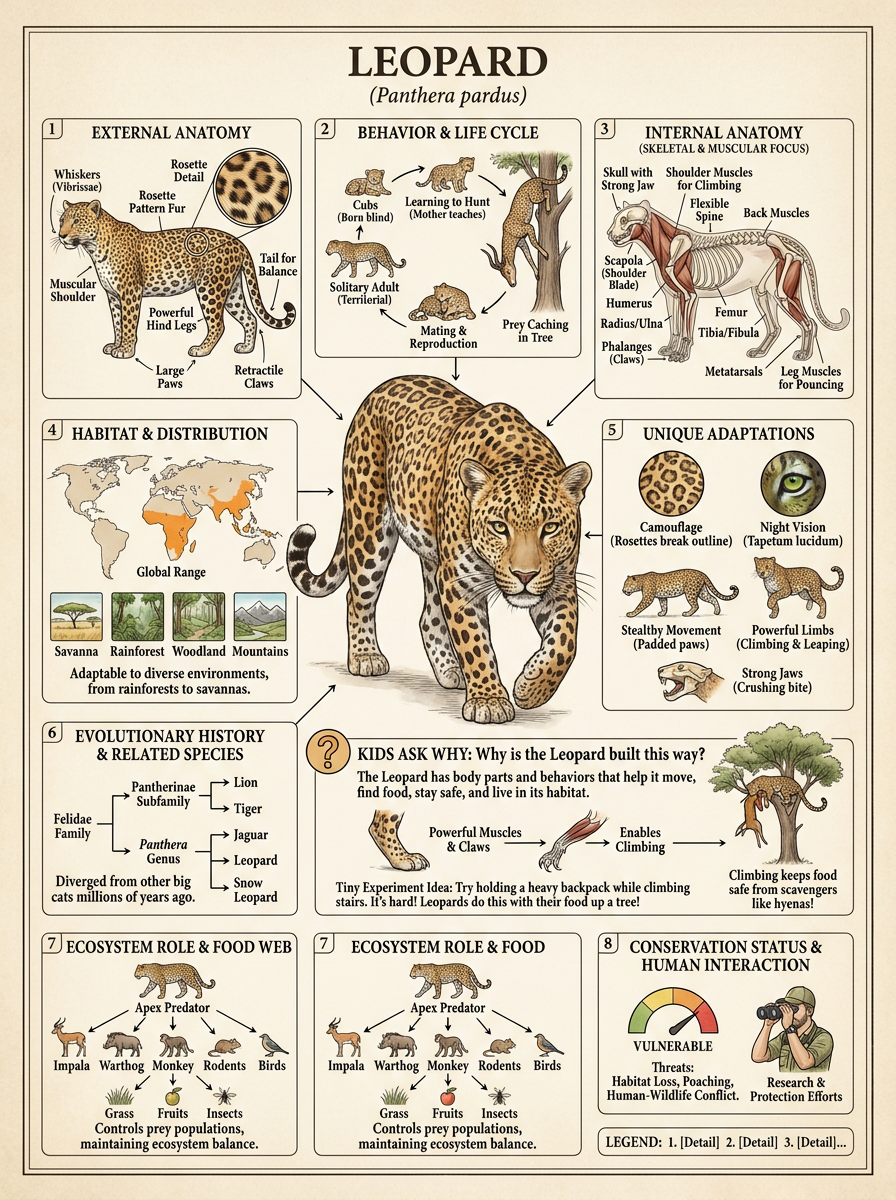
Why is the Leopard built this way?
This pack includes a reviewed diagram poster and a Kids Ask Why page that turns curiosity into a short explanation and mini activity.

Page 2
Vocabulary Builder
Little Leopard Learners
Leopard
Trace the word 'leopard' with your finger or a crayon.
Look at the leopard picture. What colors do you see? Point to its spots!
Let's pretend to be a leopard climbing a tree! Reach your arms up high and then crouch down.
Leopard Language Builders
A leopard has beautiful spots.
It can climb trees very well.
Leopards are wild animals.
Use three words from the word bank to write a sentence about a leopard.
Word bank: spots · climb · tree · wild · fast · strong
Leopard Science Explorers
Leopards have unique spot patterns called rosettes. These patterns are like fingerprints; no two leopards have exactly the same ones! Rosettes help leopards blend perfectly into their environment, especially in dappled sunlight under trees. This amazing camouflage allows them to sneak up on their prey without being seen. It's a fantastic example of natural adaptation, where an animal's features help it survive and hu...
Why is camouflage so important for a leopard's survival?
Page 3
Size Science Lab
Read the size clue
A leopard is a medium-sized big cat. From its nose to the tip of its tail, a leopard can be about 1900 millimeters (1.90 meters) long. That's about the same length as a grown-up's bicycle! When standing on all fours, it can be around 800 millimeters (80.0 centimeters) tall, which is as tall as a standard kitchen table. Its body depth is about 350 millimeters (35.0 centimeters). Imagine a leopard stretching out; it's quite a long animal, but not super tall. These dimensions help it move quietly through dense bushes...
Quick Check
How tall is a leopard in centimeters?
Estimate
Imagine a leopard lying down. How many small school rulers (30 cm each) would you need to measure its total length?
If a leopard is as tall as a kitchen table, what other everyday object is about the same height?
Page 4
Scientific Diagram Poster
Reviewed diagram
Leopard Scientific Diagram with Kids Ask Why
Batch reviewed generated diagram for Pro Pack use. Check labels, Kids Ask Why panel, anatomy/context modules, and print readability.
2026-06-11
Page 5
Kids Ask Why Lab
Big Question
Why is the Leopard built this way?
The Leopard has body parts and behaviors that help it move, find food, stay safe, and live in its habitat.
How to diagram it
Connect one body part to one survival job with arrows and short labels.
Cause-and-effect arrows
1-minute activity
Choose one visible body part and ask what job it might help the animal do.
I noticed:
My answer in one sentence:
Draw your own explanation
Page 6
Comprehension + Drawing
1. What kind of animal is a leopard?
2. Where do leopards carry their food?
3. What helps a leopard hide in its environment?
4. Can a leopard climb trees?
Draw and compare
Draw a leopard climbing a tree. Next to it, draw a bicycle to show how long the leopard is.
Page 7
Answer Key + Teaching Notes
Answer Key
- 80 cm
- About 6 rulers (190cm / 30cm = 6.33)
- A small dog, a chair seat, a toddler.
- A wild animal / a big cat.
- Up into a tree.
Teaching Notes
- Encourage students to make leopard sounds (growls, purrs) during activities.
- Use a measuring tape or string to demonstrate the leopard's actual dimensions in the classroom.
- Discuss the importance of protecting wild animals and their habitats.
- Point out the unique rosette patterns on a leopard's fur.
- Connect the leopard's climbing ability to its strong muscles and sharp claws.
Extension Activity
Watch a short, child-friendly video of leopards in their natural habitat and discuss what they observed about their movements and behaviors.
Unlock the full Pro library
This Pro Pack delivers a complete, multi-age lesson plan, saving hours of research and activity design for busy educators and parents.