Free Printable Pack
Light Rail printable lesson pack
Free to print or save as PDF — no account needed. Go ad-free for $9.9 (one-time).
SizeRef Pro Pack
Light Rail
This pack offers comprehensive, ready-to-use lessons to teach children about light rail vehicles and their role in city life.
Learning Goals
- Identify and name a light rail.
- Describe what a light rail looks like and does.
- Understand the size of a light rail using comparisons.
- Learn new vocabulary related to transportation and cities.
Teacher / Parent Setup
Print all pages. Gather crayons, pencils, and a ruler. Prepare a clear space for activities and movement.
Curiosity Focus
Why does the Light Rail work the way it does?
This pack includes a reviewed diagram poster and a Kids Ask Why page that turns curiosity into a short explanation and mini activity.

Page 2
Vocabulary Builder
My First Light Rail
Light Rail
Trace the word 'Light Rail' with your finger or a crayon.
Look at the picture of the light rail. What colors do you see? Can you find the wheels and the doors?
Pretend you are a light rail moving smoothly. Make a 'whoosh' sound and glide your arms like the train.
Light Rail Builders
A light rail is a type of train that carries people.
It runs on tracks in the city.
Light rails help many people travel without cars.
Write one sentence about where you would like a light rail to take you.
Word bank: track · city · people · smooth · electric · station
The Science of Light Rail
Light rail systems are a smart solution for urban transportation. They use electricity, often from overhead lines, which means they produce less pollution than cars or buses that burn fuel. Their design allows them to carry many passengers efficiently, reducing traffic congestion and the need for large parking areas. This efficient movement of people helps cities function better and supports a cleaner environment. Th...
How do light rails help make cities better places to live and visit?
Page 3
Size Science Lab
Read the size clue
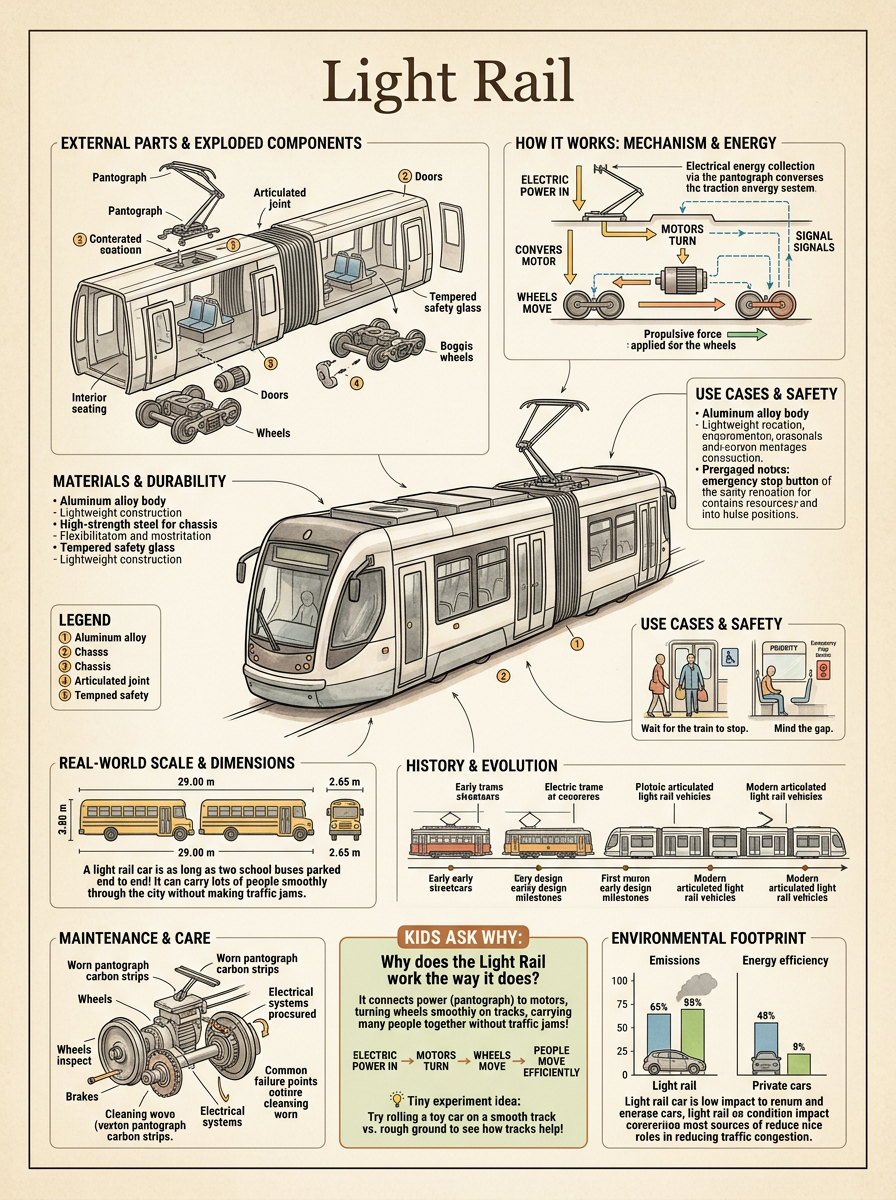
A light rail is a very long vehicle. Its length is 29,000 millimeters, which is 29 meters, or about the length of five large cars parked bumper to bumper. It stands 3,800 millimeters (3.8 meters) tall, taller than a giraffe! Its width (side-to-side) is 2,650 millimeters (2.65 meters), which is a bit wider than a large truck. Imagine a light rail car being as long as two school buses parked end to end! It can carry lots of people smoothly through the city without making traffic jams.
Quick Check
How many meters long is a light rail?
Estimate
Estimate how many regular cars could fit inside a light rail car.
How is a light rail different from a regular bus?
Page 4
Scientific Diagram Poster
Reviewed diagram
Light Rail Scientific Diagram with Kids Ask Why
Batch reviewed generated diagram for Pro Pack use. Check labels, Kids Ask Why panel, anatomy/context modules, and print readability.
2026-06-12
Page 5
Kids Ask Why Lab
Big Question
Why does the Light Rail work the way it does?
The Light Rail works because its shape, materials, parts, and forces fit together to solve a real-world problem.
How to diagram it
Use arrows to connect the main parts to their jobs, then show the input and output.
Cause-and-effect arrows
1-minute activity
Find one part of the object and explain what would happen if that part was missing.
I noticed:
My answer in one sentence:
Draw your own explanation
Page 6
Comprehension + Drawing
1. What is a light rail?
2. Where do light rails usually travel?
3. What is one good thing about light rails for cities?
4. Why do light rails help the environment?
Draw and compare
Draw a picture of a light rail in your city. Show people getting on or off. How does your drawing compare to the real light rail picture?
Page 7
Answer Key + Teaching Notes
Answer Key
- A type of train that carries people.
- They usually travel in cities on tracks.
- They carry many people, reduce traffic, or are good for the environment.
- They use electricity and produce less pollution.
- 29 meters.
Teaching Notes
- Encourage children to share any personal experiences with trains or light rails.
- Use a map to show where light rails might run in a city.
- Emphasize the sound a light rail makes (smooth, quiet, bell).
- Discuss the importance of public transportation for everyone.
- For older children, research local light rail systems if available.
Extension Activity
Design your own light rail station, including where people wait and how they get on the train safely.
Unlock the full Pro library
This Pro Pack provides a complete, structured lesson plan with age-appropriate activities, saving valuable preparation time for educators.