Free Printable Pack
Lorikeet printable lesson pack
Free to print or save as PDF — no account needed. Go ad-free for $9.9 (one-time).
SizeRef Pro Pack
Lorikeet
This pack offers engaging, age-appropriate activities to teach English vocabulary and concepts using the colorful lorikeet.
Learning Goals
- Identify and name a lorikeet.
- Describe a lorikeet's features and actions.
- Understand basic size comparisons using a lorikeet.
- Practice English vocabulary related to birds and nature.
Teacher / Parent Setup
Print all activity pages. Gather crayons, pencils, and a ruler. Prepare a picture or video of a real lorikeet for discussion.
Curiosity Focus
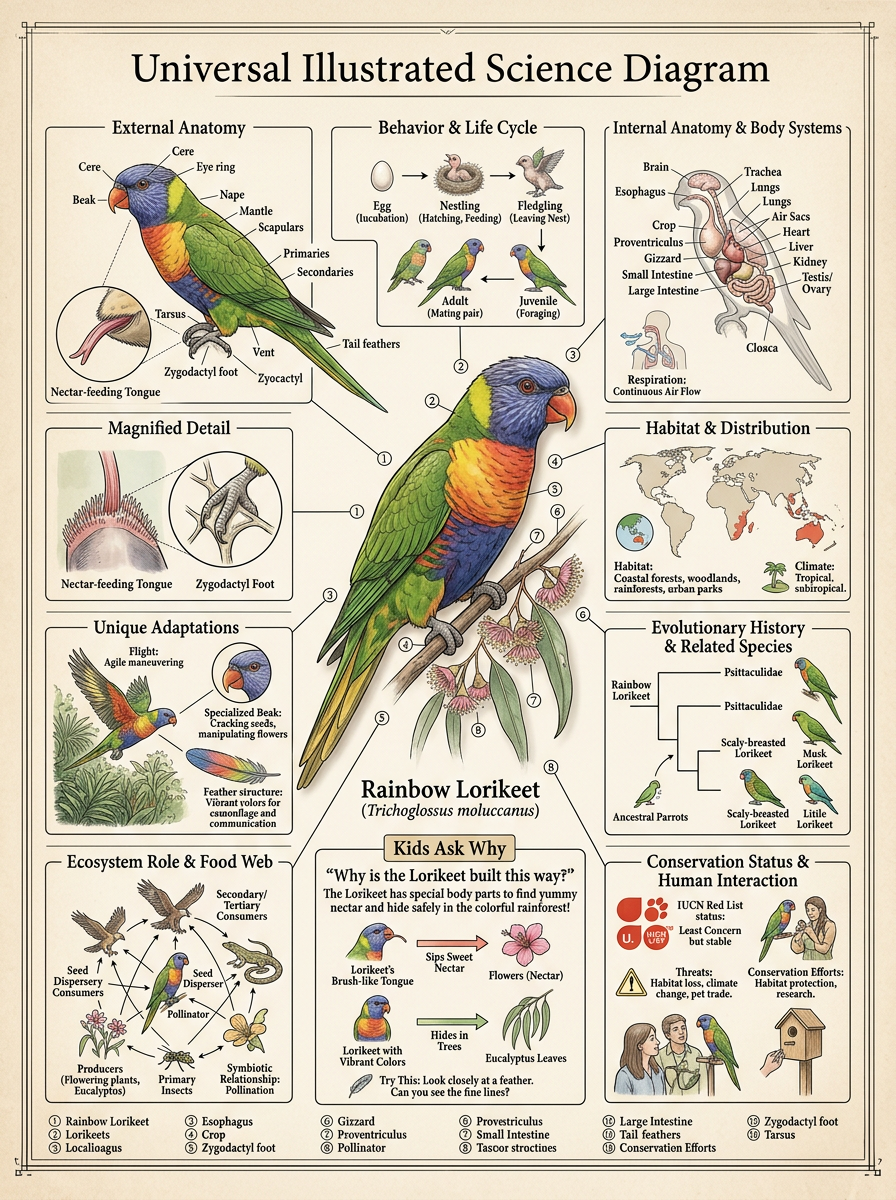
Why is the Lorikeet built this way?
This pack includes a reviewed diagram poster and a Kids Ask Why page that turns curiosity into a short explanation and mini activity.

Page 2
Vocabulary Builder
Little Lorikeet Learners
Lorikeet
Trace the word 'lorikeet' with your finger or a crayon. Say the word as you trace.
Look at the lorikeet picture. What colors do you see? Point to its beak and its tail.
Flap your arms like a lorikeet flying. Pretend to sip nectar from a flower with your tongue.
Lorikeet Language Adventures
A lorikeet is a colorful bird.
It has a brush-like tongue.
Lorikeets love to eat sweet nectar.
Write one sentence about what a lorikeet eats, using words from the word bank.
Word bank: lorikeet · bird · colorful · nectar · flower · tongue
Deep Dive into Lorikeets
Lorikeets are special birds because of their amazing tongues! Unlike many birds that eat seeds, lorikeets have a tongue that looks and works like a tiny brush. This 'brush' helps them soak up sweet nectar from flowers. This special adaptation means they can get all the energy they need from sugary flower juice. Their bright colors also help them blend in with tropical flowers, which is a clever way to stay safe while...
How does a lorikeet's unique tongue help it survive in its environment? What might happen if it didn't have this special tongue?
Page 3
Size Science Lab
Read the size clue
Imagine a lorikeet stretching out its wings! From wingtip to wingtip, it can be about 300 millimeters (30.0 cm) wide, which is like the length of a standard ruler. From its head to the tip of its tail, a lorikeet is about 200 millimeters (20.0 cm) tall, similar to the height of a small paperback book. And how thick is it? Only about 60 millimeters (6.0 cm) deep, which is less than the width of your hand. So, a lorikeet is as wide as a ruler, as tall as a small book, and as thin as your hand!
Quick Check
How wide is a lorikeet, from one wingtip to the other?
Estimate
Find an object in your classroom that you think is about 20 cm tall, like a lorikeet.
Compare the width of a lorikeet (30 cm) to the length of your forearm. Which is longer?
Page 4
Scientific Diagram Poster
Reviewed diagram
Lorikeet Scientific Diagram with Kids Ask Why
Batch reviewed generated diagram for Pro Pack use. Check labels, Kids Ask Why panel, anatomy/context modules, and print readability.
2026-06-11
Page 5
Kids Ask Why Lab
Big Question
Why is the Lorikeet built this way?
The Lorikeet has body parts and behaviors that help it move, find food, stay safe, and live in its habitat.
How to diagram it
Connect one body part to one survival job with arrows and short labels.
Cause-and-effect arrows
1-minute activity
Choose one visible body part and ask what job it might help the animal do.
I noticed:
My answer in one sentence:
Draw your own explanation
Page 6
Comprehension + Drawing
1. What is a lorikeet?
2. What special part of its body helps it eat nectar?
3. What does a lorikeet eat?
4. Are lorikeets usually one color or many colors?
Draw and compare
Draw a picture of a lorikeet eating nectar from a flower. Make sure to show its colorful feathers and special tongue. Compare your drawing to the real lorikeet picture.
Page 7
Answer Key + Teaching Notes
Answer Key
- A colorful bird.
- Its brush-like tongue.
- Nectar from flowers.
- Many colors.
- 300 millimeters or 30.0 centimeters.
Teaching Notes
- Encourage learners to use gestures when describing the lorikeet.
- Use real photos or videos of lorikeets to enhance engagement.
- Emphasize the 'a' article before 'lorikeet' for singular objects.
- Review color vocabulary before starting the activities.
- Adapt activities for different age groups within the suggested ranges.
Extension Activity
Research other birds that eat nectar. How are they similar or different from lorikeets?
Unlock the full Pro library
This Pro Pack provides ready-to-use, differentiated activities, saving valuable lesson planning time for educators and parents.