Free Printable Pack
Mulberry printable lesson pack
Free to print or save as PDF — no account needed. Go ad-free for $9.9 (one-time).
SizeRef Pro Pack
Mulberry
This printable pack offers structured, age-appropriate activities to teach English vocabulary and concepts about mulberries, saving you valuable preparation tim...
Learning Goals
- Identify and name 'a mulberry' in English.
- Describe the physical characteristics of a mulberry.
- Understand simple facts about mulberries.
- Compare the size of a mulberry to other objects.
Teacher / Parent Setup
Print all pages. Gather crayons, pencils, and optionally, real mulberries or pictures. Prepare a space for drawing and discussion.
Curiosity Focus
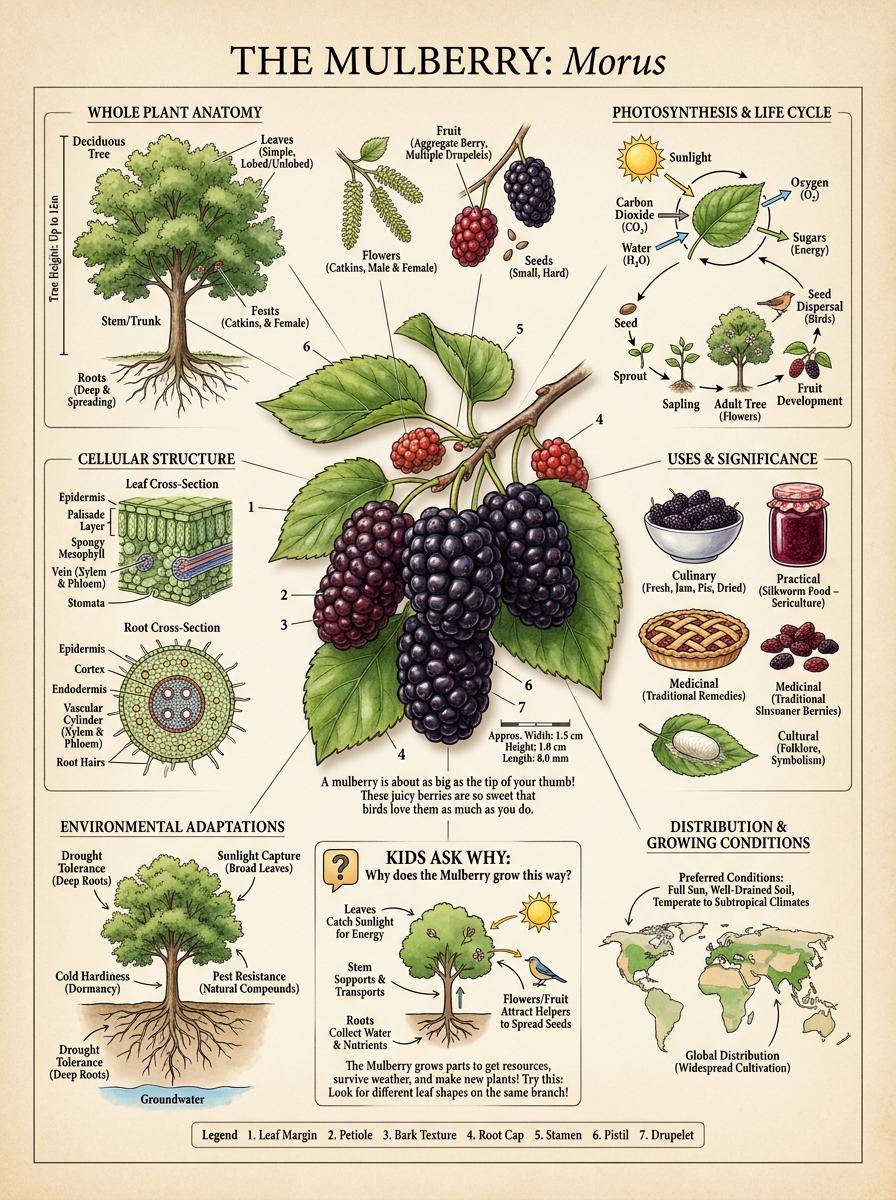
Why does the Mulberry grow this way?
This pack includes a reviewed diagram poster and a Kids Ask Why page that turns curiosity into a short explanation and mini activity.

Page 2
Vocabulary Builder
My First Mulberry Words
Mulberry
Trace the word 'Mulberry' with your finger or a crayon.
Look at the picture of the mulberry. What color is it? What shape is it?
Point to the mulberry in the picture. Pretend to pick a mulberry and eat it. Say 'Yum!'
Reading and Writing About Mulberries
A mulberry is a small, sweet fruit.
It grows on a mulberry tree.
Mulberries can be dark purple, red, or white.
Use three words from the word bank to describe a mulberry. Write your sentences here.
Word bank: sweet · fruit · small · tree · purple · juicy
Mulberry Science and Cognition
Did you know a mulberry is not a true berry? It's actually a cluster of tiny fruits called drupelets, all grown together. Each little bump on a mulberry is a single drupelet, containing a seed. This clever design helps birds eat the fruit and spread the seeds far away. The sweet taste and bright colors signal to animals that the fruit is ripe and ready to be eaten, aiding in its reproduction cycle. This is a great ex...
Why is it helpful for a mulberry to be made of many small drupelets instead of one big fruit?
Page 3
Size Science Lab
Read the size clue
A mulberry is a very small fruit, often compared to the tip of your thumb. Let's look at its exact size. It is about 15 millimeters (1.5 centimeters) wide, which is like the width of a small button. Its height is around 10 millimeters (1.0 centimeter), similar to a small pea. The depth is about 8 millimeters (0.8 centimeters), making it a bit flat. Imagine three small buttons lined up to get an idea of its width. Its tiny size makes it easy for birds to swallow whole, helping to spread its seeds.
Quick Check
What is the approximate width of a mulberry in millimeters?
Estimate
Look at your own thumb. How many mulberries do you think would fit on the tip of your thumb?
Is a mulberry generally bigger or smaller than a blueberry? How are they similar or different in shape?
Page 4
Scientific Diagram Poster
Reviewed diagram
Mulberry Scientific Diagram with Kids Ask Why
Batch reviewed generated diagram for Pro Pack use. Check labels, Kids Ask Why panel, anatomy/context modules, and print readability.
2026-06-11
Page 5
Kids Ask Why Lab
Big Question
Why does the Mulberry grow this way?
The Mulberry grows parts such as roots, stems, leaves, flowers, or seeds to collect resources, survive weather, and make more plants.
How to diagram it
Show roots, leaves, sunlight, water, and growth arrows in one simple cause-and-effect panel.
Cause-and-effect arrows
1-minute activity
Look at a leaf or plant photo and point to the part that catches light.
I noticed:
My answer in one sentence:
Draw your own explanation
Page 6
Comprehension + Drawing
1. What color can mulberries be?
2. Where do mulberries grow?
3. Who likes to eat mulberries?
4. Is a mulberry a true berry?
Draw and compare
Draw a mulberry. Next to it, draw something else that is about the same size as a mulberry.
Page 7
Answer Key + Teaching Notes
Answer Key
- Mulberries can be dark purple, red, or white.
- Mulberries grow on mulberry trees.
- Birds and people like to eat mulberries.
- No, a mulberry is not a true berry.
- A mulberry is approximately 15 millimeters wide.
Teaching Notes
- Encourage learners to use their senses if real mulberries are available (touch, smell, taste).
- For younger learners, focus on color and shape identification.
- Emphasize the 'a' article before 'mulberry' for correct English usage.
- Connect the science explanation to real-world examples of plant reproduction.
- Adapt activities to suit the learner's English proficiency level, providing extra vocabulary support if needed.
Extension Activity
If possible, take a nature walk to look for mulberry trees or other small berries. Discuss where they grow and what animals might eat them.
Unlock the full Pro library
This pack delivers a complete, multi-level lesson on mulberries, eliminating the need for extensive research and activity creation.