Free Printable Pack
Mutton printable lesson pack
Free to print or save as PDF — no account needed. Go ad-free for $9.9 (one-time).
SizeRef Pro Pack
Mutton
This Pro Pack offers ready-to-use, age-differentiated activities to teach children about mutton, its characteristics, and related English vocabulary.
Learning Goals
- Identify and name 'mutton' in English.
- Understand basic characteristics of mutton, like its source and taste.
- Practice English vocabulary related to food and animals.
- Develop early literacy and critical thinking skills through guided activities.
Teacher / Parent Setup
Print the activity sheets. Gather crayons, pencils, and a ruler. Prepare a visual of a mutton chop if possible, or use the provided image.
Curiosity Focus
Why does the Mutton work the way it does?
This pack includes a reviewed diagram poster and a Kids Ask Why page that turns curiosity into a short explanation and mini activity.

Page 2
Vocabulary Builder
Mutton Fun for Little Learners
Mutton
Trace the word 'Mutton' with your finger, then with a crayon. Say 'Mutton' out loud!
Look at the picture of the mutton chop. What color is it? Do you see any bone?
Point to the mutton chop in the picture. Now, pretend to hold a mutton chop in your hands. How big is it?
Exploring Mutton
Mutton comes from an adult sheep.
It has a rich, savory taste.
A mutton chop is a piece of this meat.
Write one sentence about what you learned about mutton. Use a word from the word bank.
Word bank: sheep · adult · meat · taste · chop · cook
The Science of Mutton's Flavor
Mutton comes from adult sheep, not young lambs. This difference in age means the muscles have developed more, leading to a stronger, more complex flavor. The fat content also changes, contributing to its distinct, savory taste. Our brains learn to distinguish these subtle flavor profiles through experience, associating them with different animals and cooking methods. This cognitive process helps us appreciate the var...
Why do you think some people prefer the taste of mutton over lamb, and what does that tell us about our sense of taste?
Page 3
Size Science Lab
Read the size clue
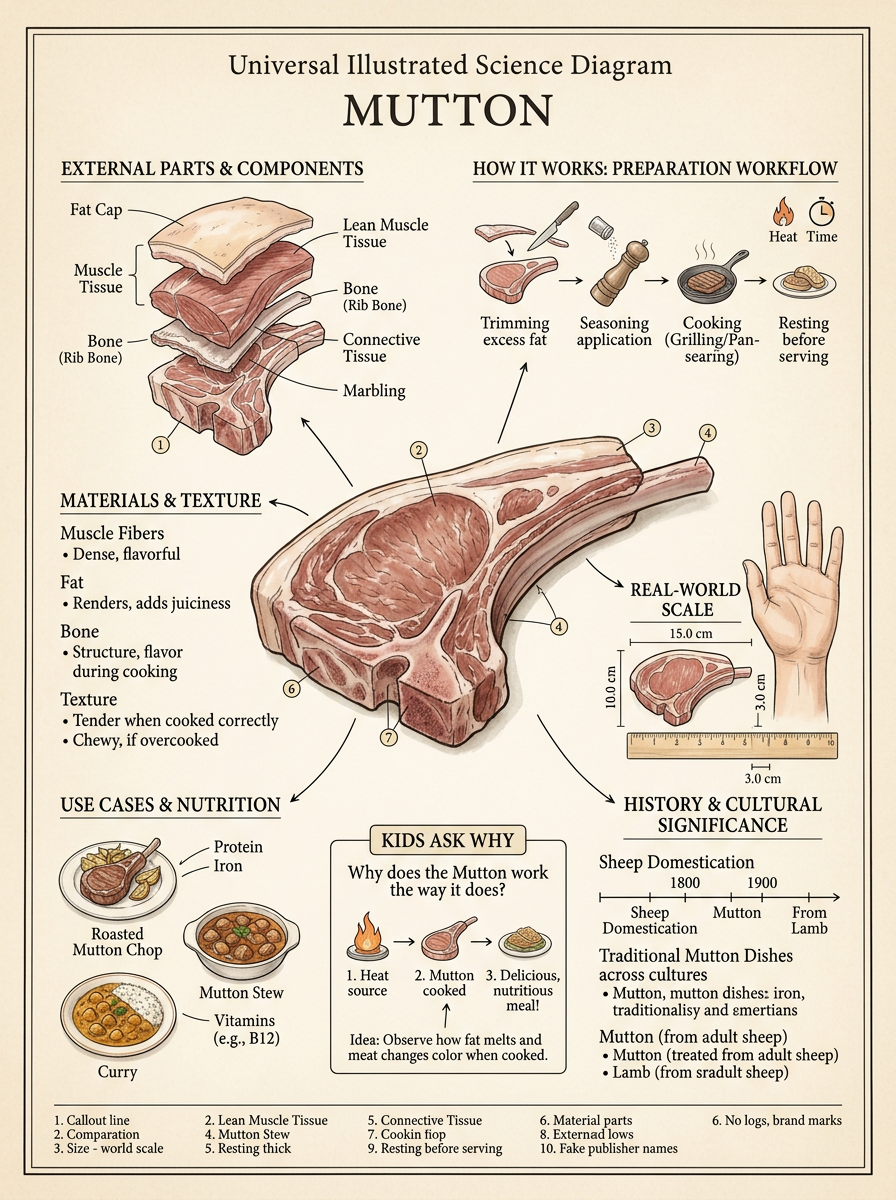
Imagine a mutton chop that is about 150 millimeters (15 centimeters) wide. That's roughly the length of a standard pencil! It stands 100 millimeters (10 centimeters) high, which is similar to the width of a common smartphone. Its depth is 30 millimeters (3 centimeters), which is about as thick as two fingers stacked together. So, a mutton chop is a substantial piece of meat, roughly the size of your hand and quite thick.
Quick Check
How many centimeters wide is a mutton chop?
Estimate
Without measuring, estimate how many mutton chops would fit side-by-side on a dinner plate.
How is the thickness of a mutton chop (30mm) similar or different to the thickness of a small book?
Page 4
Scientific Diagram Poster
Reviewed diagram
Mutton Scientific Diagram with Kids Ask Why
Batch reviewed generated diagram for Pro Pack use. Check labels, Kids Ask Why panel, anatomy/context modules, and print readability.
2026-06-11
Page 5
Kids Ask Why Lab
Big Question
Why does the Mutton work the way it does?
The Mutton works because its shape, materials, parts, and forces fit together to solve a real-world problem.
How to diagram it
Use arrows to connect the main parts to their jobs, then show the input and output.
Cause-and-effect arrows
1-minute activity
Find one part of the object and explain what would happen if that part was missing.
I noticed:
My answer in one sentence:
Draw your own explanation
Page 6
Comprehension + Drawing
1. What animal does mutton come from?
2. Is mutton from a young or adult sheep?
3. How does the taste of mutton compare to lamb?
4. What is a 'mutton chop'?
Draw and compare
Draw a mutton chop on a plate. Next to it, draw something else that is about 15 cm wide.
Page 7
Answer Key + Teaching Notes
Answer Key
- Mutton comes from a sheep.
- It comes from an adult sheep.
- Mutton has a richer, more savory taste than lamb.
- A mutton chop is a piece of meat from an adult sheep.
- A mutton chop is 15 centimeters wide.
Teaching Notes
- Emphasize the 'a' article for 'a mutton chop' versus 'mutton' as a general food.
- Use real-life objects to demonstrate the dimensions for younger learners.
- Encourage sensory language when discussing taste for older children.
- Connect mutton to cultural dishes where appropriate for global learners.
- Remind children that 'mutton' is the meat, and 'sheep' is the animal.
Extension Activity
Research a traditional recipe that uses mutton from a different country and discuss its ingredients and cooking method.
Unlock the full Pro library
This pack provides differentiated, ready-to-teach content for multiple age groups, saving valuable lesson planning time for busy educators and parents.