Free Printable Pack
Otter printable lesson pack
Free to print or save as PDF — no account needed. Go ad-free for $9.9 (one-time).
SizeRef Pro Pack
Otter
Unlock engaging English, science, and cognition lessons about otters, ready to print and teach.
Learning Goals
- Identify key features and behaviors of an otter.
- Understand and compare the size of an otter using real-world measurements.
- Learn new English vocabulary related to animals and water environments.
- Develop critical thinking skills through discussion and estimation tasks.
Teacher / Parent Setup
Print all pages for each student or group. Prepare a large image or toy of an otter for visual reference. Gather crayons, pencils, and a measuring tape for activities.
Curiosity Focus
Why is the Otter built this way?
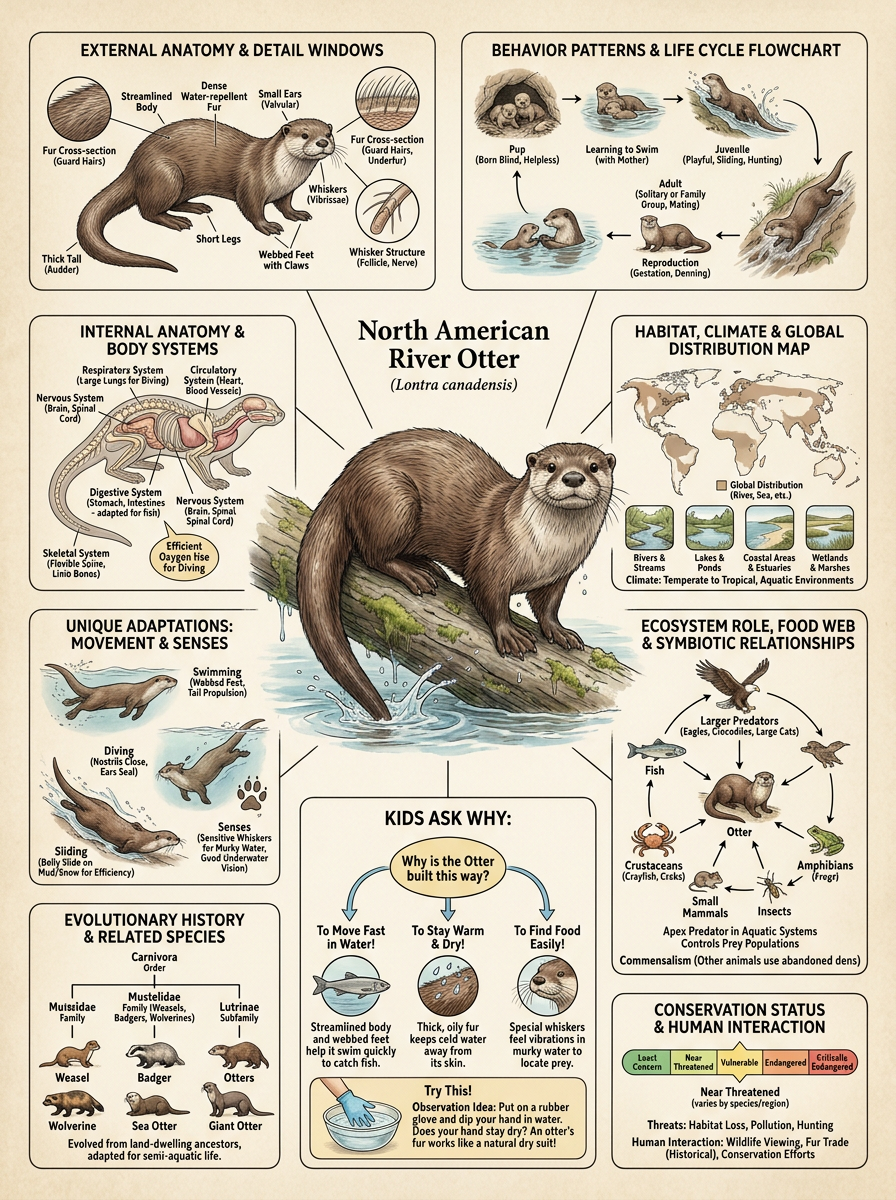
This pack includes a reviewed diagram poster and a Kids Ask Why page that turns curiosity into a short explanation and mini activity.

Page 2
Vocabulary Builder
Playful Otter Fun!
Otter
Trace the word 'OTTER' with your finger or a crayon. What sound does 'O' make?
Look at the otter picture. What do you see? Does it have fur? Does it have a long tail? What color is it?
Let's pretend to be an otter! Wiggle your body and slide on the floor like an otter on its belly!
Otter Adventures
An otter is a playful animal that loves water.
Otters have sleek bodies and webbed feet for swimming fast.
They often slide on their bellies down muddy banks into the river.
Draw your favorite otter activity. Write one sentence about what the otter is doing.
Word bank: swim · playful · river · fish · sleek · slide
Otter Adaptations and Intelligence
Otters are incredibly well-adapted for life in and around water. Their sleek, streamlined bodies and powerful tails help them glide effortlessly through the water. They have webbed feet, like ducks, which act as paddles. Otters can also close their nostrils and ears when underwater to keep water out. Their dense fur traps air, providing insulation and buoyancy. Otters are also known for their intelligence and playful...
How do an otter's physical features help it survive and thrive in its natural habitat?
Page 3
Size Science Lab
Read the size clue
An otter is about 1.10 meters long from its nose to the tip of its tail. Imagine a child's height, that's how long! It stands about 28 centimeters tall, which is shorter than a standard school ruler. And it's quite slender, only about 18 centimeters deep, like a thick book. So, an otter is long and thin, perfect for swimming! A big cat like a Maine Coon might be 1 meter long, making the otter a bit longer but much slimmer, built for agility in water rather than pouncing on land.
Quick Check
Is an otter longer or shorter than 1 meter?
Estimate
Estimate how many standard school rulers (30cm) you would need to line up to match an otter's length.
If you had a toy car that is 18 cm long, would it be longer or shorter than an otter's depth?
Page 4
Scientific Diagram Poster
Reviewed diagram
Otter Scientific Diagram with Kids Ask Why
Batch reviewed generated diagram for Pro Pack use. Check labels, Kids Ask Why panel, anatomy/context modules, and print readability.
2026-06-12
Page 5
Kids Ask Why Lab
Big Question
Why is the Otter built this way?
The Otter has body parts and behaviors that help it move, find food, stay safe, and live in its habitat.
How to diagram it
Connect one body part to one survival job with arrows and short labels.
Cause-and-effect arrows
1-minute activity
Choose one visible body part and ask what job it might help the animal do.
I noticed:
My answer in one sentence:
Draw your own explanation
Page 6
Comprehension + Drawing
1. What is one thing otters love to do?
2. What helps an otter swim fast?
3. What kind of food do otters eat?
4. How long is an otter from nose to tail?
Draw and compare
Draw an otter next to a Maine Coon cat. Try to show how the otter is longer but much slimmer.
Page 7
Answer Key + Teaching Notes
Answer Key
- Otters love to slide on their bellies and are super playful in the water.
- Sleek bodies and webbed feet help an otter swim fast.
- Otters eat fish, crabs, and other small water animals.
- An otter is about 1.10 meters long.
- Longer (1.10 meters is longer than 1 meter).
Teaching Notes
- Encourage students to make otter sounds or movements during the lesson.
- Use a real measuring tape to demonstrate the otter's dimensions for better understanding.
- Pair younger learners with an adult or older student for tracing and drawing activities.
- For the discussion prompt, encourage students to use specific vocabulary learned in the pack.
- Consider showing a short, child-friendly video of otters playing or swimming to enhance engagement.
Extension Activity
Research different types of otters (e.g., sea otter, river otter) and compare their habitats and diets.
Unlock the full Pro library
This pack provides ready-to-use, age-differentiated activities, saving hours of preparation time for educators and parents.