Free Printable Pack
Owl printable lesson pack
Free to print or save as PDF — no account needed. Go ad-free for $9.9 (one-time).
SizeRef Pro Pack
Owl
This premium pack provides ready-to-use, age-differentiated activities to teach children about owls, saving you valuable preparation time.
Learning Goals
- Identify and name an owl in English.
- Understand key physical characteristics and behaviors of an owl.
- Develop early literacy skills through tracing, writing, and reading.
- Practice measurement and comparison skills using real-world object dimensions.
Teacher / Parent Setup
Print the entire pack. Gather pencils, crayons, and a ruler or measuring tape. Prepare a space for a short movement activity.
Curiosity Focus
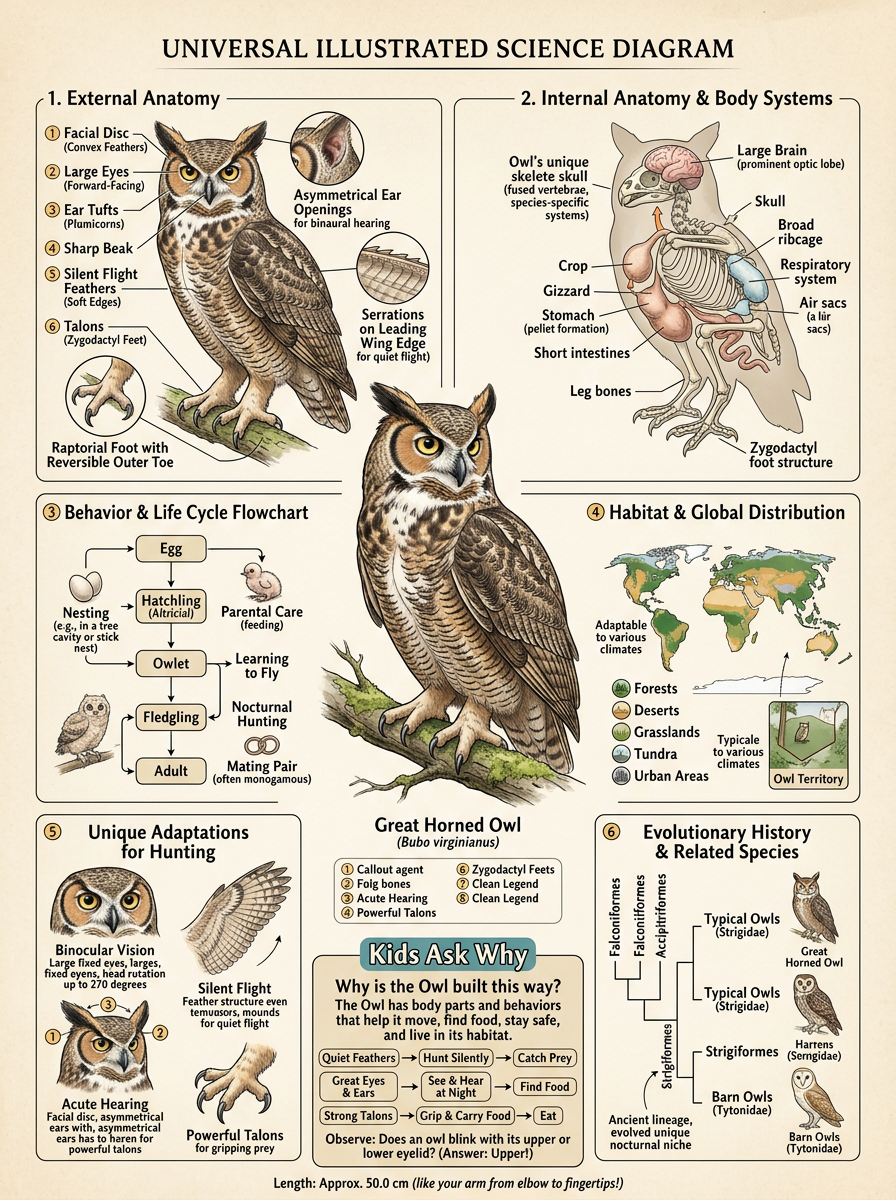
Why is the Owl built this way?
This pack includes a reviewed diagram poster and a Kids Ask Why page that turns curiosity into a short explanation and mini activity.

Page 2
Vocabulary Builder
My First Owl
Owl
Trace the word 'owl' with your finger, then with a crayon.
Look at the owl picture. What do you see? Point to its big eyes and soft feathers.
Twist your head from side to side like an owl. How far can you turn?
Owl Facts for Kids
An owl is a bird.
Owls have big eyes.
They hunt at night.
Use words from the word bank to write one new sentence about an owl.
Word bank: owl · bird · night · eyes · hunt · head
The Amazing Owl
Owls are fascinating birds with special adaptations. Their large, forward-facing eyes help them see very well in low light, making them excellent nocturnal hunters. Unlike humans, owls cannot move their eyeballs, so they must turn their entire head to change their field of vision. They have 14 neck vertebrae (humans have 7), allowing them to rotate their heads up to 270 degrees in either direction. This incredible fl...
If you couldn't move your eyes, only your head, how would your daily life be different?
Page 3
Size Science Lab
Read the size clue
An owl is about 50.0 cm (500mm) long from head to tail. Imagine your arm from your elbow to your fingertips – that's how long an owl can be! It stands about 45.0 cm (450mm) tall, which is a bit shorter than a standard school backpack. An owl's body is about 18.0 cm (180mm) deep, similar to the length of a medium-sized book. These measurements show that an owl is a substantial bird, not tiny, and its size helps it be a powerful hunter.
Quick Check
How many centimeters long is an owl?
Estimate
Find an object in your room that is about 18 cm long. Is it longer or shorter than an owl's depth?
Is an owl's length (50 cm) longer or shorter than its height (45 cm)?
Page 4
Scientific Diagram Poster
Reviewed diagram
Owl Scientific Diagram with Kids Ask Why
Batch reviewed generated diagram for Pro Pack use. Check labels, Kids Ask Why panel, anatomy/context modules, and print readability.
2026-06-11
Page 5
Kids Ask Why Lab
Big Question
Why is the Owl built this way?
The Owl has body parts and behaviors that help it move, find food, stay safe, and live in its habitat.
How to diagram it
Connect one body part to one survival job with arrows and short labels.
Cause-and-effect arrows
1-minute activity
Choose one visible body part and ask what job it might help the animal do.
I noticed:
My answer in one sentence:
Draw your own explanation
Page 6
Comprehension + Drawing
1. What is an owl good at doing at night?
2. How far can an owl turn its head?
3. Why do owls need to turn their heads so much?
4. How many neck bones do owls have compared to humans?
Draw and compare
Draw an owl. Then, draw something else that is about 50 cm long next to it to show its size.
Page 7
Answer Key + Teaching Notes
Answer Key
- An owl is about 50.0 cm long.
- An owl is good at hunting at night.
- An owl can turn its head almost all the way around (up to 270 degrees).
- Owls need to turn their heads a lot because they cannot move their eyeballs.
- Owls have 14 neck vertebrae, while humans have 7.
Teaching Notes
- Encourage children to use descriptive words when talking about the owl picture.
- For younger learners, focus on the 'big eyes' and 'head turning' concepts.
- When discussing size, use a real ruler or measuring tape to demonstrate 50 cm, 45 cm, and 18 cm.
- Emphasize the silence of an owl's flight as a key adaptation.
- Connect the owl's nocturnal nature to other animals that are active at night.
Extension Activity
Research different types of owls and their habitats. Draw your favorite type of owl.
Unlock the full Pro library
This pack provides a complete, multi-age lesson plan, eliminating the need for extensive research and activity creation.