Free Printable Pack
Panda printable lesson pack
Free to print or save as PDF — no account needed. Go ad-free for $9.9 (one-time).
SizeRef Pro Pack
Panda
This lesson pack provides ready-to-use, age-appropriate activities to teach English vocabulary and science concepts about pandas.
Learning Goals
- Identify the word 'panda' and its pronunciation.
- Learn basic facts about pandas, including their diet and behavior.
- Understand and compare the size of a panda using familiar objects.
- Develop early literacy and critical thinking skills.
Teacher / Parent Setup
Print all activity sheets. Gather crayons, pencils, and a picture of a panda. Prepare a small bicycle and measure a kitchen counter if possible for real-world size comparisons.
Curiosity Focus
Why is the Panda built this way?
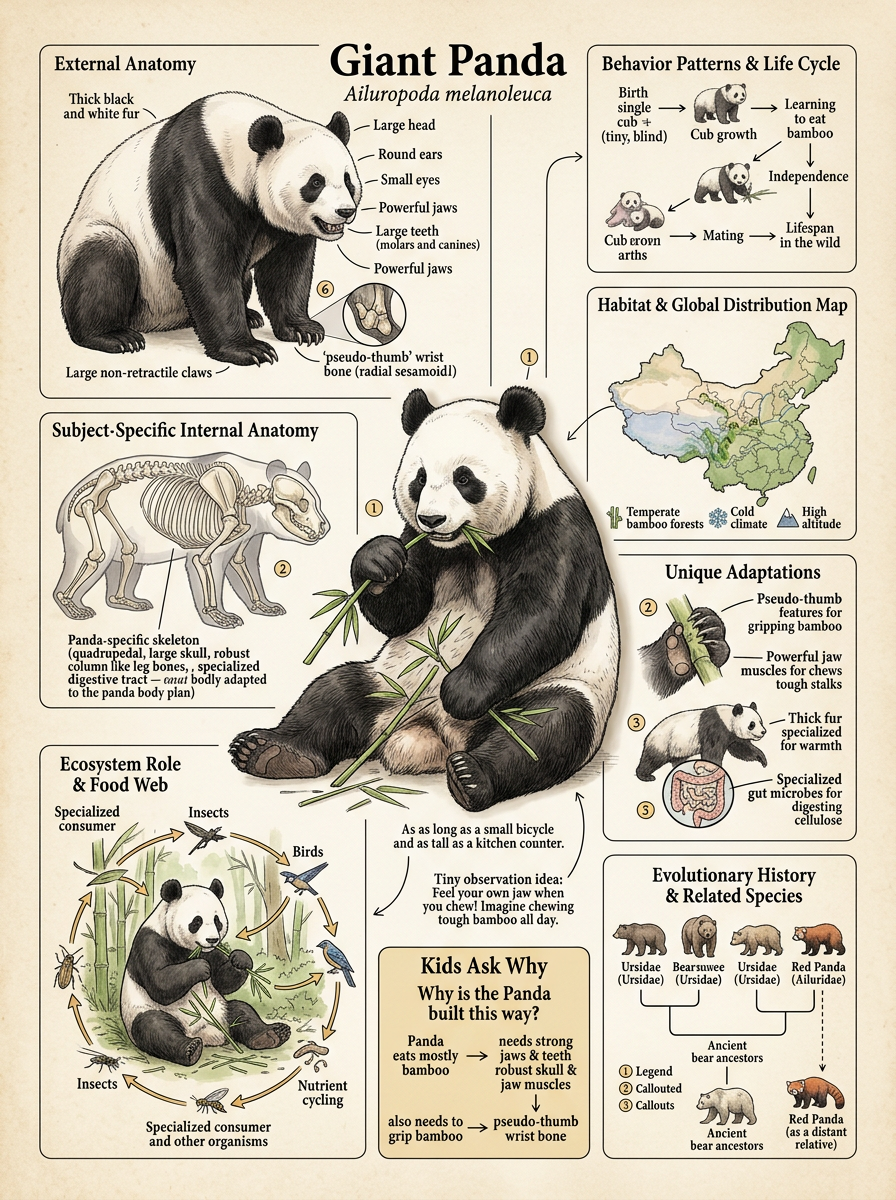
This pack includes a reviewed diagram poster and a Kids Ask Why page that turns curiosity into a short explanation and mini activity.

Page 2
Vocabulary Builder
My First Panda Words!
Panda
Trace the word 'PANDA' with your finger or a crayon.
Look at the panda picture. What colors do you see? Point to the panda's eyes, nose, and ears.
Waddle like a panda! Pretend to eat a big piece of bamboo. Point to something black, then something white in the room.
Panda Facts and Fun!
A panda is a black and white bear.
Pandas live in the mountains of China.
They love to eat bamboo all day long.
Complete the sentence: A panda is a _______ and _______ _______. It likes to eat _________.
Word bank: panda · black · white · bear · bamboo · eat
The Amazing Bamboo Bear!
Pandas are fascinating bears with a very special diet. Almost all of their food is bamboo, which is a tough plant not very rich in nutrients. Because of this, pandas must eat for many hours each day, sometimes up to 15 hours! To help them grip and strip bamboo, pandas have a unique 'thumb' on their front paws, which is actually an extra bone. Since bamboo provides little energy, pandas move slowly and spend a lot of...
Why do you think pandas need to eat so much bamboo and nap often?
Page 3
Size Science Lab
Read the size clue
A panda is a surprisingly big bear! Imagine a small bicycle. A panda can be about 1500 millimeters (1.5 meters) long from its nose to its tail, which is just like lying a small bicycle on its side. When a panda stands on all four legs, it's about 800 millimeters (80 centimeters) tall, similar to the height of your kitchen counter. They are also quite round, about 500 millimeters (50 centimeters) deep. That's half a meter! They are chunky, fluffy animals, much larger than they might seem in pictures.
Quick Check
How tall is a panda in centimeters?
Estimate
If a panda is 1.5 meters long, how many of your shoes would you need to line up to match its length?
Is a panda longer or shorter than your bed? Is it taller or shorter than your chair?
Page 4
Scientific Diagram Poster
Reviewed diagram
Panda Scientific Diagram with Kids Ask Why
Batch reviewed generated diagram for Pro Pack use. Check labels, Kids Ask Why panel, anatomy/context modules, and print readability.
2026-06-11
Page 5
Kids Ask Why Lab
Big Question
Why is the Panda built this way?
The Panda has body parts and behaviors that help it move, find food, stay safe, and live in its habitat.
How to diagram it
Connect one body part to one survival job with arrows and short labels.
Cause-and-effect arrows
1-minute activity
Choose one visible body part and ask what job it might help the animal do.
I noticed:
My answer in one sentence:
Draw your own explanation
Page 6
Comprehension + Drawing
1. What colors are pandas?
2. What do pandas mostly eat?
3. How long is a panda, like what object?
4. What do pandas do a lot to save energy?
Draw and compare
Draw a panda. Next to it, draw a small bicycle to show how long a panda is. How big is your panda compared to the bicycle?
Page 7
Answer Key + Teaching Notes
Answer Key
- 80 centimeters
- Answers will vary, e.g., 'black and white'
- Bamboo
- A small bicycle
- Nap or rest
Teaching Notes
- Encourage active participation by having children mimic panda actions.
- Use a real measuring tape to show 1.5 meters, 80 cm, and 50 cm for concrete understanding.
- For younger learners, focus on the visual aspects and key vocabulary.
- For older learners, emphasize the scientific explanation of the panda's diet and adaptations.
- Remind students that pandas are an endangered species and why it's important to protect them.
Extension Activity
Research other animals that eat only one type of food. How are their bodies adapted to their diet?
Unlock the full Pro library
This Pro Pack saves hours of preparation by providing structured, multi-level activities and clear teaching guidance for the 'Panda' object.