Free Printable Pack
Papillon printable lesson pack
Free to print or save as PDF — no account needed. Go ad-free for $9.9 (one-time).
SizeRef Pro Pack
Papillon
This pack provides engaging, age-appropriate activities to learn about a Papillon, enhancing English vocabulary and understanding.
Learning Goals
- Identify and name a Papillon.
- Describe a Papillon's key features, especially its ears.
- Understand the meaning of the name 'Papillon'.
- Compare the Papillon's size to familiar objects.
Teacher / Parent Setup
Print all activity sheets. Gather a ruler, a school textbook, and a smartphone for size comparisons. Prepare a picture of a Papillon and a butterfly.
Curiosity Focus
Why is the Papillon built this way?
This pack includes a reviewed diagram poster and a Kids Ask Why page that turns curiosity into a short explanation and mini activity.

Page 2
Vocabulary Builder
Little Learners: Meet the Papillon
Papillon
Trace the word 'Papillon' with your finger or a crayon.
Look at the picture of the Papillon. What do you see? Point to its big, fluffy ears!
Flap your hands like butterfly wings, just like a Papillon's ears!
Papillon Explorers: Words and Writing
A Papillon is a small, friendly dog.
It has big ears that look like butterfly wings.
The word 'Papillon' means 'butterfly' in French.
Write one sentence about what a Papillon's ears look like.
Word bank: dog · ears · small · fluffy · butterfly · friendly
Papillon Discoveries: Science and Cognition
The Papillon's name comes from the French word for 'butterfly,' which perfectly describes its large, upright ears. These ears are not just for show; they help the dog hear very well, picking up sounds from far away. Papillons are known for being very intelligent and easy to train, often excelling in dog sports. Their small size and alert nature make them excellent companions, always ready to play or learn new tricks....
Why do you think the Papillon's ears are so important for its name and its abilities?
Page 3
Size Science Lab
Read the size clue
Imagine a Papillon. It's about 450 millimeters (45.0 cm) long from its nose to its tail. That's like two standard rulers placed end-to-end! Its height is around 300 millimeters (30.0 cm), which is similar to the long side of a big school textbook. And it's about 100 millimeters (10.0 cm) deep, which is a bit wider than a smartphone. So, a Papillon is a small dog, but its length is quite noticeable, like a long, soft cushion.
Quick Check
How long is a Papillon from nose to tail?
Estimate
Without measuring, point to something in the room that is about 30 cm tall, like a Papillon's height.
How is a Papillon's size different from a cat's size?
Page 4
Scientific Diagram Poster
Reviewed diagram
Papillon Scientific Diagram with Kids Ask Why
Batch reviewed generated diagram for Pro Pack use. Check labels, Kids Ask Why panel, anatomy/context modules, and print readability.
2026-06-12
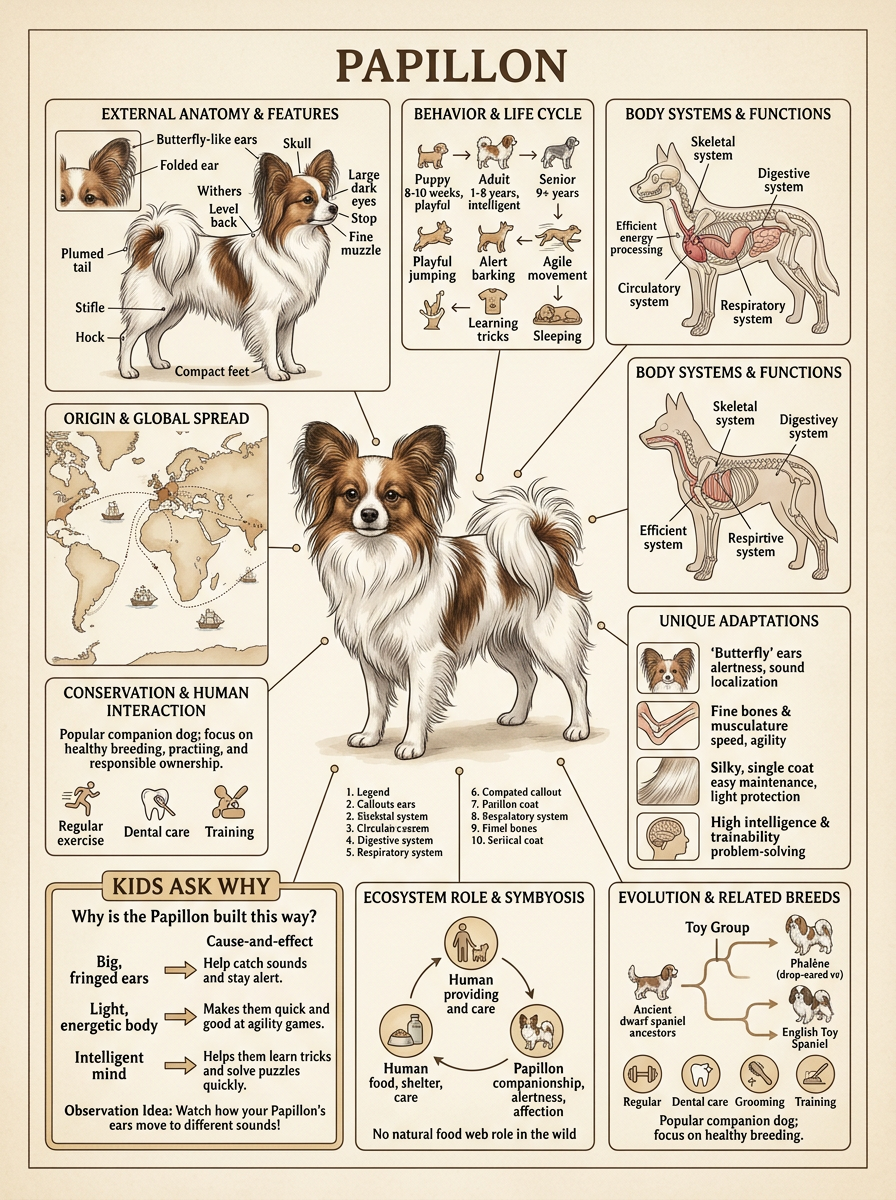
Page 5
Kids Ask Why Lab
Big Question
Why is the Papillon built this way?
The Papillon has body parts and behaviors that help it move, find food, stay safe, and live in its habitat.
How to diagram it
Connect one body part to one survival job with arrows and short labels.
Cause-and-effect arrows
1-minute activity
Choose one visible body part and ask what job it might help the animal do.
I noticed:
My answer in one sentence:
Draw your own explanation
Page 6
Comprehension + Drawing
1. What is a Papillon?
2. What do its ears look like?
3. What does 'Papillon' mean?
4. Are Papillons big or small dogs?
Draw and compare
Draw a Papillon. Then, draw a butterfly next to it. How are their 'wings' similar?
Page 7
Answer Key + Teaching Notes
Answer Key
- A Papillon is a small dog.
- Its ears look like butterfly wings.
- 'Papillon' means 'butterfly' in French.
- Papillons are small dogs.
- A Papillon is 450 millimeters (45.0 cm) long.
Teaching Notes
- Encourage students to use the word 'Papillon' often.
- Use visuals of real butterflies to reinforce the name meaning.
- Emphasize the size comparisons with familiar objects to build spatial understanding.
- Allow for creative answers in drawing and discussion prompts, focusing on language use.
- Adapt activities to suit individual learner's English level and attention span.
Extension Activity
Research other dog breeds named after animals or objects. What do their names mean?
Unlock the full Pro library
This pack offers a complete, ready-to-teach lesson, saving valuable preparation time for educators and parents.