Free Printable Pack
Plover printable lesson pack
Free to print or save as PDF — no account needed. Go ad-free for $9.9 (one-time).
SizeRef Pro Pack
Plover
This pack helps children learn about plovers and practice English skills.
Learning Goals
- Learn new vocabulary related to birds.
- Practice reading and writing simple sentences.
- Understand basic measurement concepts.
- Develop observation and critical thinking skills.
Teacher / Parent Setup
Print all pages. Gather crayons, pencils, and a ruler. Prepare a clear space for activities.
Curiosity Focus
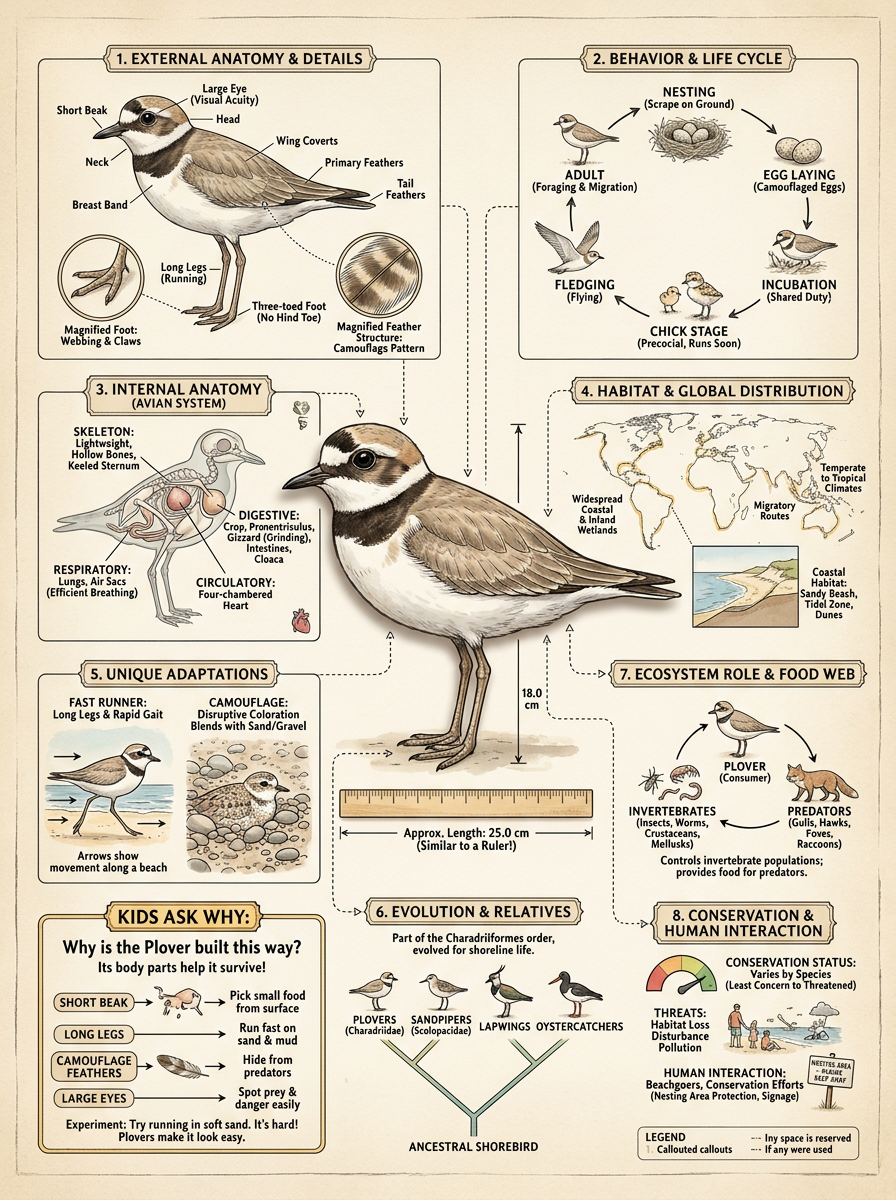
Why is the Plover built this way?
This pack includes a reviewed diagram poster and a Kids Ask Why page that turns curiosity into a short explanation and mini activity.

Page 2
Vocabulary Builder
Little Plover Fun
Plover
Trace the word "Plover" with your finger, then with a crayon.
Look at the plover picture. What colors do you see? What is it doing?
Pretend to be a plover. Run quickly like a plover on the sand!
Plover Story Time
A plover is a small bird.
It lives near the water.
Plovers run very fast.
Write a sentence about what a plover likes to do.
Word bank: Plover · bird · fast · beach · sand · run
Plover Science Deep Dive
Plovers are fascinating birds known for their "stop-and-go" foraging technique. They run a short distance, stop suddenly to scan for food, then run again. This method helps them spot tiny insects and crustaceans that might be hidden. Their large eyes give them excellent vision, crucial for finding food and watching for predators. This quick movement and sharp eyesight are examples of adaptations, special traits that...
Why do you think plovers need to be fast runners and have good eyesight to survive on the beach?
Page 3
Size Science Lab
Read the size clue
Imagine a standard school ruler; it's about 30 cm long. A plover is about 25.0 cm long from its beak to its tail, so it's a little shorter than a ruler! If you put two plovers nose-to-tail, they would be about 50 cm long. Its height is about 18.0 cm, which is like stacking two standard-sized soda cans. The plover's depth, or how wide it is from front to back, is only 6.0 cm, about the width of your hand. These measurements show plovers are small, compact birds, perfect for darting across the sand.
Quick Check
Is a plover longer or shorter than a 30 cm ruler?
Estimate
Estimate how many plovers, placed head-to-tail, would fit across your classroom door.
Compare the plover's length to the length of your shoe. Which is longer?
Page 4
Scientific Diagram Poster
Reviewed diagram
Plover Scientific Diagram with Kids Ask Why
Batch reviewed generated diagram for Pro Pack use. Check labels, Kids Ask Why panel, anatomy/context modules, and print readability.
2026-06-11
Page 5
Kids Ask Why Lab
Big Question
Why is the Plover built this way?
The Plover has body parts and behaviors that help it move, find food, stay safe, and live in its habitat.
How to diagram it
Connect one body part to one survival job with arrows and short labels.
Cause-and-effect arrows
1-minute activity
Choose one visible body part and ask what job it might help the animal do.
I noticed:
My answer in one sentence:
Draw your own explanation
Page 6
Comprehension + Drawing
1. What kind of animal is a plover?
2. Where does a plover like to live?
3. What is special about how plovers run?
4. What do plovers eat?
Draw and compare
Draw a plover running on the beach. Then, draw a ruler next to it to show its size.
Page 7
Answer Key + Teaching Notes
Answer Key
- (Quick Check Question) Shorter.
- (Comprehension Q1) A bird.
- (Comprehension Q2) Near the water, on the beach.
- (Comprehension Q3) They run very fast in a stop-and-go way.
- (Comprehension Q4) Insects and crustaceans.
Teaching Notes
- Encourage learners to use gestures when describing plover actions.
- Use real rulers or measuring tapes for the science activities.
- For younger learners, focus on key vocabulary and simple sentences.
- Discuss the importance of protecting beach habitats for plovers.
- Adapt activities to suit individual learner needs and English levels.
Extension Activity
Research different types of plovers and their habitats around the world.
Unlock the full Pro library
This comprehensive pack provides ready-to-use, age-appropriate activities, saving valuable lesson planning time.