Free Printable Pack
Popcorn printable lesson pack
Free to print or save as PDF — no account needed. Go ad-free for $9.9 (one-time).
SizeRef Pro Pack
Popcorn
This Pro Pack offers ready-to-teach English, science, and cognition lessons about popcorn for all ages.
Learning Goals
- Identify and describe 'popcorn' using new vocabulary.
- Understand basic size comparisons and measurements.
- Learn how popcorn changes from a kernel to a snack.
- Develop critical thinking skills through discussion and estimation.
Teacher / Parent Setup
Gather real popcorn (popped and unpopped kernels if possible) and a ruler. Prepare drawing materials and ensure access to a printer for worksheets.
Curiosity Focus
Why does the Popcorn work the way it does?
This pack includes a reviewed diagram poster and a Kids Ask Why page that turns curiosity into a short explanation and mini activity.

Page 2
Vocabulary Builder
Little Poppers
Popcorn
Trace the word: P-O-P-C-O-R-N
Look at the picture of popcorn. What color is it? Is it soft or hard? What shape is it?
Hold up your hand and pretend to eat popcorn! Say 'Pop! Pop! Pop!'
Popcorn Builders
Popcorn is a yummy snack.
It starts as a tiny, hard kernel.
When heated, the kernel pops into a fluffy treat.
Use three words from the word bank to write two sentences about popcorn.
Word bank: snack · tiny · kernel · heated · fluffy · movies
The Science of Pop!
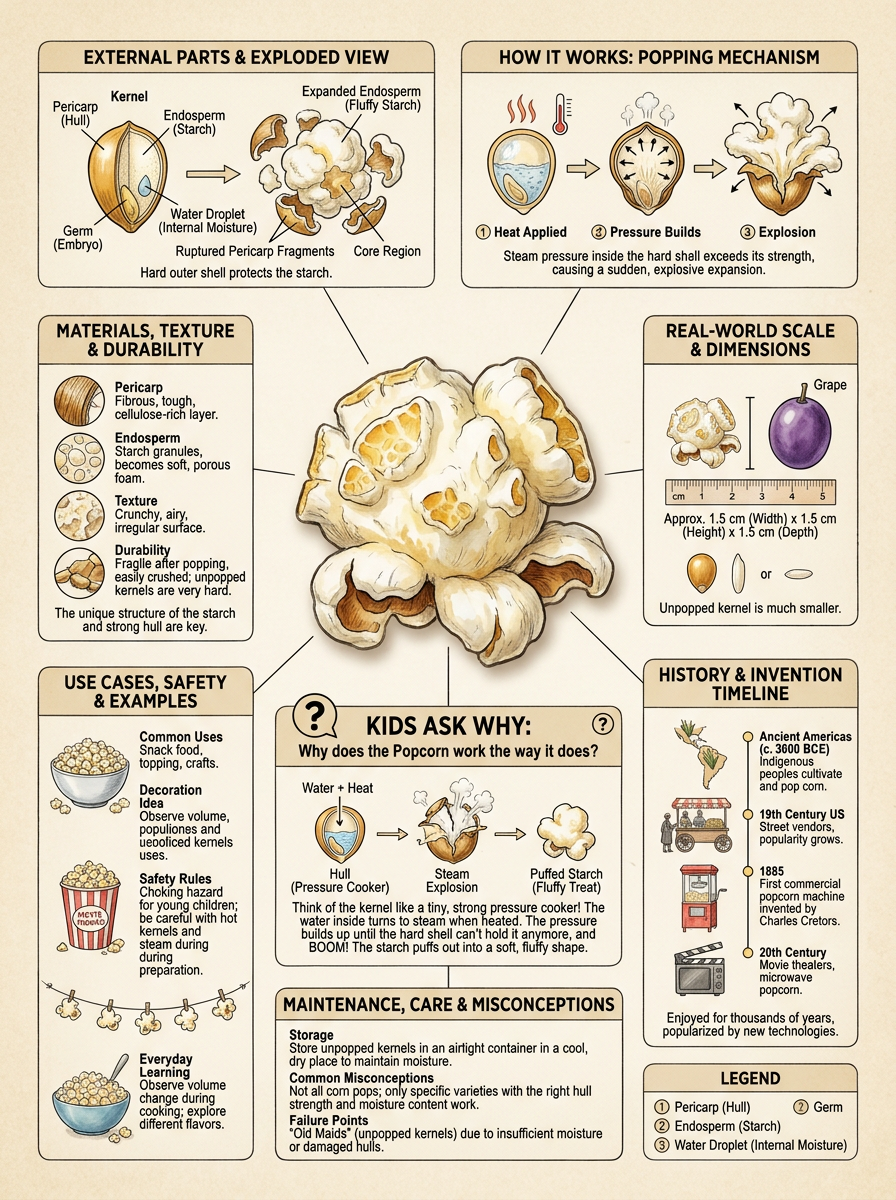
Popcorn is special because each kernel has a tiny drop of water inside. When you heat a kernel, this water turns into steam. The steam builds up pressure until the kernel's hard shell can't hold it anymore. POP! The kernel bursts open, and the starchy inside explodes and cools quickly, creating the light, fluffy snack we love. This rapid change is a physical transformation driven by heat and pressure.
Why do you think popcorn is such a popular snack for watching movies or sports?
Page 3
Size Science Lab
Read the size clue
Imagine a single piece of popped popcorn. It's quite small! Each piece is about 15 millimeters wide, 15 millimeters high, and 15 millimeters deep. That's 1.5 centimeters in every direction. To help you picture this, a single piece of popcorn is about the same size as a plump grape, a small marble, or a large blueberry. It's much bigger than the tiny, hard kernel it started as, which is only about 5 millimeters. Think about how much a kernel expands to become this fluffy snack!
Quick Check
How wide is one piece of popcorn in millimeters?
Estimate
Estimate how many pieces of popcorn would fit in the palm of your hand.
How is a piece of popcorn different in size and shape from the unpopped kernel?
Page 4
Scientific Diagram Poster
Reviewed diagram
Popcorn Scientific Diagram with Kids Ask Why
Batch reviewed generated diagram for Pro Pack use. Check labels, Kids Ask Why panel, anatomy/context modules, and print readability.
2026-06-11
Page 5
Kids Ask Why Lab
Big Question
Why does the Popcorn work the way it does?
The Popcorn works because its shape, materials, parts, and forces fit together to solve a real-world problem.
How to diagram it
Use arrows to connect the main parts to their jobs, then show the input and output.
Cause-and-effect arrows
1-minute activity
Find one part of the object and explain what would happen if that part was missing.
I noticed:
My answer in one sentence:
Draw your own explanation
Page 6
Comprehension + Drawing
1. What kind of snack is popcorn?
2. What does a popcorn kernel need to turn into popcorn?
3. About how big is one piece of popcorn?
4. Where do people often eat popcorn?
Draw and compare
Draw a picture of a single piece of popcorn next to something else that is about 15mm big. Label both objects.
Page 7
Answer Key + Teaching Notes
Answer Key
- Popcorn is a yummy, fluffy snack.
- It needs heat (and water inside) to pop.
- One piece of popcorn is about 15 millimeters (or 1.5 centimeters) big, like a grape.
- People often eat popcorn at the movies.
- 15 millimeters.
Teaching Notes
- Use real popcorn (popped and unpopped) for a multisensory experience.
- Encourage students to describe popcorn using adjectives like 'fluffy,' 'crunchy,' 'salty,' 'buttery.'
- For younger learners, focus on the 'pop' sound and action.
- Emphasize the transformation from small kernel to big snack.
- Connect the science explanation to real-world examples of steam and pressure.
Extension Activity
Have students measure and compare the size of an unpopped kernel to a popped piece of popcorn, then calculate how much bigger it gets.
Unlock the full Pro library
This Pro Pack provides differentiated, ready-to-use activities and explanations, saving hours of lesson planning and resource creation.