Free Printable Pack
Python printable lesson pack
Free to print or save as PDF — no account needed. Go ad-free for $9.9 (one-time).
SizeRef Pro Pack
Python
This Pro Pack offers engaging, age-appropriate activities to teach English vocabulary and science concepts about pythons.
Learning Goals
- Identify the word 'python' and its meaning.
- Understand basic facts about python size and diet.
- Practice English vocabulary related to animals and measurements.
- Develop critical thinking skills about animal adaptations.
Teacher / Parent Setup
Print all activity pages. Gather crayons, pencils, and a measuring tape or string. Review the answer key and teaching notes before starting.
Curiosity Focus
Why is the Python built this way?
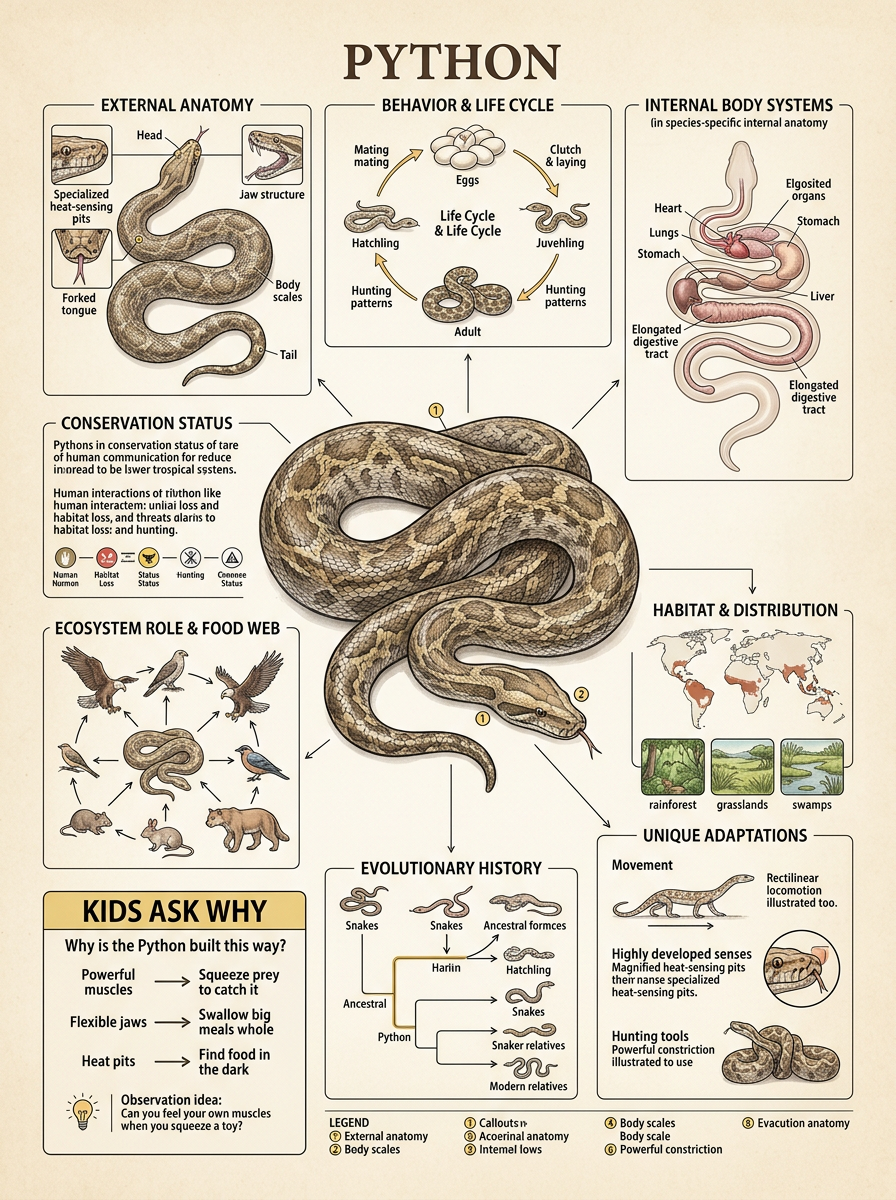
This pack includes a reviewed diagram poster and a Kids Ask Why page that turns curiosity into a short explanation and mini activity.

Page 2
Vocabulary Builder
Little Learners: Pythons
Python
Trace the word 'python' with your finger or a crayon.
Look at the python picture. What colors do you see on its skin? Is it long or short?
Stretch out your arms wide like a long, long python. Can you slither on the floor like a python?
Growing Readers: Python Facts
A python is a very long snake.
Pythons can be as long as a family car.
They eat animals bigger than their head.
Write one sentence about what a python eats.
Word bank: snake · long · car · eat · wrap · food
Expert Explorers: Python Adaptations
Pythons are fascinating predators. They are known as constrictors, meaning they squeeze their prey very tightly. This action stops the prey from breathing. Unlike many animals that chew their food, pythons swallow their meals whole. Their jaws are specially adapted to open incredibly wide, allowing them to eat animals much larger than their own head, sometimes even a deer! This incredible ability is a key survival st...
Why do you think a python needs to be so long to catch its food?
Page 3
Size Science Lab
Read the size clue
Imagine a python that is 4000 millimeters long. That's 4 meters! To help you picture this, think about your family's car. Many cars are about 4 meters long. So, a python can be as long as an entire car! Now, imagine its body is about 150 millimeters wide and 150 millimeters deep. That's 15 centimeters. This is about the width of a large soda can or a small ruler. Even though it's not very thick, its incredible length makes it a powerful hunter.
Quick Check
How many meters long can a python be?
Estimate
Estimate how many of your shoes, placed heel to toe, would equal the width of a python.
Find something in your classroom or home that is about 15 cm long. How does it compare to the python's width?
Page 4
Scientific Diagram Poster
Reviewed diagram
Python Scientific Diagram with Kids Ask Why
Batch reviewed generated diagram for Pro Pack use. Check labels, Kids Ask Why panel, anatomy/context modules, and print readability.
2026-06-12
Page 5
Kids Ask Why Lab
Big Question
Why is the Python built this way?
The Python has body parts and behaviors that help it move, find food, stay safe, and live in its habitat.
How to diagram it
Connect one body part to one survival job with arrows and short labels.
Cause-and-effect arrows
1-minute activity
Choose one visible body part and ask what job it might help the animal do.
I noticed:
My answer in one sentence:
Draw your own explanation
Page 6
Comprehension + Drawing
1. What kind of animal is a python?
2. How long can a python be?
3. What special thing can pythons do with their food?
4. Name one word to describe a python.
Draw and compare
Draw a python. Next to it, draw something that is about the same length as a python. Label both drawings.
Page 7
Answer Key + Teaching Notes
Answer Key
- A python is a snake.
- A python can be 4 meters long (or as long as a family car).
- Pythons can swallow prey bigger than their own head.
- Long, big, strong, constrictor (any reasonable adjective).
- 4 meters (for the quick check question).
Teaching Notes
- Encourage learners to use gestures when describing the python's length.
- For younger learners, focus on visual recognition and simple vocabulary.
- Discuss the difference between 'long' and 'wide/deep' using real-world examples.
- Emphasize the unique jaw adaptation for swallowing large prey.
- Connect the python's size and body shape to its hunting strategy.
Extension Activity
Research different types of pythons and their habitats, then draw your favorite one.
Unlock the full Pro library
This Pro Pack provides ready-to-use, differentiated activities and comprehensive notes, saving valuable preparation time for educators.