Free Printable Pack
Ray printable lesson pack
Free to print or save as PDF — no account needed. Go ad-free for $9.9 (one-time).
SizeRef Pro Pack
Ray
This comprehensive pack offers age-appropriate English language and science activities for learners of all levels, ready to print and teach.
Learning Goals
- Identify the animal 'ray' and its key features.
- Understand basic vocabulary related to ocean animals and movement.
- Grasp comparative size concepts using familiar objects.
- Develop early reading, writing, and critical thinking skills.
Teacher / Parent Setup
Print all activity pages. Prepare a large image or video of a ray for visual reference. Gather crayons, pencils, and paper for drawing.
Curiosity Focus
Why is the Ray built this way?
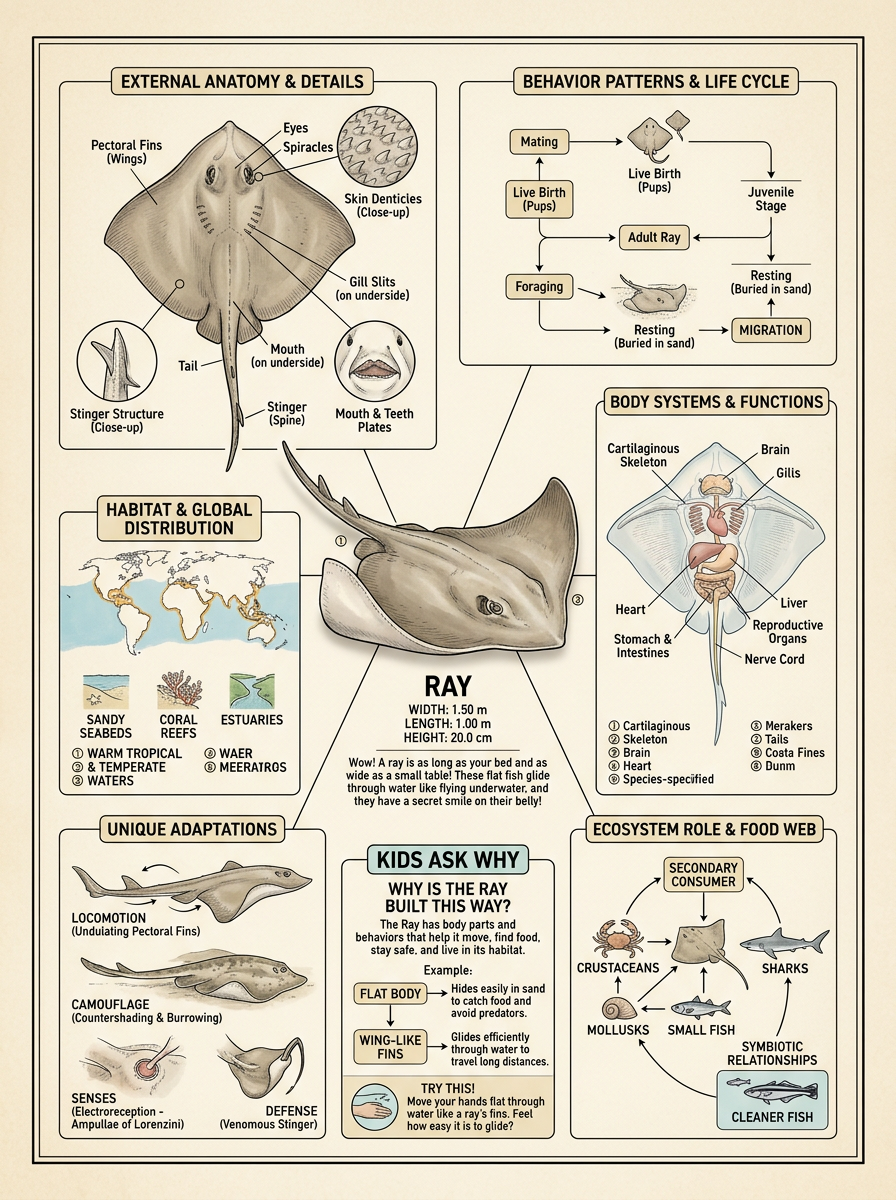
This pack includes a reviewed diagram poster and a Kids Ask Why page that turns curiosity into a short explanation and mini activity.

Page 2
Vocabulary Builder
Little Learners: Ray Fun
Ray
Trace the word 'Ray' with your finger, then with a crayon. What colors do you see on the ray?
Look at the picture of the ray. Point to its big fins. Can you find its eyes? Where is its 'secret smile'?
Pretend to be a ray! Glide your arms like big fins, moving slowly and smoothly across the floor.
Young Explorers: Ray Facts
A ray is a type of fish.
It has a flat body and big fins.
Rays glide through the water like they are flying.
Write one sentence about how a ray moves in the water.
Word bank: ray · fish · flat · fins · glide · ocean
Deep Dive: Ray Wonders
Rays are incredible ocean creatures with a unique body shape that helps them thrive. Unlike most fish that swim by wiggling their bodies, rays use their large, flat pectoral fins like wings to 'fly' or glide through the water. This special movement is called undulation. Their flattened bodies also allow them to hide easily on the sandy seafloor, blending in with their surroundings. Plus, their mouths and gill slits o...
How does a ray's flat body and unique way of swimming help it survive in the ocean?
Page 3
Size Science Lab
Read the size clue
Imagine a ray! It can be very big. A ray can be 1.50 meters wide. That's like the length of a small dining table, or even wider than many doors! It can be 1.00 meter long, which is about the height of a small child or a large dog. But rays are quite flat, only about 20 centimeters tall. That's thinner than a stack of three school books! So, a ray is wide and long, but not very tall, making it perfect for gliding close to the ocean floor.
Quick Check
How wide can a large ray be in meters?
Estimate
If you lie down on the floor, how many 'you's' long do you think a 1.00-meter ray is?
Compare the height of a ray (20 cm) to the height of your school backpack.
Page 4
Scientific Diagram Poster
Reviewed diagram
Ray Scientific Diagram with Kids Ask Why
Batch reviewed generated diagram for Pro Pack use. Check labels, Kids Ask Why panel, anatomy/context modules, and print readability.
2026-06-12
Page 5
Kids Ask Why Lab
Big Question
Why is the Ray built this way?
The Ray has body parts and behaviors that help it move, find food, stay safe, and live in its habitat.
How to diagram it
Connect one body part to one survival job with arrows and short labels.
Cause-and-effect arrows
1-minute activity
Choose one visible body part and ask what job it might help the animal do.
I noticed:
My answer in one sentence:
Draw your own explanation
Page 6
Comprehension + Drawing
1. What kind of animal is a ray?
2. How does a ray move in the water?
3. Where can you find a ray's 'secret smile'?
4. Is a ray tall or flat?
Draw and compare
Draw a picture of a ray swimming. Then, draw something next to it that is about the same length as a ray (1.00 meter).
Page 7
Answer Key + Teaching Notes
Answer Key
- A fish.
- It glides or 'flies' with its fins.
- On its belly (underside).
- Flat.
- 1.50 meters.
Teaching Notes
- Encourage learners to use their hands to show the size of the ray when discussing dimensions.
- Use a large picture or video of a ray to enhance visual learning and engagement.
- For younger children, focus on the 'gliding' movement and the 'secret smile' to build excitement.
- For older children, discuss different types of rays (e.g., manta ray, stingray) if time allows.
- Emphasize that 'depth' here refers to the ray's length from head to tail, not how deep it lives.
Extension Activity
Create a 'Ray Fact Card' with a drawing of a ray, its size, and two interesting facts you learned from this lesson.
Unlock the full Pro library
This pack provides ready-to-use, age-differentiated activities and clear instructions, saving valuable preparation time for busy educators.