Free Printable Pack
Rice printable lesson pack
Free to print or save as PDF — no account needed. Go ad-free for $9.9 (one-time).
SizeRef Pro Pack
Rice
This Pro Pack provides ready-to-use, age-appropriate activities to teach English and science concepts using the everyday object: rice.
Learning Goals
- Identify and name 'rice' in English.
- Understand the small size of a single grain of rice.
- Learn about rice as a global food source.
- Practice English vocabulary and sentence structure related to food.
Teacher / Parent Setup
Print all pages for the lesson. Prepare a small bowl of uncooked rice for hands-on activities. Have drawing and writing supplies ready for learners.
Curiosity Focus
Why does the Rice work the way it does?
This pack includes a reviewed diagram poster and a Kids Ask Why page that turns curiosity into a short explanation and mini activity.

Page 2
Vocabulary Builder
My First Rice Words
Rice
Trace the word 'rice' with your finger or a crayon. Say 'rice' as you trace.
Look at the picture of rice. What color is it? Is it big or small?
Point to the rice on your plate. Can you make a 'tiny' finger gesture like a grain of rice?
Rice Facts and Sentences
Rice is a small grain.
Many people eat rice every day.
Rice grows in warm places.
Write one sentence about your favorite way to eat rice.
Word bank: grain · small · eat · cook · food · world
The Global Story of Rice
Rice is more than just food; it's a staple for over half the world's population. This tiny grain, measuring about 7 millimeters long, provides essential energy. Its ability to grow in diverse climates and feed so many people makes it incredibly important for global food security. Think about how many grains are in just one bowl – it's a huge number! This shows how small things can have a massive impact on human life...
Why do you think rice is so important to people all over the world?
Page 3
Size Science Lab
Read the size clue
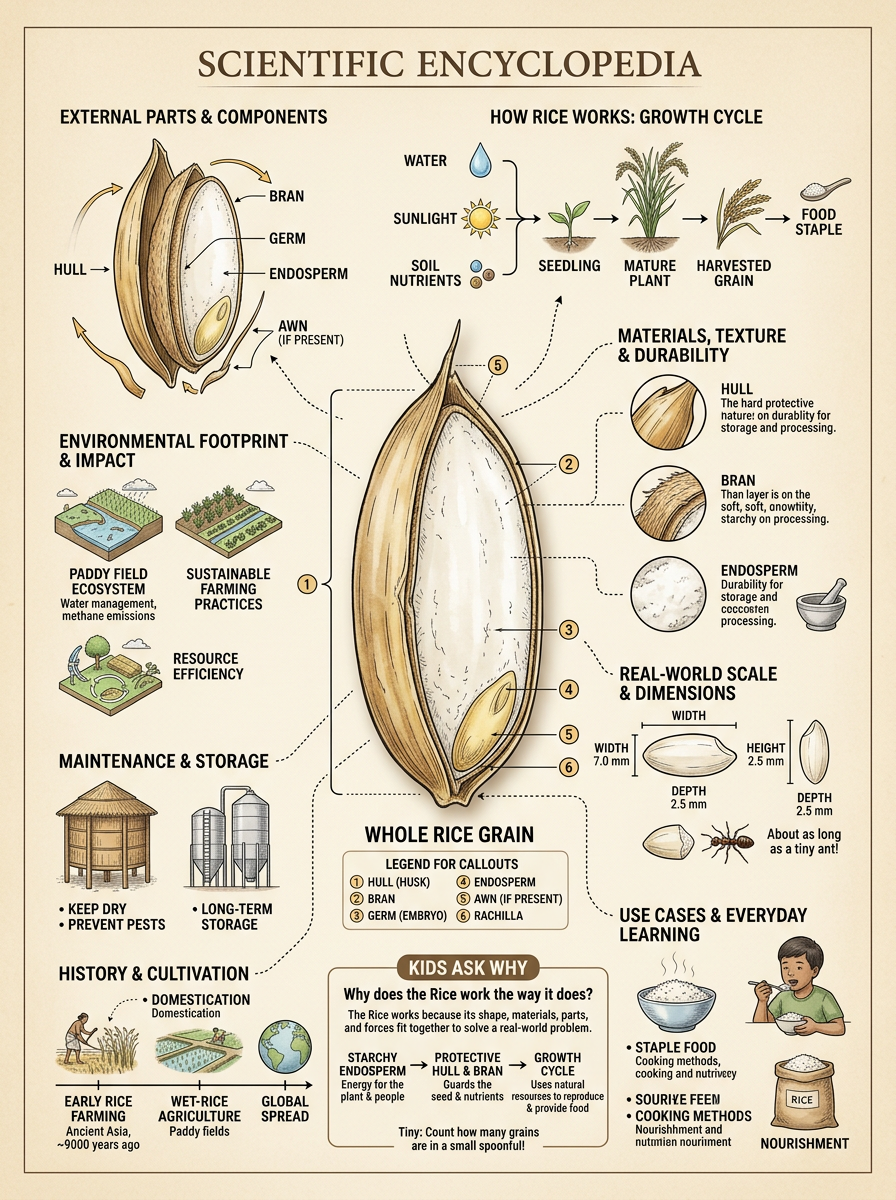
A single grain of rice is incredibly small, measuring just 7.0 millimeters long, 2.5 millimeters high, and 2.5 millimeters deep. To help you imagine this, a grain of rice is about the same length as a tiny ant! If you put ten grains of rice end-to-end, they would be about 7 centimeters long, which is shorter than your hand. It's amazing that something so small feeds billions of people daily. This shows how many grains are needed to make a meal and how important even tiny things can be in our world.
Quick Check
How long is one grain of rice?
Estimate
Estimate how many grains of rice are in one spoonful.
Compare the size of a grain of rice to a small button or a piece of confetti.
Page 4
Scientific Diagram Poster
Reviewed diagram
Rice Scientific Diagram with Kids Ask Why
Batch reviewed generated diagram for Pro Pack use. Check labels, Kids Ask Why panel, anatomy/context modules, and print readability.
2026-06-11
Page 5
Kids Ask Why Lab
Big Question
Why does the Rice work the way it does?
The Rice works because its shape, materials, parts, and forces fit together to solve a real-world problem.
How to diagram it
Use arrows to connect the main parts to their jobs, then show the input and output.
Cause-and-effect arrows
1-minute activity
Find one part of the object and explain what would happen if that part was missing.
I noticed:
My answer in one sentence:
Draw your own explanation
Page 6
Comprehension + Drawing
1. What is the name of the food we are learning about?
2. Is a grain of rice big or small?
3. Who eats rice every day?
4. What is one way people cook rice?
Draw and compare
Draw a picture of rice growing in a field. Then, draw a tiny grain of rice next to something much bigger, like a plate or a spoon, to show its size.
Page 7
Answer Key + Teaching Notes
Answer Key
- Rice.
- It is small.
- Many people all over the world.
- They can boil it, fry it, or steam it. (Accept any reasonable answer like 'cook it').
- 7.0 millimeters.
Teaching Notes
- Encourage multi-sensory learning: let children touch and feel uncooked rice.
- Use visual aids like pictures of rice fields and different rice dishes from around the world.
- Emphasize the global aspect of rice consumption and its cultural significance.
- Adapt activities to suit the specific English proficiency level of the learners.
- Celebrate all attempts at speaking and writing, focusing on communication and understanding.
Extension Activity
Research different types of rice (e.g., brown, white, basmati, sticky) and where they come from, then share your findings with the class or family.
Unlock the full Pro library
This pack saves hours of preparation by providing structured, engaging, and age-appropriate content for teaching about rice and its global importance.