Free Printable Pack
Robin printable lesson pack
Free to print or save as PDF — no account needed. Go ad-free for $9.9 (one-time).
SizeRef Pro Pack
Robin
This pack offers ready-to-use, age-specific activities to teach English and science through the fascinating world of the robin.
Learning Goals
- Identify and spell the word 'robin'.
- Describe a robin's appearance and common behaviors.
- Compare the robin's size to familiar objects using measurements.
- Use new vocabulary to form simple sentences and discuss observations.
Teacher / Parent Setup
Print all activity pages. Gather crayons, pencils, a ruler, and a picture or video of a robin. Prepare for outdoor listening if possible.
Curiosity Focus
Why is the Robin built this way?
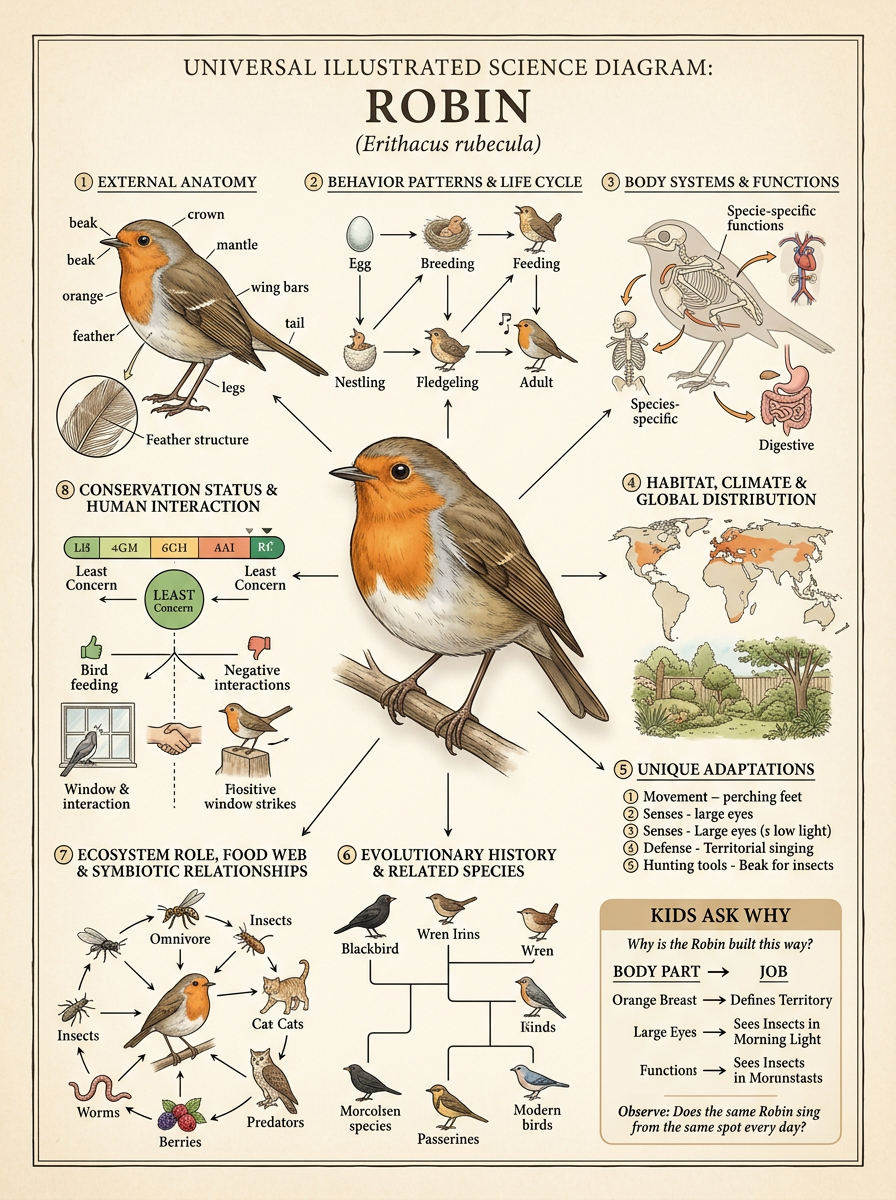
This pack includes a reviewed diagram poster and a Kids Ask Why page that turns curiosity into a short explanation and mini activity.

Page 2
Vocabulary Builder
My First Robin Words
Robin
Trace the letters: R-O-B-I-N. Say 'robin' as you trace each letter!
Look closely at the robin picture. What color is its chest? Can you see its wings and tail?
Flap your arms like a robin flying! Point to its beak, then its feet, then its red chest.
Robin Stories and Sentences
A robin is a small bird.
It has a bright red-orange chest.
Robins sing beautiful songs in the morning.
Write two sentences about the robin using at least three words from the word bank.
Word bank: bird · red · sing · worms · nest · fly
Robin Habits and Habitat
Robins are known for their beautiful songs, especially at dawn. Male robins sing to attract a mate and to mark their territory, telling other birds to stay away. Their songs can be complex, with different sounds meaning different things, like a warning call or a happy tune. Listening to a robin's song is a great way to connect with nature and understand how animals communicate. It helps them find food and stay safe t...
Why do you think robins sing so early in the morning, and what might their songs be communicating?
Page 3
Size Science Lab
Read the size clue
A robin is a small bird. From its beak to its tail, it measures about 140 millimeters long, which is 14 centimeters. That's about the length of a standard pencil! It stands about 110 millimeters (11 cm) tall, almost as tall as a small juice box. And it's quite thin, only about 30 millimeters (3 cm) deep, like the thickness of a small book. So, it's long like a pencil, tall like a juice box, and thin like a book!
Quick Check
How many centimeters long is a robin from beak to tail?
Estimate
Hold your hand up. How long do you think a robin is from your thumb to your pinky finger? Now, measure it with a ruler.
Find something in your room that is about the same length as a robin (14 cm).
Page 4
Scientific Diagram Poster
Reviewed diagram
Robin Scientific Diagram with Kids Ask Why
Batch reviewed generated diagram for Pro Pack use. Check labels, Kids Ask Why panel, anatomy/context modules, and print readability.
2026-06-11
Page 5
Kids Ask Why Lab
Big Question
Why is the Robin built this way?
The Robin has body parts and behaviors that help it move, find food, stay safe, and live in its habitat.
How to diagram it
Connect one body part to one survival job with arrows and short labels.
Cause-and-effect arrows
1-minute activity
Choose one visible body part and ask what job it might help the animal do.
I noticed:
My answer in one sentence:
Draw your own explanation
Page 6
Comprehension + Drawing
1. What color is a robin's chest?
2. When does a robin sing its beautiful songs?
3. What are two things a robin likes to eat?
4. Why do male robins sing?
Draw and compare
Draw a robin. Try to make your drawing about 14 centimeters long, like a real robin. How does your drawing compare to a real robin's size?
Page 7
Answer Key + Teaching Notes
Answer Key
- Red-orange.
- In the morning (or at dawn).
- Worms and berries (or insects).
- To attract a mate and mark their territory.
- 14 centimeters.
Teaching Notes
- Encourage children to make bird sounds and mimic robin movements.
- Point out the robin's distinct red chest and other colors in the provided picture.
- For ESL learners, repeat new vocabulary clearly and have them echo the words.
- Connect the robin's size comparisons to objects readily available in the classroom or home.
- Discuss what other birds the children know and how they are similar or different from a robin.
Extension Activity
Go outside and listen for bird songs. Can you hear a robin? Try to draw what you imagine the robin is doing while it sings.
Unlock the full Pro library
This pack provides a complete, ready-to-use lesson with differentiated activities, saving hours of research and activity creation time for busy educators and parents.