Free Printable Pack
Rooster printable lesson pack
Free to print or save as PDF — no account needed. Go ad-free for $9.9 (one-time).
SizeRef Pro Pack
Rooster
This pack helps children learn about roosters, English vocabulary, and size comparisons through fun, ready-to-use activities.
Learning Goals
- Identify and name a rooster in English.
- Understand basic facts about roosters.
- Practice English vocabulary and sentence structure.
- Develop an understanding of size and measurement concepts.
Teacher / Parent Setup
Print all pages. Prepare a picture of a rooster for visual reference. Gather pencils, crayons, and paper for drawing activities.
Curiosity Focus
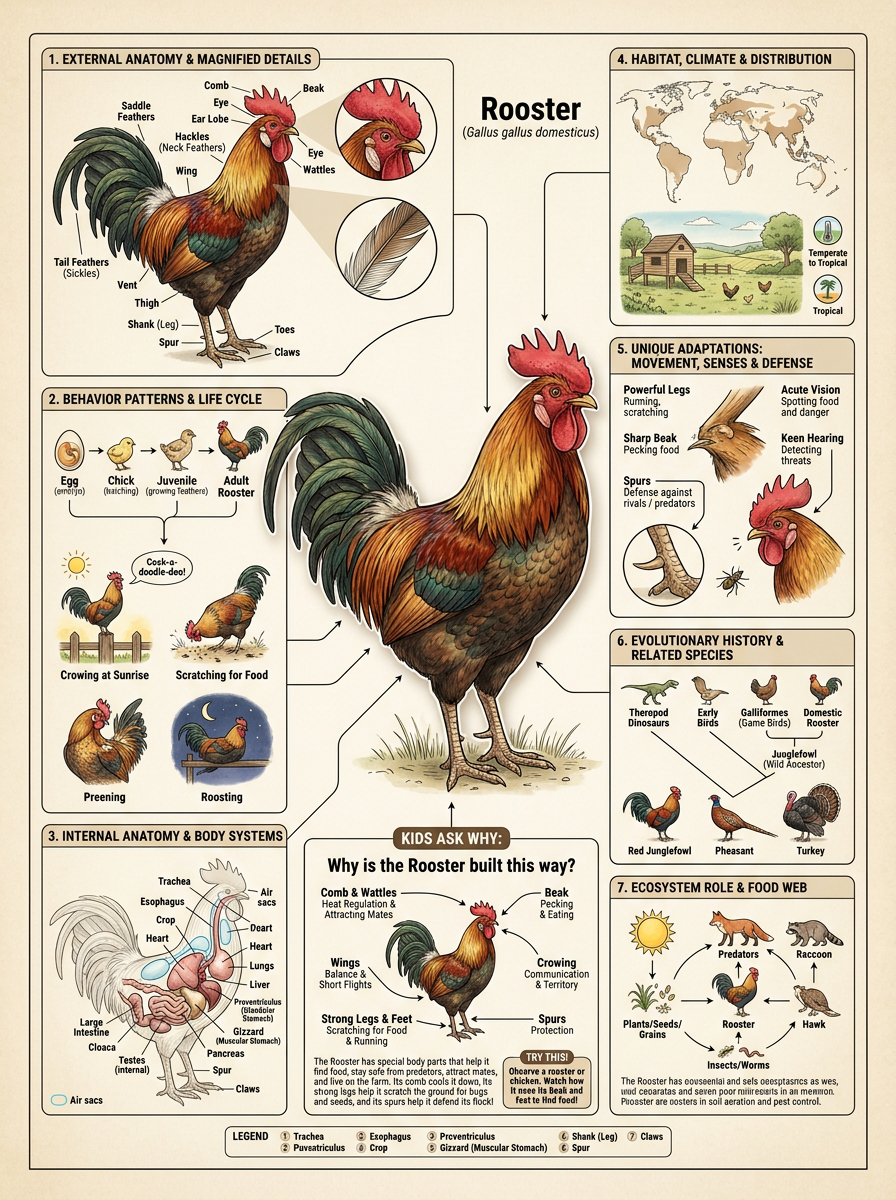
Why is the Rooster built this way?
This pack includes a reviewed diagram poster and a Kids Ask Why page that turns curiosity into a short explanation and mini activity.

Page 2
Vocabulary Builder
Meet the Rooster!
Rooster
Trace the word 'Rooster' with your finger or a crayon.
Look at the rooster picture. What colors do you see? Can you find its comb and wattle?
Flap your arms like a rooster's wings! Then, make a loud 'cock-a-doodle-doo' sound!
Rooster Words and Sentences
A rooster is a farm bird.
It has colorful feathers.
Roosters crow very loudly.
Use three words from the word bank to write two sentences about a rooster.
Word bank: rooster · crow · feathers · farm · morning · loud
The Rooster's Morning Call
Roosters crow to tell other roosters where their territory is. It's like saying, 'This is my space!' They also crow to show who is the boss in their group of chickens. This loud call, 'cock-a-doodle-doo,' helps them communicate important messages about safety and leadership, even though they don't always crow exactly at sunrise. It's a natural behavior driven by their instincts and social structure.
Why do you think roosters need to tell other roosters where their territory is? How is this like other animals you know?
Page 3
Size Science Lab
Read the size clue
Imagine a rooster! It can be about 800 millimeters (80 centimeters) long, which is almost as long as a baseball bat. It stands about 600 millimeters (60 centimeters) tall, like a small dog or your little brother's waist. From front to back, it's about 180 millimeters (18 centimeters) deep, which is similar to the length of a common school ruler. So, a rooster is a good-sized bird, not too small and not too big for a farm animal!
Quick Check
How many centimeters long is a rooster?
Estimate
If a rooster is 60 cm tall, how many roosters would you need to stack to reach a door that is 200 cm tall?
Is a rooster taller or shorter than a cat? (A cat is usually about 25-30 cm tall.)
Page 4
Scientific Diagram Poster
Reviewed diagram
Rooster Scientific Diagram with Kids Ask Why
Batch reviewed generated diagram for Pro Pack use. Check labels, Kids Ask Why panel, anatomy/context modules, and print readability.
2026-06-11
Page 5
Kids Ask Why Lab
Big Question
Why is the Rooster built this way?
The Rooster has body parts and behaviors that help it move, find food, stay safe, and live in its habitat.
How to diagram it
Connect one body part to one survival job with arrows and short labels.
Cause-and-effect arrows
1-minute activity
Choose one visible body part and ask what job it might help the animal do.
I noticed:
My answer in one sentence:
Draw your own explanation
Page 6
Comprehension + Drawing
1. What sound does a rooster make?
2. Where does a rooster usually live?
3. What time of day do roosters often crow?
4. What are two colorful parts you might see on a rooster's head?
Draw and compare
Draw a rooster. Then, draw something next to it that is about the same height as a rooster (60 cm).
Page 7
Answer Key + Teaching Notes
Answer Key
- Cock-a-doodle-doo!
- On a farm.
- In the morning (or sunrise).
- Comb and wattle.
- 80 centimeters.
Teaching Notes
- Use real pictures or videos of roosters to enhance learning.
- Encourage children to make the rooster sound during activities.
- For younger learners, focus on colors and sounds before words.
- When discussing size, use objects in the room for comparison.
- Adapt writing tasks for different skill levels; allow drawing for those who can't write yet.
Extension Activity
Listen to different rooster sounds online and try to imitate them. Discuss why roosters might sound different.
Unlock the full Pro library
This ready-to-use pack saves valuable preparation time with age-appropriate content and clear instructions.