Free Printable Pack
Scallion printable lesson pack
Free to print or save as PDF — no account needed. Go ad-free for $9.9 (one-time).
SizeRef Pro Pack
Scallion
This Pro Pack offers ready-to-use, multi-level activities to teach English vocabulary and science concepts about a scallion.
Learning Goals
- Identify and name a scallion in English.
- Describe the physical characteristics of a scallion.
- Understand basic size and measurement concepts using a scallion.
- Learn about a scallion's life cycle as a young onion.
Teacher / Parent Setup
Print the lesson pack. Gather a real scallion, a pencil, and drawing supplies. Prepare a space for movement activities.
Curiosity Focus
Why is the Scallion built this way?
This pack includes a reviewed diagram poster and a Kids Ask Why page that turns curiosity into a short explanation and mini activity.

Page 2
Vocabulary Builder
Little Learners: Meet a Scallion!
Scallion
Trace the word 'scallion' with your finger or a crayon.
Look at the picture of the scallion. What colors do you see? Point to the green part. Point to the white part.
Stand up tall like a long green scallion! Now wiggle like a scallion in the wind.
Scallion Sentences and Stories
A scallion is a vegetable.
It looks like a long, green onion.
We can eat scallions in salads.
Write two sentences about what a scallion looks like or where it grows.
Word bank: scallion · green · white · vegetable · onion · salad
Scallions: Baby Onions and More!
A scallion is a young plant from the onion family. It's harvested before its bulb grows big and round like a mature onion. This makes it long and thin, with a mild flavor. Botanically, it's often the same species as a regular onion, *Allium cepa*, but picked at an earlier stage. Sometimes, 'spring onions' or 'green onions' are other names for scallions. They're a great source of vitamins and add a fresh, zesty taste...
Why do you think some plants are harvested when they are young, like a scallion, instead of waiting for them to fully grow?
Page 3
Size Science Lab
Read the size clue
A typical scallion is about 25.0 centimeters (250mm) long. Imagine a standard pencil, from its tip to the end of its eraser – that's roughly the length of a scallion! Its thickness is quite small, around 1.5 centimeters (15mm) in both width and depth. This means it's about as wide as your little finger. So, a scallion is long and thin, not round and fat like a big onion. It's like a long, green stick of flavor!
Quick Check
How long is a scallion in centimeters?
Estimate
Without measuring, find an object in the classroom or home that you think is about the same length as a scallion.
How is the shape of a scallion different from a regular, round onion?
Page 4
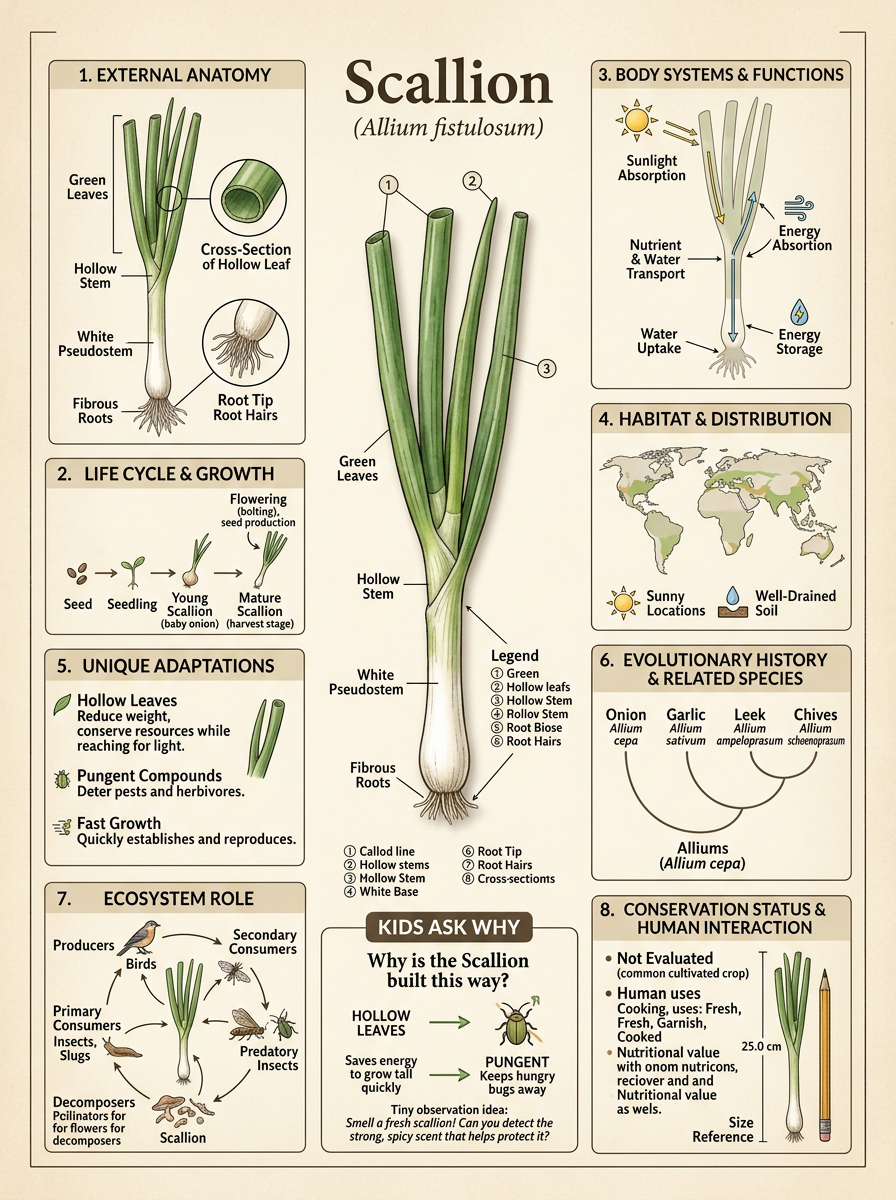
Scientific Diagram Poster
Reviewed diagram
Scallion Scientific Diagram with Kids Ask Why
Batch reviewed generated diagram for Pro Pack use. Check labels, Kids Ask Why panel, anatomy/context modules, and print readability.
2026-06-12
Page 5
Kids Ask Why Lab
Big Question
Why is the Scallion built this way?
The Scallion has body parts and behaviors that help it move, find food, stay safe, and live in its habitat.
How to diagram it
Connect one body part to one survival job with arrows and short labels.
Cause-and-effect arrows
1-minute activity
Choose one visible body part and ask what job it might help the animal do.
I noticed:
My answer in one sentence:
Draw your own explanation
Page 6
Comprehension + Drawing
1. What color is the top part of a scallion?
2. Is a scallion a fruit or a vegetable?
3. What is another name for a scallion?
4. What kind of plant does a scallion grow into if it gets bigger?
Draw and compare
Draw a picture of a scallion next to an object that is about the same length, like a pencil. Label both items.
Page 7
Answer Key + Teaching Notes
Answer Key
- Green.
- A vegetable.
- Green onion or spring onion.
- A regular onion (with a big bulb).
- 25.0 centimeters (or 250mm).
Teaching Notes
- Use real scallions if possible for a sensory experience.
- Encourage students to touch, smell, and even taste a small piece (if safe and allowed).
- Connect the scallion to other vegetables they know.
- Emphasize the 'baby onion' concept for younger learners.
- Review measurements and comparisons frequently.
Extension Activity
Plan a simple recipe using scallions, like a chopped salad or a stir-fry, and discuss the ingredients and steps.
Unlock the full Pro library
This pack provides differentiated, ready-to-teach content, saving educators valuable lesson planning time.