Free Printable Pack
Spoonbill printable lesson pack
Free to print or save as PDF — no account needed. Go ad-free for $9.9 (one-time).
SizeRef Pro Pack
Spoonbill
This Pro Pack offers ready-to-use, multi-age activities to teach English vocabulary and science concepts about the unique spoonbill.
Learning Goals
- Identify the spoonbill and its key features.
- Learn descriptive words related to the spoonbill and its habitat.
- Understand how the spoonbill's specialized bill helps it find food.
- Compare the spoonbill's size to familiar objects using measurements.
Teacher / Parent Setup
Print the Spoonbill image and activity sheets. Prepare crayons, pencils, and a ruler or tape measure. Have a large open space for movement activities.
Curiosity Focus
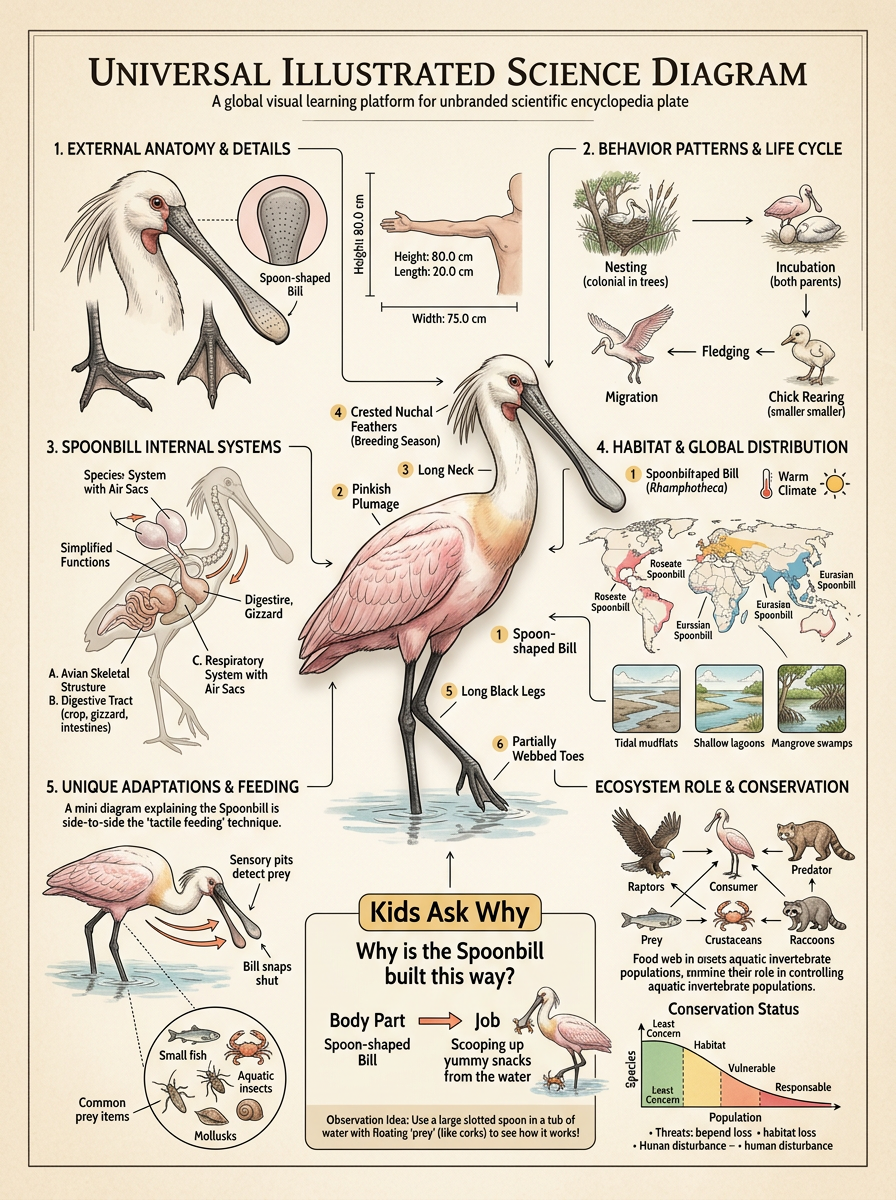
Why is the Spoonbill built this way?
This pack includes a reviewed diagram poster and a Kids Ask Why page that turns curiosity into a short explanation and mini activity.

Page 2
Vocabulary Builder
Spoonbill Fun for Little Learners
Spoonbill
Trace the word 'Spoonbill' with your finger or a crayon.
Look at the spoonbill picture. What color is it? What shape is its mouth?
Pretend your hand is a spoonbill's bill. Scoop up imaginary water or food. Wiggle your body like a bird!
Spoonbill Sentences and Words
A spoonbill is a large bird.
It has a special bill shaped like a spoon.
Spoonbills eat small fish and insects.
Write two sentences about what a spoonbill eats using words from the word bank.
Word bank: spoonbill · bird · bill · scoop · water · fish
Spoonbill Science and Adaptations
The spoonbill's unique bill is a perfect example of adaptation. Its flat, wide tip acts like a natural sieve or scoop, allowing the bird to sweep its head side to side in shallow water. This motion helps it feel for and catch small aquatic creatures like fish, insects, and crustaceans, which are then trapped in its bill. This specialized feeding strategy means the spoonbill doesn't need to see its prey to catch it, m...
How does the spoonbill's bill help it survive better than a bird with a pointy bill in the same environment?
Page 3
Size Science Lab
Read the size clue
Imagine holding your arm straight out from your shoulder to your fingertips. That's about how long a spoonbill is, around 80.0 cm tall! Its body is about 75.0 cm wide, which is like two large school rulers placed end-to-end. The spoonbill is also about 20.0 cm deep, similar to the length of a standard pencil. These measurements show it's a fairly large bird, especially its height, making it easy to spot in its watery habitat. Its unique size helps it wade through shallow waters to find food.
Quick Check
Is a spoonbill taller or wider?
Estimate
Estimate how many standard school pencils, placed end-to-end, would equal the spoonbill's depth.
Find an object in your classroom or home that is about 75.0 cm wide. What is it?
Page 4
Scientific Diagram Poster
Reviewed diagram
Spoonbill Scientific Diagram with Kids Ask Why
Batch reviewed generated diagram for Pro Pack use. Check labels, Kids Ask Why panel, anatomy/context modules, and print readability.
2026-06-11
Page 5
Kids Ask Why Lab
Big Question
Why is the Spoonbill built this way?
The Spoonbill has body parts and behaviors that help it move, find food, stay safe, and live in its habitat.
How to diagram it
Connect one body part to one survival job with arrows and short labels.
Cause-and-effect arrows
1-minute activity
Choose one visible body part and ask what job it might help the animal do.
I noticed:
My answer in one sentence:
Draw your own explanation
Page 6
Comprehension + Drawing
1. What shape is a spoonbill's bill?
2. What does a spoonbill eat?
3. Where do spoonbills live?
4. How does its bill help it find food?
Draw and compare
Draw a spoonbill. Then, draw another bird next to it with a different shaped bill. How are their bills different?
Page 7
Answer Key + Teaching Notes
Answer Key
- Taller.
- About 1 pencil.
- Its bill is shaped like a spoon.
- Small fish, insects, and other water creatures.
- Near water, like swamps and lakes.
Teaching Notes
- Encourage learners to act out the spoonbill's feeding motion.
- Use a real ruler or tape measure to demonstrate the spoonbill's dimensions.
- Discuss different types of bird bills and their functions.
- For younger learners, focus on colors and sounds associated with birds.
- Emphasize the 'spoon' shape of the bill for vocabulary reinforcement.
Extension Activity
Research different types of spoonbills (e.g., Roseate Spoonbill, Eurasian Spoonbill) and compare their colors and habitats.
Unlock the full Pro library
This comprehensive pack provides ready-to-implement, age-differentiated activities, saving hours of lesson planning and resource creation.