Free Printable Pack
Sweets printable lesson pack
Free to print or save as PDF — no account needed. Go ad-free for $9.9 (one-time).
SizeRef Pro Pack
Sweets
This Pro Pack offers ready-to-use activities and clear teaching guidance for exploring the word 'sweet' and its size.
Learning Goals
- Identify the word 'sweet' and its meaning.
- Describe the taste and appearance of sweets.
- Understand basic size comparisons using 'sweet' as a reference.
- Practice early literacy and writing skills related to sweets.
Teacher / Parent Setup
Print the activity sheets. Gather a few small sweets (if allowed) and a ruler or measuring tape. Prepare colored pencils or crayons for drawing activities.
Curiosity Focus
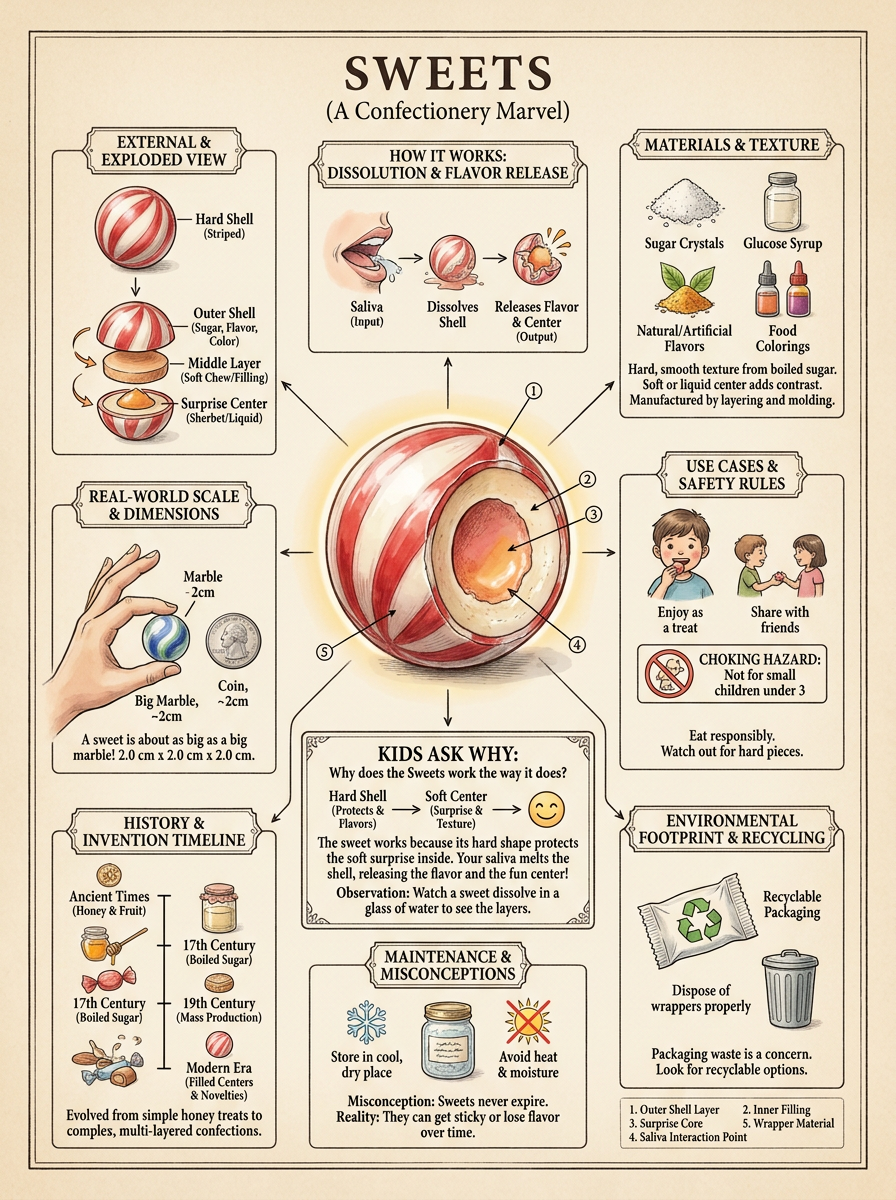
Why does the Sweets work the way it does?
This pack includes a reviewed diagram poster and a Kids Ask Why page that turns curiosity into a short explanation and mini activity.

Page 2
Vocabulary Builder
My First Sweet Words
Sweets
Trace the word 'sweet' with your finger, then with a crayon. Say 'sweet' as you trace.
Look at the picture of the sweet. What colors do you see? Does it look yummy?
Point to your mouth and say 'Mmm, sweet!' when you see a sweet in the picture.
Sweets: Reading & Writing
A sweet is a small, tasty treat.
Sweets can be different colors.
Some sweets are hard, and some are chewy.
Write one sentence about your favorite kind of sweet or what a sweet tastes like.
Word bank: sweet · tasty · small · chewy · candy · sugar
The Science of Sweetness
Our tongues have special taste buds that can detect different flavors, including sweet. When we eat a sweet, the sugar in it sends signals to our brain. Our brain releases 'feel-good' chemicals, which is why eating sweets often makes us happy! This is a natural response, but it's important to remember that too much sugar isn't good for our bodies. Enjoying sweets in small amounts helps us appreciate their special tas...
Why do you think humans enjoy the taste of sweet things so much, and how does this affect our food choices?
Page 3
Size Science Lab
Read the size clue
Imagine a tiny cube that is 20 millimeters wide, 20 millimeters high, and 20 millimeters deep. That's how big a sweet is! This is about the same size as a big marble you might play with. It's also similar to the size of a dice used in board games, but maybe a little rounder. If you hold a small button, it might be close to the size of a sweet. Sweets are small enough to pop right into your mouth for a quick taste!
Quick Check
How many millimeters wide is a sweet?
Estimate
Estimate how many sweets would fit across your palm, side by side.
Find one object in the room that is smaller than a sweet and one object that is bigger than a sweet.
Page 4
Scientific Diagram Poster
Reviewed diagram
Sweets Scientific Diagram with Kids Ask Why
Batch reviewed generated diagram for Pro Pack use. Check labels, Kids Ask Why panel, anatomy/context modules, and print readability.
2026-06-11
Page 5
Kids Ask Why Lab
Big Question
Why does the Sweets work the way it does?
The Sweets works because its shape, materials, parts, and forces fit together to solve a real-world problem.
How to diagram it
Use arrows to connect the main parts to their jobs, then show the input and output.
Cause-and-effect arrows
1-minute activity
Find one part of the object and explain what would happen if that part was missing.
I noticed:
My answer in one sentence:
Draw your own explanation
Page 6
Comprehension + Drawing
1. What is a sweet?
2. What colors can sweets be?
3. What does a sweet taste like?
4. Why do sweets make us feel happy?
Draw and compare
Draw a picture of your favorite sweet. Next to it, draw something that is much bigger than your sweet.
Page 7
Answer Key + Teaching Notes
Answer Key
- A sweet is 20 millimeters wide.
- Answers will vary for how many sweets fit across a palm.
- Answers will vary for smaller and bigger objects.
- A sweet is a small, tasty treat.
- Sweets can be many different colors.
Teaching Notes
- Encourage students to use descriptive words when talking about sweets (e.g., 'shiny', 'round', 'fizzy').
- If possible, bring a few small, individually wrapped sweets (allergy-safe) for a real-life size comparison.
- Emphasize that sweets are treats to be enjoyed in moderation.
- For younger learners, focus on the visual and tactile aspects of sweets.
- Use the drawing prompt to reinforce size concepts like 'bigger' and 'smaller'.
Extension Activity
Create a 'Sweet Shop' role-play area where students can practice buying and selling sweets, using new vocabulary and simple math.
Unlock the full Pro library
This pack provides a complete, multi-age lesson plan and activities, saving hours of research and preparation time.