Free Printable Pack
Tea printable lesson pack
Free to print or save as PDF — no account needed. Go ad-free for $9.9 (one-time).
SizeRef Pro Pack
Tea
This Pro Pack offers ready-to-use, age-differentiated activities to explore the word 'tea' and its real-world connections.
Learning Goals
- Identify the word 'tea' and its meaning.
- Understand tea as a warm drink enjoyed globally.
- Describe the size of a tea cup using measurements.
- Learn basic facts about tea production and culture.
Teacher / Parent Setup
Print the activity sheets for each age group. Gather drawing supplies like crayons or markers. Have a real cup of tea (or an empty cup) available for demonstration.
Curiosity Focus
Why does the Tea work the way it does?
This pack includes a reviewed diagram poster and a Kids Ask Why page that turns curiosity into a short explanation and mini activity.

Page 2
Vocabulary Builder
My First Tea Words
Tea
Trace the letters to write the word 'tea'. Say 'tea' as you trace.
Look at the picture of the tea cup. What do you see? Is the tea hot or cold? What color is the tea?
Pretend to hold a warm cup of tea. Take a pretend sip and say 'Mmm, delicious tea!'
Tea Time Stories
Tea is a warm drink.
Many people drink tea in the morning.
You can add milk or sugar to tea.
Write one sentence about when you would like to drink tea.
Word bank: warm · drink · cup · hot · plant · sugar
The Science of Tea
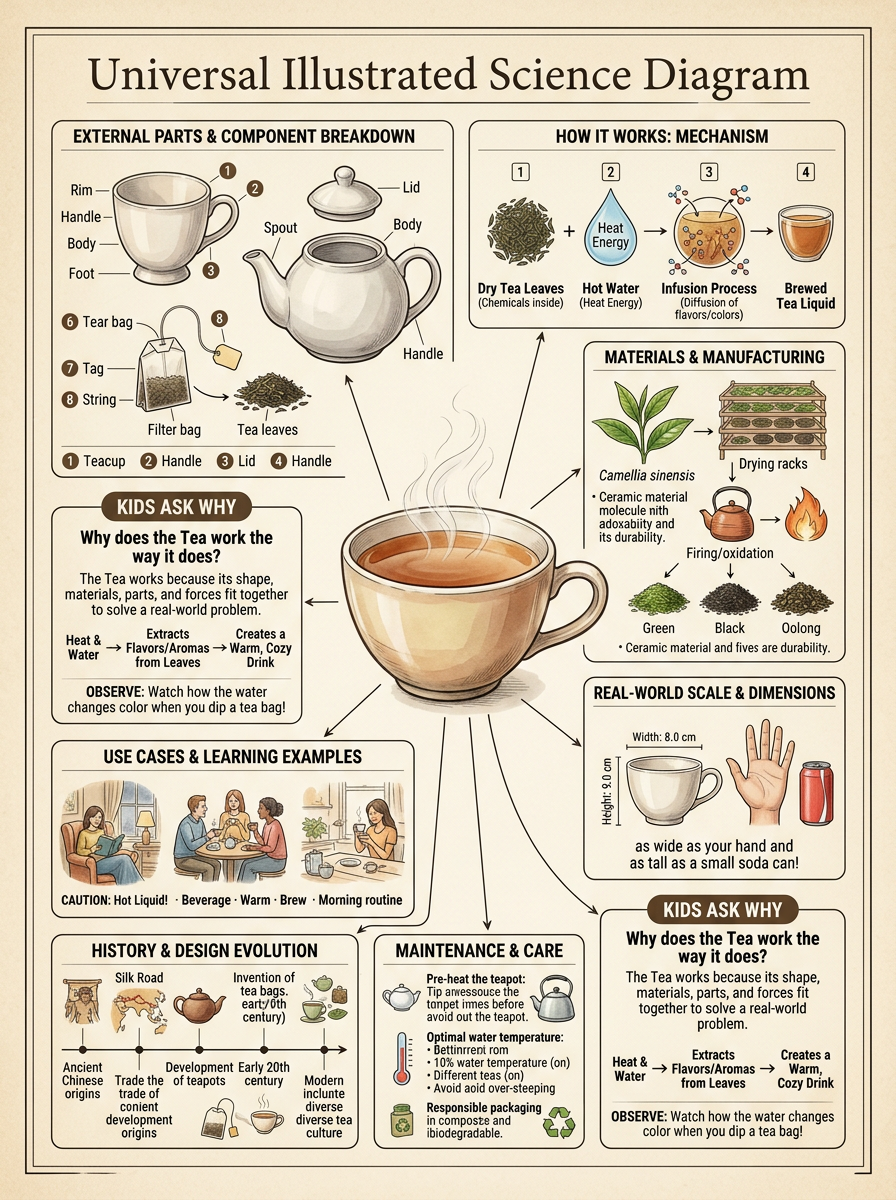
Tea leaves come from the Camellia sinensis plant. When hot water is added to these leaves, compounds like tannins and caffeine are released. Tannins give tea its color and some of its taste, while caffeine is a natural stimulant that can make you feel more awake. Different types of tea, like green, black, or oolong, depend on how the leaves are processed after picking, affecting their flavor and chemical composition.
Why do you think different cultures have special ceremonies or times for drinking tea?
Page 3
Size Science Lab
Read the size clue
A typical cup of tea is about 80 millimeters (8 centimeters) wide, which is roughly the width of your hand. It stands about 90 millimeters (9 centimeters) tall, similar to a small soda can. The depth is also around 80 millimeters. This size makes it easy to hold and perfect for a warm, comforting drink. Imagine holding a small ball in your hand – that's close to the width of a tea cup!
Quick Check
How tall is a cup of tea in centimeters?
Estimate
Find an object in your classroom or home that you think is about 8 cm wide. What is it?
How is the size of a tea cup similar to or different from a coffee mug?
Page 4
Scientific Diagram Poster
Reviewed diagram
Tea Scientific Diagram with Kids Ask Why
Batch reviewed generated diagram for Pro Pack use. Check labels, Kids Ask Why panel, anatomy/context modules, and print readability.
2026-06-11
Page 5
Kids Ask Why Lab
Big Question
Why does the Tea work the way it does?
The Tea works because its shape, materials, parts, and forces fit together to solve a real-world problem.
How to diagram it
Use arrows to connect the main parts to their jobs, then show the input and output.
Cause-and-effect arrows
1-minute activity
Find one part of the object and explain what would happen if that part was missing.
I noticed:
My answer in one sentence:
Draw your own explanation
Page 6
Comprehension + Drawing
1. What is tea?
2. Is tea usually hot or cold?
3. What can you add to tea?
4. Where do tea leaves come from?
Draw and compare
Draw a picture of yourself enjoying a cup of tea. Show what you would add to your tea and where you would drink it.
Page 7
Answer Key + Teaching Notes
Answer Key
- 9 cm
- Tea is a warm drink.
- Tea is usually hot.
- You can add milk or sugar to tea.
- Tea leaves come from a plant (Camellia sinensis).
Teaching Notes
- Encourage learners to share their own experiences with tea.
- Use real tea bags or leaves to show the raw material.
- Discuss different types of tea (e.g., black, green, herbal).
- Emphasize safety if using hot water for demonstrations.
- Connect tea to geography by showing countries known for tea production.
Extension Activity
Have a 'tea party' where students can try different (decaffeinated) teas and describe their flavors.
Unlock the full Pro library
This Pro Pack provides comprehensive, ready-to-teach materials, saving educators valuable lesson planning time.