Free Printable Pack
Tuna printable lesson pack
Free to print or save as PDF — no account needed. Go ad-free for $9.9 (one-time).
SizeRef Pro Pack
Tuna
This Pro Pack helps children learn about tuna through engaging activities, visual comparisons, and science facts.
Learning Goals
- Identify and name a tuna.
- Understand basic facts about tuna size and speed.
- Practice English vocabulary related to fish and the ocean.
- Develop critical thinking skills through comparison and estimation.
Teacher / Parent Setup
Print all activity sheets. Gather crayons, pencils, and a ruler or tape measure. Prepare a space for movement activities.
Curiosity Focus
Why does the Tuna work the way it does?
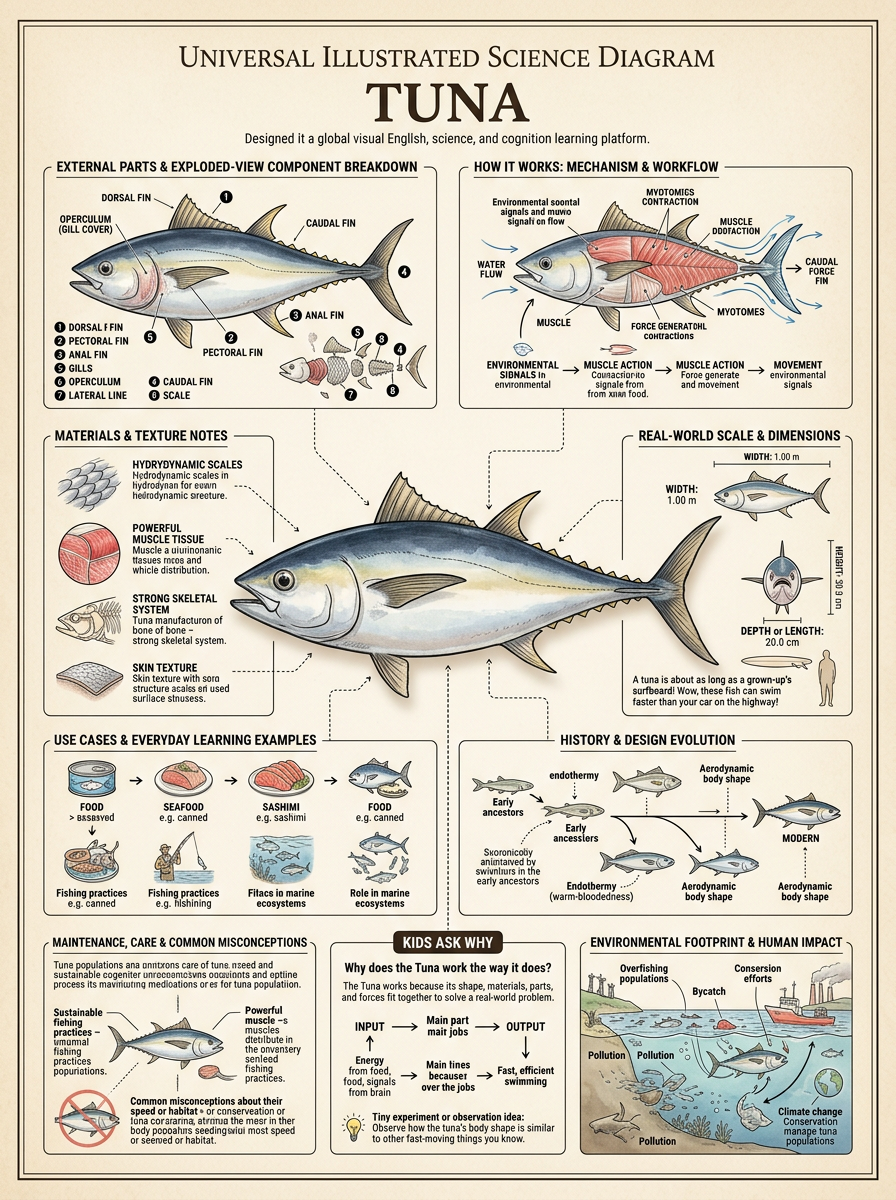
This pack includes a reviewed diagram poster and a Kids Ask Why page that turns curiosity into a short explanation and mini activity.

Page 2
Vocabulary Builder
Meet the Tuna!
Tuna
Trace the word 'TUNA' with your finger, then with a crayon.
Look at the tuna picture. What color is the tuna? Can you see its fins?
Pretend to swim like a fast tuna! Wiggle your body and move your arms quickly.
Tuna Facts and Fun
A tuna is a very big fish.
It lives in the ocean and swims very fast.
Tuna can be as long as a grown-up's surfboard!
Write two sentences about what you learned about tuna.
Word bank: fish · ocean · swim · fast · big · fins
Tuna: An Amazing Swimmer
Tuna are incredible ocean athletes. Their sleek, torpedo-shaped bodies help them cut through water with very little drag. This special body shape, along with powerful tail fins, allows them to swim at amazing speeds, much faster than a car on the highway! Tuna also have a unique ability to keep their bodies warmer than the surrounding water, which helps their muscles work more efficiently for long, fast journeys acro...
Why is it important for tuna to be able to swim so fast and travel long distances?
Page 3
Size Science Lab
Read the size clue
Imagine a tuna! It can be very long, about 1000 millimeters (1 meter), which is like the length of a grown-up's surfboard. Its body is about 300 millimeters (30 centimeters) tall, like a tall stack of dinner plates. And it's about 200 millimeters (20 centimeters) deep, similar to the width of a small shoebox. These amazing fish are huge, especially compared to many other ocean creatures. They need this size to be powerful and fast swimmers in the big ocean.
Quick Check
How long is a tuna in meters?
Estimate
Estimate how many small fish could fit along the length of one tuna.
Compare the width of a tuna (200mm) to the height of a standard soda can (about 120mm). Which is bigger?
Page 4
Scientific Diagram Poster
Reviewed diagram
Tuna Scientific Diagram with Kids Ask Why
Batch reviewed generated diagram for Pro Pack use. Check labels, Kids Ask Why panel, anatomy/context modules, and print readability.
2026-06-11
Page 5
Kids Ask Why Lab
Big Question
Why does the Tuna work the way it does?
The Tuna works because its shape, materials, parts, and forces fit together to solve a real-world problem.
How to diagram it
Use arrows to connect the main parts to their jobs, then show the input and output.
Cause-and-effect arrows
1-minute activity
Find one part of the object and explain what would happen if that part was missing.
I noticed:
My answer in one sentence:
Draw your own explanation
Page 6
Comprehension + Drawing
1. What is the name of the fish we learned about?
2. Where does a tuna live?
3. Is a tuna a fast or slow swimmer?
4. What is one thing a tuna is compared to in size?
Draw and compare
Draw a picture of a tuna next to something you think is about the same size as its height (30cm).
Page 7
Answer Key + Teaching Notes
Answer Key
- Tuna
- In the ocean
- Fast
- A surfboard
- 1 meter
Teaching Notes
- Encourage children to use gestures when describing tuna.
- Emphasize the 'wow' factor of tuna's speed and size.
- Provide visual aids for size comparisons (e.g., a tape measure, a picture of a surfboard).
- Allow for creative answers in drawing and estimation tasks.
- For ESL learners, pre-teach key vocabulary if needed.
Extension Activity
Research different types of tuna and their migration paths on a world map.
Unlock the full Pro library
This Pro Pack provides ready-to-use, age-differentiated activities, saving hours of lesson planning and resource creation.