Free Printable Pack
Turkey printable lesson pack
Free to print or save as PDF — no account needed. Go ad-free for $9.9 (one-time).
SizeRef Pro Pack
Turkey
This Pro Pack uses engaging visuals and multi-age activities to teach English and science concepts about a turkey.
Learning Goals
- Identify and name 'a turkey' in English.
- Learn basic facts about turkeys, including their sounds and behaviors.
- Practice English vocabulary and simple sentence structures related to turkeys.
- Understand and compare the size of a turkey using measurements and familiar objects.
Teacher / Parent Setup
Print all activity sheets and prepare drawing materials. Review the age-specific sections to tailor the lesson. Encourage learners to use body language and sounds.
Curiosity Focus
Why is the Turkey built this way?
This pack includes a reviewed diagram poster and a Kids Ask Why page that turns curiosity into a short explanation and mini activity.

Page 2
Vocabulary Builder
Little Learners: Meet the Turkey
Turkey
Trace the word 'turkey' with your finger or a crayon.
What colors do you see on the turkey? Point to its big feathers!
Gobble like a turkey and puff out your cheeks like its feathers!
Young Explorers: Turkey Talk
A turkey is a big bird.
It has colorful feathers.
Turkeys like to gobble.
Write one sentence about what a turkey does.
Word bank: turkey · bird · feathers · gobble · big · fly
Science Sleuths: The Turkey's World
Turkeys are known for their unique 'gobble' sound and the way male turkeys (toms) puff up their feathers. This behavior is called 'display' and is a way for them to show off to female turkeys (hens) and other males. They make themselves look bigger and more impressive, using their bright red wattle and snood. This visual signal, combined with their loud calls, helps them communicate important messages about territory...
Why do you think turkeys puff up their feathers and make loud gobbling sounds?
Page 3
Size Science Lab
Read the size clue
Imagine a turkey standing tall. It can be about 800 millimeters (80 centimeters) high, which is like the height of a small child's bicycle. When it spreads its feathers, it can be 1000 millimeters (1 meter) wide, as long as a big armchair! And its depth, from its chest to its tail, is about 350 millimeters (35 centimeters), a bit longer than a standard ruler. So, a turkey is a pretty large bird, much bigger than a chicken!
Quick Check
How tall is a turkey in centimeters?
Estimate
Find something in your room that is about 1 meter long, like a turkey's width.
Is a turkey taller or shorter than your school desk?
Page 4
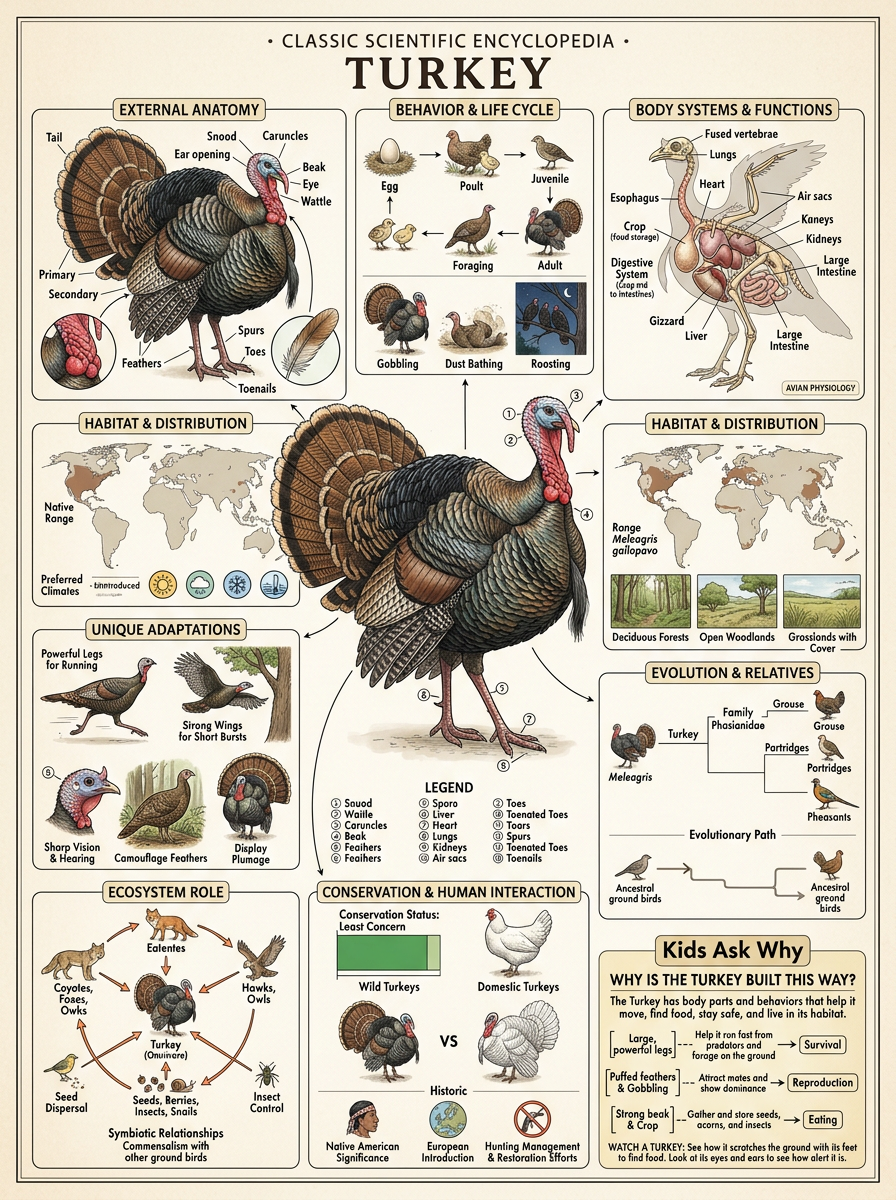
Scientific Diagram Poster
Reviewed diagram
Turkey Scientific Diagram with Kids Ask Why
Batch reviewed generated diagram for Pro Pack use. Check labels, Kids Ask Why panel, anatomy/context modules, and print readability.
2026-06-11
Page 5
Kids Ask Why Lab
Big Question
Why is the Turkey built this way?
The Turkey has body parts and behaviors that help it move, find food, stay safe, and live in its habitat.
How to diagram it
Connect one body part to one survival job with arrows and short labels.
Cause-and-effect arrows
1-minute activity
Choose one visible body part and ask what job it might help the animal do.
I noticed:
My answer in one sentence:
Draw your own explanation
Page 6
Comprehension + Drawing
1. What sound does a turkey make?
2. What does a turkey do with its feathers?
3. Is a turkey a big or small bird?
4. What color are a turkey's feathers?
Draw and compare
Draw a turkey and show how big it is compared to your hand or foot.
Page 7
Answer Key + Teaching Notes
Answer Key
- A turkey makes a gobble sound.
- A turkey puffs up its feathers.
- A turkey is a big bird.
- A turkey's feathers are colorful (or brown, black, red, etc., depending on the visual).
- A turkey is 80 centimeters tall.
Teaching Notes
- Encourage learners to make turkey sounds and actions.
- Use a large picture of a turkey for visual reference throughout the lesson.
- Adapt activities to suit the specific English level of your learners.
- Connect the lesson to real-world animals or farm visits if possible.
- Emphasize key vocabulary like 'gobble', 'feathers', 'big', and 'bird'.
Extension Activity
Watch a short video of real turkeys gobbling and displaying their feathers. Discuss what you see and hear.
Unlock the full Pro library
This comprehensive pack provides ready-to-use, age-differentiated activities, saving hours of lesson planning and resource creation.