Free Printable Pack
Water Lily printable lesson pack
Free to print or save as PDF — no account needed. Go ad-free for $9.9 (one-time).
SizeRef Pro Pack
Water Lily
This comprehensive pack provides engaging activities for all ages to learn about water lilies.
Learning Goals
- Identify a water lily by sight and name.
- Learn descriptive words for a water lily.
- Understand the habitat and basic needs of a water lily.
- Practice English vocabulary and sentence structure related to nature.
Teacher / Parent Setup
Print all pages for each student or group. Prepare crayons, pencils, and paper. Consider finding a picture or short video of a real water lily for visual reference.
Curiosity Focus
Why does the Water Lily grow this way?
This pack includes a reviewed diagram poster and a Kids Ask Why page that turns curiosity into a short explanation and mini activity.

Page 2
Vocabulary Builder
Little Explorers: Water Lily Fun
Water Lily
Trace the word 'water lily' with your finger or a colorful crayon.
Look closely at the water lily picture. What colors do you see on the flower and the leaves? Can you point to the part that floats?
Pretend you are a water lily floating on the water. Lie on the floor and gently wave your arms like petals or leaves.
Water Lily Word Play
A water lily floats on the water.
It has big, round leaves called lily pads.
The flower can be white, pink, or yellow.
Write two sentences about what a water lily looks like or where it lives.
Word bank: float · water · flower · leaf · pond · petals
Deep Dive into Water Lilies
Water lilies are fascinating aquatic plants. Their large, flat leaves, often called lily pads, spread out on the water's surface to maximize sunlight exposure. This sunlight is crucial for photosynthesis, the process by which plants make their own food. Long, flexible stems connect these leaves and the beautiful flowers to roots anchored in the mud at the bottom of ponds or slow-moving rivers. Air spaces within their...
Why do you think water lilies have such large, flat leaves that float on the surface?
Page 3
Size Science Lab
Read the size clue
Imagine a water lily flower. It's about 150 millimeters (15.0 cm) wide, which is roughly the size of a small dinner plate or a bit wider than your hand spread out. From the water surface to the top of its beautiful petals, it stands around 100 millimeters (10.0 cm) tall, similar to the height of a standard juice box. The part of the stem and roots that goes into the water might be about 50 millimeters (5.0 cm) deep. So, a water lily is a substantial flower, much bigger than a small toy car, making it easy to spot f...
Quick Check
How wide is a water lily flower in centimeters?
Estimate
Estimate how many water lily flowers, side by side, would stretch across your teacher's desk.
How is a water lily similar to an umbrella? How is it different?
Page 4
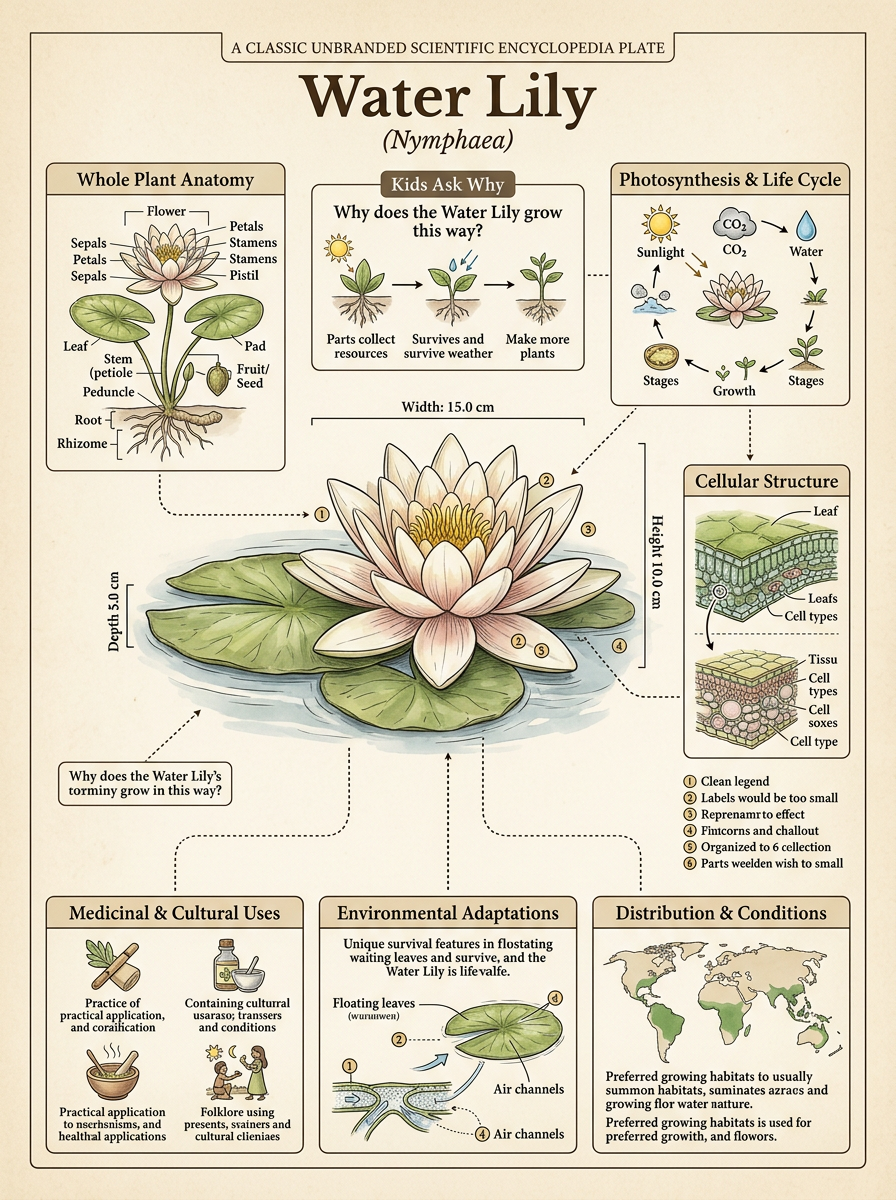
Scientific Diagram Poster
Reviewed diagram
Water Lily Scientific Diagram with Kids Ask Why
Batch reviewed generated diagram for Pro Pack use. Check labels, Kids Ask Why panel, anatomy/context modules, and print readability.
2026-06-12
Page 5
Kids Ask Why Lab
Big Question
Why does the Water Lily grow this way?
The Water Lily grows parts such as roots, stems, leaves, flowers, or seeds to collect resources, survive weather, and make more plants.
How to diagram it
Show roots, leaves, sunlight, water, and growth arrows in one simple cause-and-effect panel.
Cause-and-effect arrows
1-minute activity
Look at a leaf or plant photo and point to the part that catches light.
I noticed:
My answer in one sentence:
Draw your own explanation
Page 6
Comprehension + Drawing
1. Where does a water lily live?
2. What are the big, round leaves of a water lily called?
3. What colors can a water lily flower be?
4. Why does a water lily need sunlight?
Draw and compare
Draw a picture of a water lily floating on a pond. Add other things you might see in a pond, like fish or frogs.
Page 7
Answer Key + Teaching Notes
Answer Key
- 15.0 cm
- In water, like a pond or lake.
- Lily pads.
- White, pink, or yellow (and other colors).
- To make its own food (photosynthesis).
Teaching Notes
- Encourage learners to use the article 'a' when referring to 'a water lily'.
- Adapt activities for individual learning styles and English proficiency levels.
- Use real photos or videos of water lilies to enhance understanding.
- Emphasize the water lily's unique ability to float and its habitat.
- Connect the water lily's ecosystem to other plants and animals that live in ponds.
Extension Activity
Create a 'water lily pond' art project using construction paper. Cut out green circles for lily pads and colorful petals for the flowers, then arrange them on a blue background.
Unlock the full Pro library
This Pro Pack offers ready-to-use, differentiated activities, saving hours of lesson planning and resource creation.