Free Printable Pack
Gibbon printable lesson pack
Free to print or save as PDF — no account needed. Go ad-free for $9.9 (one-time).
SizeRef Pro Pack
Gibbon
This Pro Pack offers ready-to-use, age-differentiated activities to teach English and science concepts about gibbons with ease.
Learning Goals
- Identify the animal 'gibbon' and its key features.
- Learn descriptive words and simple sentences about gibbons.
- Understand gibbon size and unique movement (brachiation).
- Practice English vocabulary, comprehension, and measurement skills.
Teacher / Parent Setup
Print all pages. Have crayons, pencils, and a ruler ready. Prepare a space for movement activities and ensure access to a picture of a gibbon.
Curiosity Focus
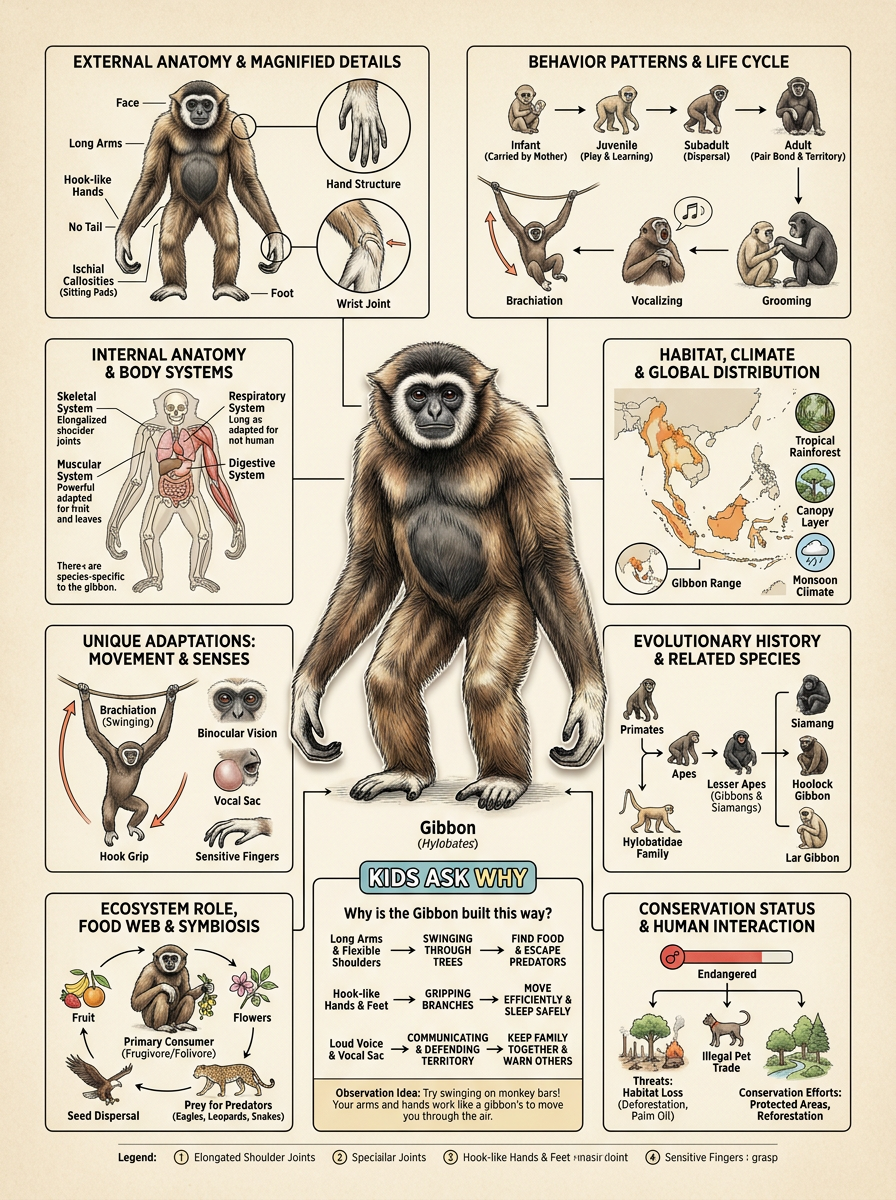
Why is the Gibbon built this way?
This pack includes a reviewed diagram poster and a Kids Ask Why page that turns curiosity into a short explanation and mini activity.

Page 2
Vocabulary Builder
Little Learners: My First Gibbon
Gibbon
Trace the word 'gibbon' with your finger, then with a crayon. Say 'gibbon' aloud.
Look at the gibbon picture. What color is it? Where is it? What is it doing with its long arms?
Can you swing your arms like a gibbon? Try to move your body like a gibbon swinging through trees.
Gibbon Explorers: Words and Sentences
A gibbon is a type of ape with very long arms.
Gibbons live in warm forests and spend most of their time in trees.
They swing fast from branch to branch to find food like fruit and leaves.
Write one sentence about what makes a gibbon special.
Word bank: gibbon · swing · trees · long · arms · fruit
Gibbon Scientists: Adaptations and Sounds
Gibbons are masters of brachiation, which means they swing through trees using their long, powerful arms. This special way of moving helps them travel quickly and efficiently through the forest canopy to find food and escape predators. Their unique ball-and-socket shoulder joints allow for a wide range of motion, making them incredibly agile. Gibbons also communicate with loud, complex songs, sometimes called 'duets,...
How do a gibbon's long arms and loud songs help it survive and thrive in its jungle home?
Page 3
Size Science Lab
Read the size clue
Imagine a gibbon! It stands about 55.0 centimeters (550mm) tall, which is roughly the height of a small child or your little sibling. Its width is around 45.0 centimeters (450mm), making it about as wide as a large school backpack. From front to back, a gibbon is about 18.0 centimeters (180mm) deep, similar to the thickness of a thick book or a small shoe box. These dimensions show that gibbons are not very big, allowing them to move easily and quickly through the branches of trees.
Quick Check
How tall is a gibbon in centimeters?
Estimate
Estimate how many gibbons, standing one on top of the other, would reach the height of your teacher's desk.
Find an object in your home or classroom that is about 45.0 cm wide. What is it?
Page 4
Scientific Diagram Poster
Reviewed diagram
Gibbon Scientific Diagram with Kids Ask Why
Batch reviewed generated diagram for Pro Pack use. Check labels, Kids Ask Why panel, anatomy/context modules, and print readability.
2026-06-12
Page 5
Kids Ask Why Lab
Big Question
Why is the Gibbon built this way?
The Gibbon has body parts and behaviors that help it move, find food, stay safe, and live in its habitat.
How to diagram it
Connect one body part to one survival job with arrows and short labels.
Cause-and-effect arrows
1-minute activity
Choose one visible body part and ask what job it might help the animal do.
I noticed:
My answer in one sentence:
Draw your own explanation
Page 6
Comprehension + Drawing
1. What kind of animal is a gibbon?
2. Where do gibbons mostly live?
3. What do gibbons use their long arms for?
4. What are two things gibbons eat?
Draw and compare
Draw a gibbon swinging through the trees. Next to your drawing, use a ruler to draw a line that is 55.0 cm long to show how tall a gibbon is.
Page 7
Answer Key + Teaching Notes
Answer Key
- A gibbon is 55.0 cm tall.
- A gibbon is a type of ape.
- Gibbons mostly live in trees or forests.
- Gibbons use their long arms to swing fast and move through trees.
- Gibbons eat fruit and leaves.
Teaching Notes
- Encourage learners to mimic gibbon movements and sounds to engage kinesthetic learning.
- Emphasize the unique adaptation of long arms for brachiation (swinging) and its benefits.
- Use the provided size comparisons (e.g., 'as tall as your little sibling') to make dimensions relatable.
- Discuss how gibbons communicate through their loud, distinct songs.
- Connect gibbon's diet to their habitat and movement for food.
Extension Activity
Research different types of gibbons and their unique characteristics or conservation status. Create a small poster about one type.
Unlock the full Pro library
This pack provides all necessary content and activities, saving hours of research and lesson planning for busy educators.